Creating a BYOK Instance
Download
Focus Mode
Font Size
This document describes how to create a BYOK instance.
Prerequisites
You have obtained an API key for the upstream model, which supports API keys from original vendor models, third-party proxies, or self-built models.
If your upstream model is self-built, complete the creation of CMR private network tunnels first.
Operation Guide
1. Log in to the CMR console. In the left sidebar, choose BYOK > BYOK Management.
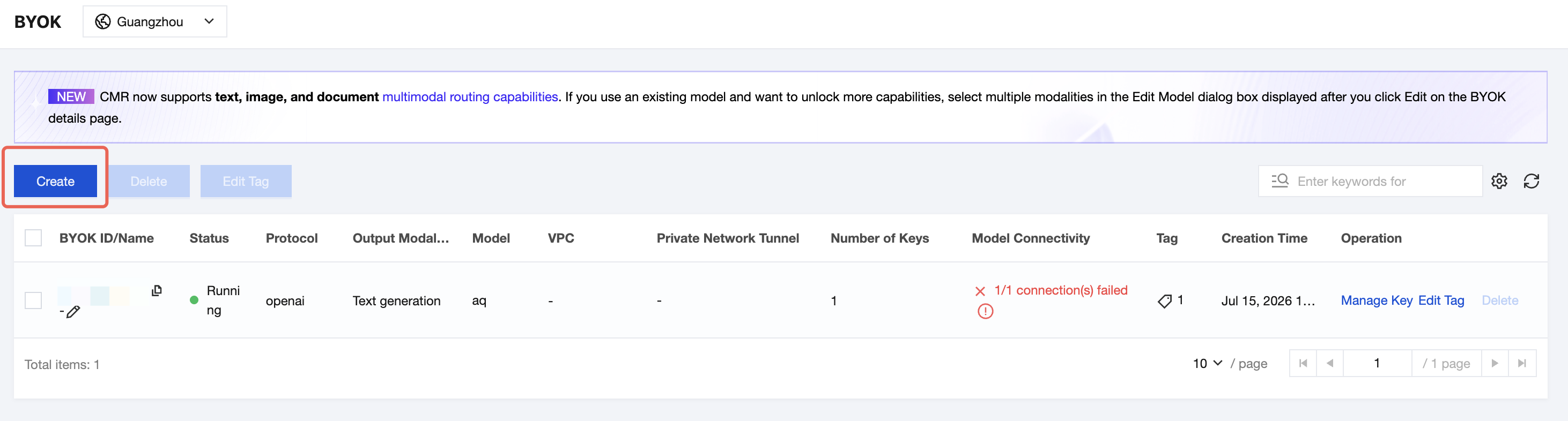
2. On the BYOK page, click Create.
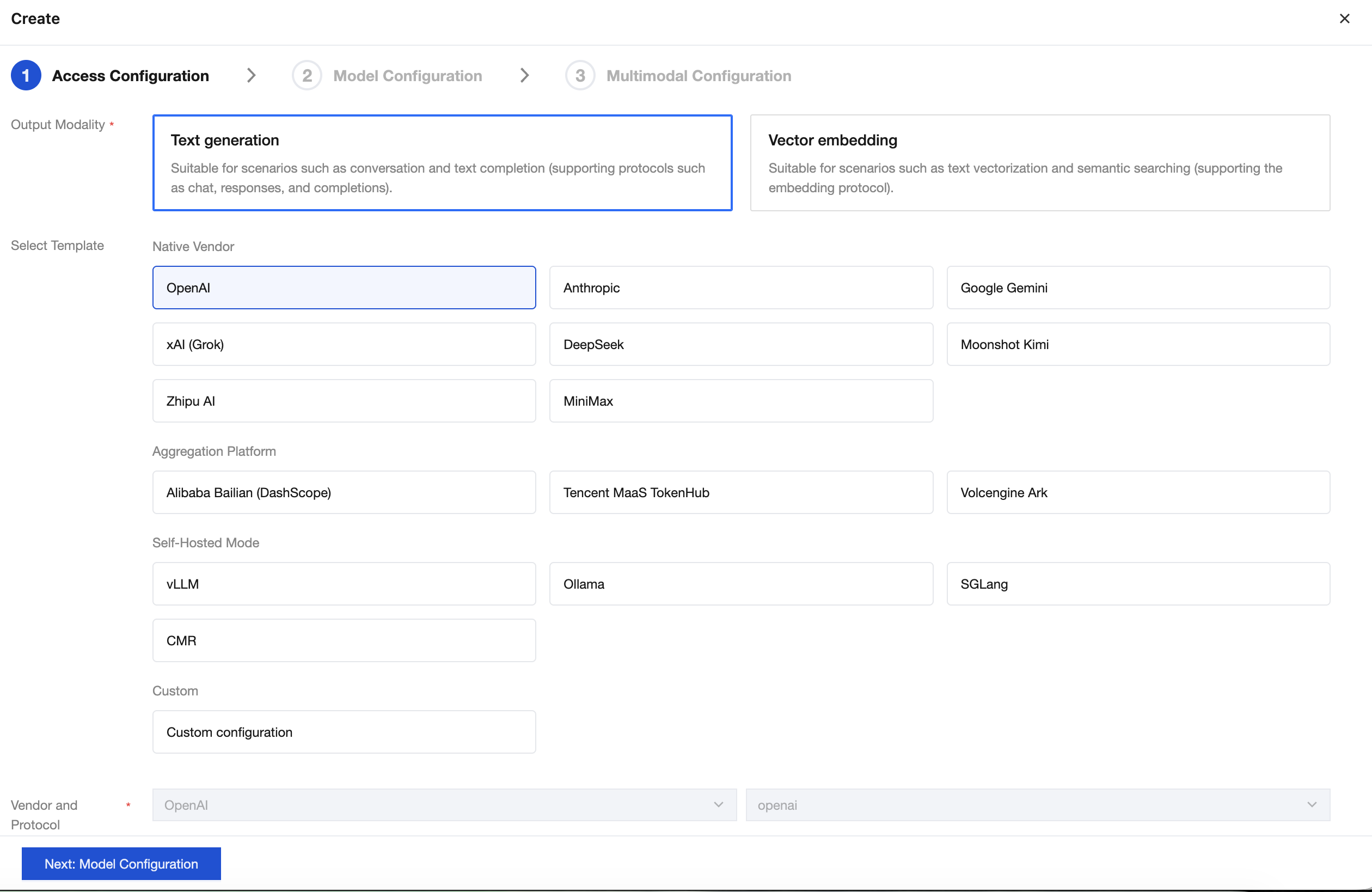
3. On the Create page, select or enter the required parameters as needed.
Parameter | Description |
Output modality | Multiple output modalities are currently supported. Text generation: suitable for scenarios such as dialogue and text completion (supporting protocols such as chat, responses, and completions). Video generation: converts text and images into video content for creation and synthesis, corresponding to the video generation protocol. Vector embedding: suitable for scenarios such as text vectorization and semantic search (supporting the embedding protocol). Reranking: suitable for scenarios such as candidate ranking and search result refinement (rerank protocol). Classification decision: determines, evaluates, or verifies content and outputs the classification decision result. |
Template selection | Two methods are supported: quick configuration using preset templates or custom configuration. Quick configuration with preset templates: To simplify user configuration, the product provides preset configuration templates from some vendors, such as Tencent Cloud MaaS TokenHub. You can select one as needed. Custom configuration: You can select this option when preset templates do not cover your use case, for example, when you use a self-built model. |
Vendor and Protocol | Vendor: When you select a preset template for quick configuration, this field is pre-filled and requires no modification. When you select custom configuration, you can choose your model provider from the dropdown list (such as DeepSeek) or enter a vendor name manually. Protocol: When you select a preset template for quick configuration, this field is pre-filled and requires no modification. When you select custom configuration, you can choose the corresponding protocol from the dropdown list. |
Site | When Output Modality is Text Generation, for some models such as Zhipu, you need to select the associated site. You can select it as needed. |
Endpoint Protocol & BaseURL | Configuration is required when Output Modality is Text Generation, specifically the OpenAI-compatible Base URL or the Anthropic Base URL. To facilitate user configuration, the product has preset relevant parameters for some vendors, including multiple protocols. You can configure them as needed. |
BaseURL & EndpointPath | Configuration is required when Output Modality is Vector Embedding. The final request URL = BaseURL + EndpointPath. To facilitate user configuration, the product has preset relevant parameters for some vendors. You can configure them as needed. |
Instance Name | Optional. Supports up to 255 characters. |
Tag | You can select an existing tag key and tag value. If the required tag does not exist, click Add Tag. For details, see Creating a Tag. |
4. After the access configuration is completed, go to the model configuration step. Select or enter the relevant parameters as needed, and click OK. Only when Output Modality is Text Generation, you need to click Next: Multimodal Configuration.
Parameter | Description |
Network Configuration | Supports configuring models through public or private networks. Public network: Configure models over the public internet, such as original vendor models. Private network: Configure models over a VPC, such as self-built models. |
CMR Private Network Tunnels | Only involved when Network Configuration is set to Private Network. Select an existing CMR private network tunnel from the dropdown list, or create a CMR private network tunnel. |
Domain Name | Optional. Only involved when Network Configuration is set to Private Network. HTTP Header carried when requests are sent to the upstream model. Usually no need to fill in. The domain name in "BaseURL" is used by default. When "BaseURL" is set to an IP address or VIP and the upstream requires domain-based routing, specify the corresponding domain name here (such as api.deepseek.com). |
API input method | Both manual entry and batch import are supported. Manual entry: Manually paste the API key and secret key into the corresponding input fields in order. Batch import: Download the template file, fill in the API key and secret key, and then import the file to quickly import keys in batches. |
Select a model: | Manual input of model names is supported, and supported models can also be pulled by clicking Obtain Model List. To change the external model name, enter a name that meets your standards in the External Display Name field. |
Connectivity probing | After adding an API Key and selecting the correct model, click Start Probing to probe the health status of the API Keys, allowing you to promptly remove unhealthy API Keys. |
5. (Only involved when Output Modality is Text Generation) In the multimodal configuration step, you can select the modalities to enable for each model as needed based on the modality availability probe results, and click OK to complete the configuration.
Parameter | Description |
Model Name | Displays the name of the selected model. Different models may support different modalities. Refer to the page display for the actual supported modalities. |
Enable Modality | Select the modalities to enable for the current model. After they are enabled, the model can be called in the corresponding modality scenarios. |
Modality Availability Detection | Used to probe the availability of each model modality under the current API Key. Click Start Probing. After the probing is completed, you can view the probe results in the modality availability section of the model list above. |
Modality Availability | Displays the availability status of each modality of the current model. You can adjust the enabled modalities or perform probing again based on the prompts. |
Enable Based on Probe Result | After clicking, the system automatically enables the available modalities based on the current probe result. |
Probe Again | After clicking, the system re-probes the availability of each model modality under the current API Key and refreshes the modality availability results. |
6. After completing the above parameter configuration, click OK to create the BYOK instance.
References
Help and Support
Was this page helpful?
You can also Contact sales or Submit a Ticket for help.
Help us improve! Rate your documentation experience in 5 mins.
Feedback