Basic Concepts
Download
Focus Mode
Font Size
A Cloud Model Routing (CMR) instance that provides services consists of the following core components:
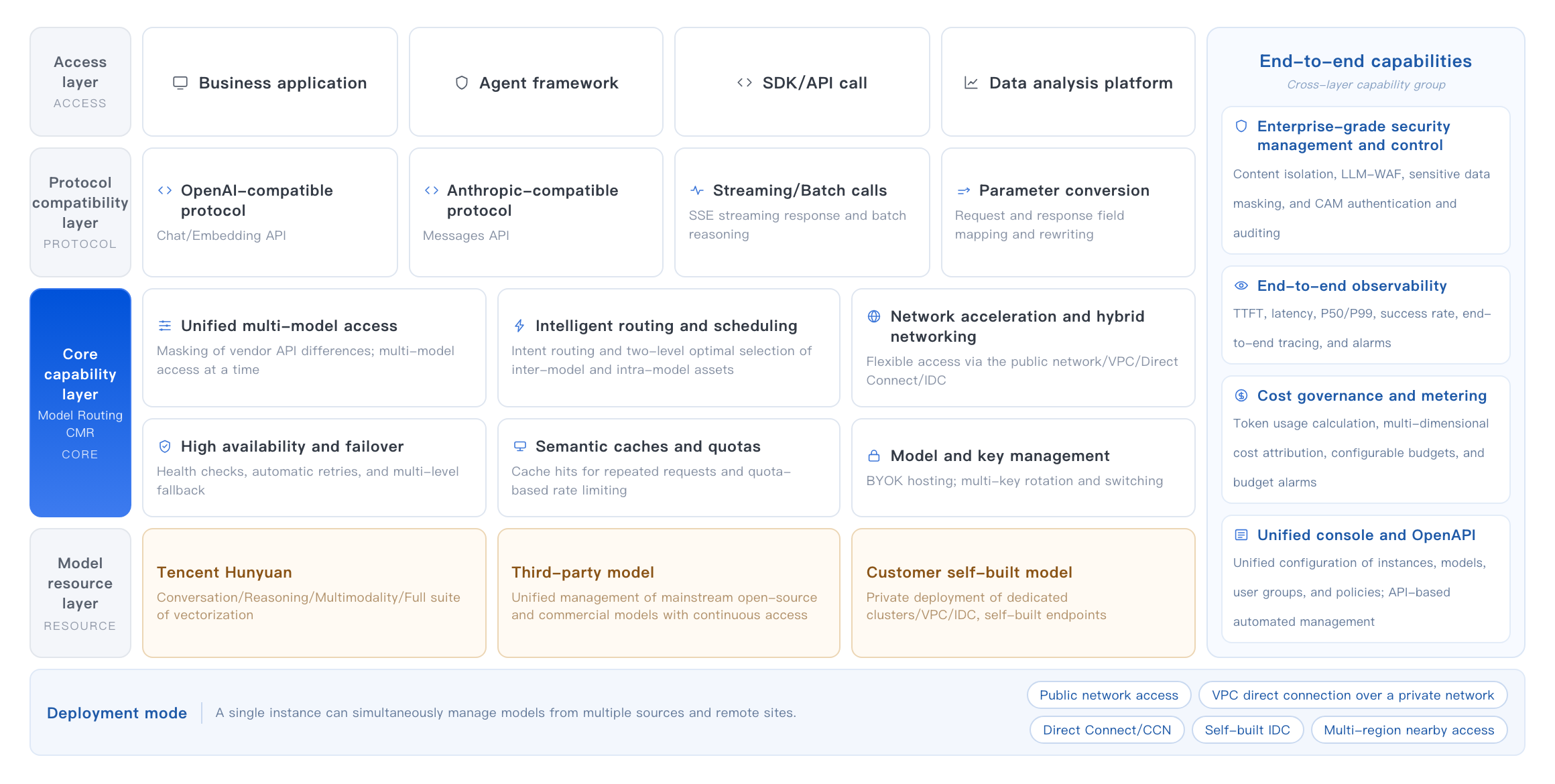
CMR Instance
A CMR instance is the smallest unit for delivering services externally and serves as the unified entry for accessing large model capabilities.
Network type: CMR instances support public or private network access and can be selected as needed.
Protocol and port: Compatible with standard protocols such as HTTP (80) and HTTPS (443).
API Key
An API Key is the credential that users carry when accessing a CMR instance. CMR uses this key for authentication and model call control.
Model Scheduling Management
Model scheduling configuration serves as the "scheduling brain" and "core engine" of CMR. It is responsible for distributing requests to appropriate model channels based on the model policies and request features configured by users. It supports intent-based intelligent routing with two layers of scheduling policies: L1 inter-model routing and L2 intra-model routing, and provides a configurable default fallback policy.
BYOK
Bring Your Own Key (BYOK) allows you to host your own large model vendor API Keys in CMR, which then calls them on your behalf, eliminating the need to hardcode keys in your business code. The product adopts a secure design with hierarchical isolation and encrypted storage to protect your upstream model API Keys. Customer API Keys are encrypted and stored only in the data plane model proxy component using the industry-standard authenticated encryption with associated data (AEAD) algorithm, with end-to-end TLS transmission. Key fields in logs and query APIs are automatically masked (such as sk-****1234), ensuring that even if the database is compromised, the original keys cannot be recovered.
Help and Support
Was this page helpful?
You can also Contact sales or Submit a Ticket for help.
Help us improve! Rate your documentation experience in 5 mins.
Feedback