Viewing Usage Details
Download
Focus Mode
Font Size
This document describes how to view usage details. In Usage Details, you can perform usage analysis and performance monitoring.
Introduction
TCOP provides data collection and display features for CMR. Tencent Cloud enables it for all users by default, with no manual configuration required. As long as you use CMR, TCOP automatically collects the relevant monitoring data.
Metric Description
CMR provides the following monitoring metrics. These metrics reflect the usage status and usage information of routing model instances, API Keys, and models. Four time granularities are supported: 1 minute, 5 minutes, 1 hour, and 1 day.
Type | Metric Value | Description | Unit |
Core usage | Total tokens (Count) | Total number of input and output tokens when conversational models are called. | Count |
| Input tokens (Count) | Total number of input tokens when conversational models are called. | Count |
| Output tokens (Count) | Total number of output tokens when conversational models are called. | Count |
| Request credit consumption (Count) | Calculated based on the configured credit calculation coefficient and the number of input and output tokens consumed by this request. | Count |
Request Information | Successful CMR requests (Count) | Total number of successful CMR requests. | Count |
| Failed CMR requests (Count) | Total number of failed CMR requests. | Count |
| Failed requests for CMR calling upstream models (Count) | Total number of requests where CMR failed to call the upstream model. | Count |
| Total CMR requests (Count) | Total number of CMR requests. | Count |
| Number of 400 status code responses (Count) | A 400 status code returned by CMR indicates invalid request parameters. Common causes include invalid request parameters and context window overflow. | Count |
| Number of 401 status code responses (Count) | A 401 status code returned by CMR indicates authentication failure. Common causes include an invalid or expired API Key provided by the user when a BYOK model is accessed, and requests that do not carry an API Key. | Count |
| Number of 403 status code responses (Count) | A 403 status code returned by CMR indicates insufficient permissions. Common causes include an API Key lacking permission to access the requested model when a BYOK model is accessed, and a suspended or restricted vendor-side account. | Count |
| Number of 404 status code responses (Count) | A 404 status code returned by CMR indicates that the resource does not exist. Common causes include a model name that does not exist on the vendor side and an incorrect path in the custom API Base of a BYOK model. | Count |
| Number of 408 status code responses (Count) | A 408 status code returned by CMR indicates request timeout. Common causes include upstream model response timeout and timeout when a connection is established with the upstream model. | Count |
| Number of 422 status code responses (Count) | A 422 status code returned by CMR indicates that the request cannot be processed. The common cause is a semantic error in the request body. | Count |
| Number of 429 status code responses (Count) | A 429 status code returned by CMR indicates that the request is rate-limited. Common causes include RPM and consumed Tokens exceeding the upstream model vendor quota, and concurrent requests exceeding the upstream model vendor limit. | Count |
| Number of 500 status code responses (Count) | A 500 status code returned by CMR indicates an internal error on the upstream model server. Common causes include internal exceptions on the upstream model server and upstream model API connection failures. | Count |
| Number of 502 status code responses (Count) | A 502 status code returned by CMR indicates an upstream model vendor gateway error. Common causes include an unreachable upstream model service and exceptions at the upstream model gateway layer. | Count |
| Number of 503 status code responses (Count) | A 503 status code returned by CMR indicates that the upstream model service is unavailable. Common causes include a temporarily unavailable upstream model service, a specific model being temporarily unavailable due to high load, and connection interruption during streaming responses. | Count |
Usage details | Read-cache tokens (Count) | Some models support counting Tokens that hit the cache in the Input direction. | Count |
| Write-cache tokens (Count) | Some models support counting Tokens written to the cache in the Input direction. | Count |
| Standard non-cache tokens (Count) | Token count for Input content that does not hit any cache. | Count |
| Built-in tool usage count of upstream models (Count) | Some models support counting the number of tool calls. | Count |
| Reasoning/thinking tokens (Count) | Some models support counting Tokens in the reasoning and thinking part. | Count |
| Standard text output tokens (Count) | Token count output by the model in the Output direction. | Count |
| Input image converted tokens (Count) | Number of tokens after image content in the Input direction is converted. | Count |
Latency | Upstream model call latency (ms) | Call latency of CMR accessing the upstream model. | ms |
| Time to first Token for streaming requests (ms) | Time interval from input to the first output Token for CMR. | ms |
| CMR processing overhead latency (ms) | Latency of CMR processing logic itself. | ms |
| CMR request latency (ms) | CMR request latency is the sum of upstream model call latency and CMR processing overhead latency. | ms |
Upstream model | Failed response count of upstream models (Count) | Number of failed responses of upstream models | Count |
| Total requests to upstream models (Count) | Total number of requests of upstream models | Count |
| Successful response count of upstream models (Count) | Number of successful responses of upstream models | Count |
| Successful fallback call count of upstream models (Count) | Number of successful fallback calls of upstream models | Count |
| Failed fallback call count of upstream models (Count) | Failed fallback call quantity of upstream models | Count |
Prerequisites
It is recommended to read Usage Constraints and Supported Models in advance for relevant information.
A CMR instance has been created. For detailed instructions, see Creating a CMR Instance.
A BYOK instance has been created. For detailed instructions, see Creating a BYOK Instance.
A CMR access key (API Key) has been created. For detailed instructions, see Creating a CMR Access Key.
Operation Steps
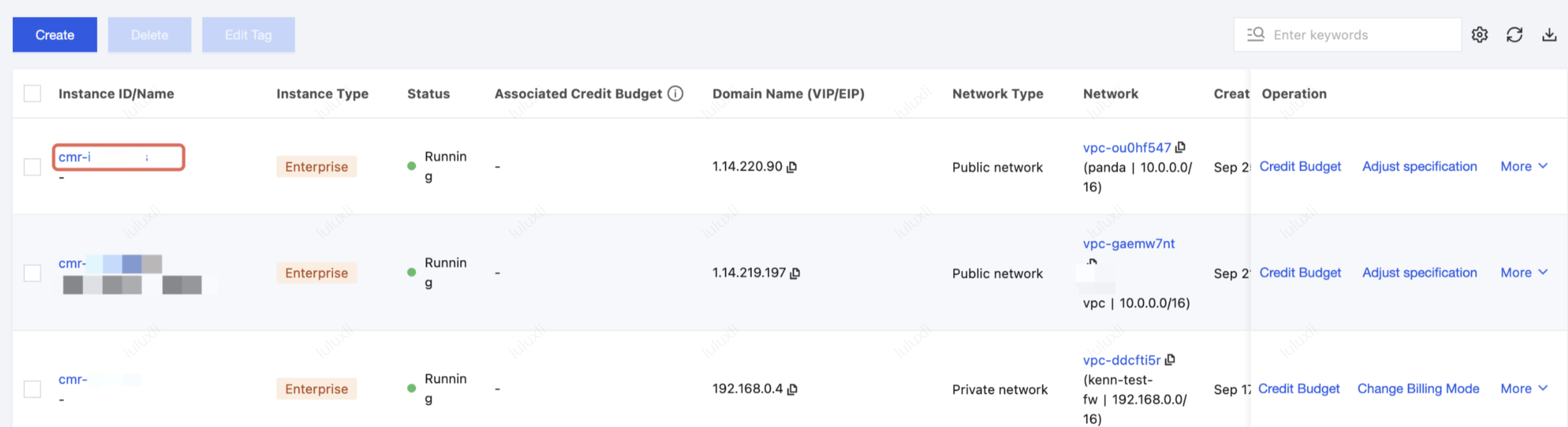
1. Log in to the CMR console. On the Instance Management page, click the target instance ID to go to the Instance Management page of the target instance.
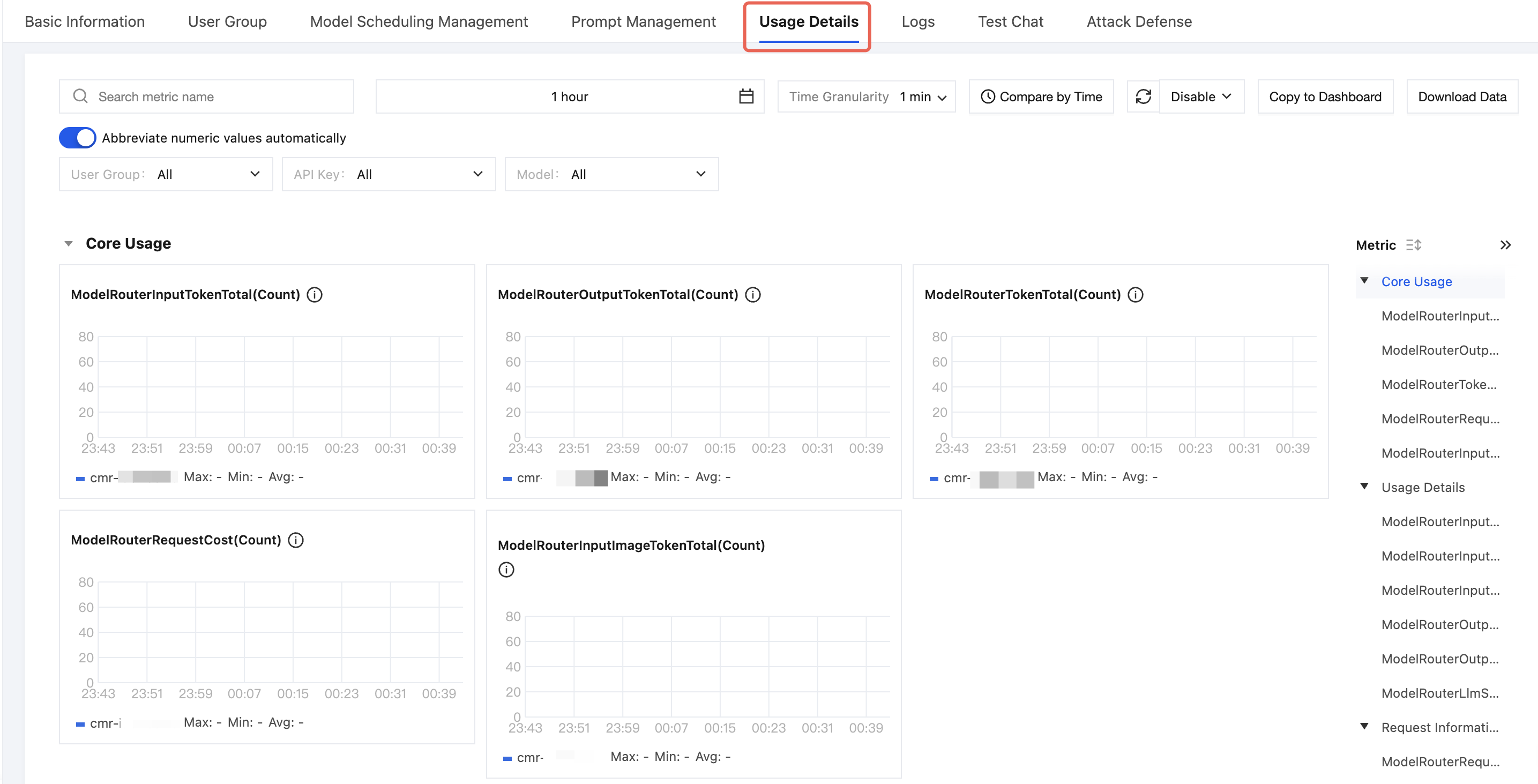
2. Switch to the Usage Details tab to view the relevant metrics. You can also filter the view by specifying an API Key or model.
Help and Support
Was this page helpful?
You can also Contact sales or Submit a Ticket for help.
Help us improve! Rate your documentation experience in 5 mins.
Feedback