tencent cloud

TDMQ for RabbitMQ

Release Notes and Announcements
Release Notes
Announcements
Product Introduction
Introduction and Selection of the TDMQ Product Series
What Is TDMQ for RabbitMQ
Strengths
Use Cases
Description of Differences Between Managed Edition and Serverless Edition
Open-Source Version Support Description
Comparison with Open-Source RabbitMQ
High Availability
Use Limits
TDMQ for RabbitMQ-Related Concepts
Regions
Related Cloud Services
Billing
Billing Overview
Pricing
Billing Example
Convert to Monthly Subscription from Hourly Postpaid
Renewal
Viewing Consumption Details
Overdue Payments
Refund
Getting Started
Getting Started Guide
Step 1: Preparations
Step 2: Creating a RabbitMQ Cluster
Step 3: Configuring a Vhost
Step 4: Using the SDK to Send and Receive Messages
Step 5: Querying a Message
Step 6: Deleting Resources
User Guide
Usage Process Guide
Configuring the Account Permission
Creating a Cluster
Configuring a Vhost
Connecting to the Cluster
Managing Messages
Configure Advanced Feature
Managing the Cluster
Viewing Monitoring Data and Configuring Alarm Policy
Use Cases
Use Instructions of Use Cases
RabbitMQ Client Use Cases
RabbitMQ Message Reliability Use Cases
Usage Instructions for MQTT Protocol Supported by RabbitMQ
Migrate Cluster
Migrating RabbitMQ to Cloud
Step 1. Purchasing a TDMQ Instance
Step 2: Migrating Metadata to the Cloud
Step 3: Enabling Dual Read-Write
API Reference (Managed Edition)
API Overview
API Reference (Serverless Edition)
History
Introduction
API Category
Making API Requests
Relevant APIs for RabbitMQ Serverless PAAS Capacity
RabbitMQ Serverless Instance Management APIs
Data Types
Error Codes
SDK Documentation
SDK Overview
Spring Boot Starter Integration
Spring Cloud Stream Integration
Java SDK
Go SDK
Python SDK
PHP SDK
Security and Compliance
Permission Management
Network Security
Deletion Protection
Change Records
CloudAudit
FAQs
Service Level Agreement
Contact Us

Migrating RabbitMQ to Cloud

PDF
Mode fokus
Ukuran font
Terakhir diperbarui: 2026-01-04 15:13:50

Migration Scenarios

RabbitMQ cluster migration mainly applies to the following two business scenarios:
1. Cross-environment migration: Migrate services from self-built or other cloud-based RabbitMQ clusters to TDMQ for RabbitMQ clusters.
2. Version upgrade migration: Migrate services from earlier RabbitMQ cluster versions (such as 3.8.30) to later versions (such as 3.13.7).

Recommended Solution: Dual-Write Dual-Consumption Migration

The solution is overall simple, clear, and easy to operate, with no data backlog, ensuring messages are consumed promptly, and business risks are controllable.

Migration Steps


Migration Step
Operation Description
Cluster Status
1.Migrate metadata.
1. Purchase a TDMQ for RabbitMQ cluster.
2. Complete metadata migration.
3. Keep the existing cluster in read-write status.
Existing cluster: Read-Write
New cluster: Ready
2.Enable dual-read.
1. Connect new consumers to the new cluster.
2. Keep parallel consumption on both the existing and new clusters.
Existing cluster: Read-Write
New cluster: Read-only
3.Enable dual-write and dual-read.
1. Connect new producers to the new cluster.
2. Gradually shift traffic to the new cluster through a grayscale release.
Existing cluster: Read-Write
New cluster: Read-Write
4.Enable single-write and dual-read.
1. Stop traffic to the producers of the existing cluster.
2. Keep the consumers of the existing clusters to continue processing residual messages.
Existing cluster: Read-only
New cluster: Read-Write
5.Complete the migration.
1. Confirm that all messages in the existing cluster have been consumed with no message backlog.
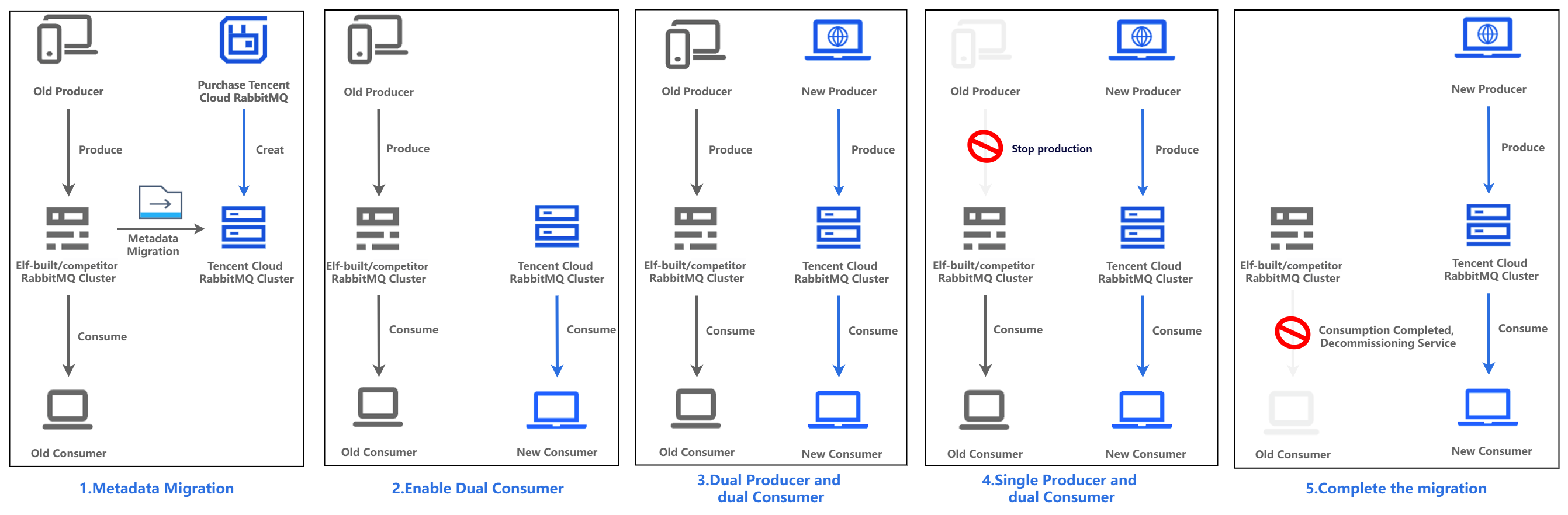
2. Take the existing consumer service offline.
Existing cluster: Offline
New cluster: Read-Write


Bantuan dan Dukungan

Apakah halaman ini membantu?

masukan