Viewing Consumption Details
Baixar
Modo Foco
Tamanho da Fonte
You can choose Billing Center > Bill Management to view the billing details of your TDMQ for RabbitMQ clusters. This helps you understand their usage and billing information during a specific period.
Bill Reporting Cycles
Yearly/monthly subscription clusters:
After you complete the payment for a yearly/monthly subscription cluster, the system reports a bill to Billing Center in real time for settlement.
If the configuration of a subsequent yearly/monthly subscription cluster changes, the system also reports a bill to Billing Center in real time.
Postpaid by hour clusters:
After you purchase a postpaid by hour cluster, the system allocates relevant cluster resources to you. Bills are generated on an hourly basis, regardless of whether you actually use the cluster and its resources.
Charges for postpaid by hour clusters are calculated on an hourly basis, with usage under one hour billed as a full hour.
Fees are automatically deducted from your account balance on a daily basis. Specifically, the bill for each day's service usage is generated and pushed the next day, with the corresponding amount deducted from your account balance.
Viewing Bills
1. Log in to the TDMQ for RabbitMQ console.
2. In the upper-right corner of the page, hover the pointer over Billing Center and click Billings in the drop-down list to go to Billing Center.
3. On the Billings > View bills > Bill Overview page, view the consumption overview of all resources under your account.
4. On the Billings > View bills page, view the consumption records of each product under your account within their respective billing cycles.
Note:
Resource ID bills are issued on the first day of the next month. The data on resource ID bills may be delayed, and the query results are for reference only. For real-time deduction details, check the detailed bills.
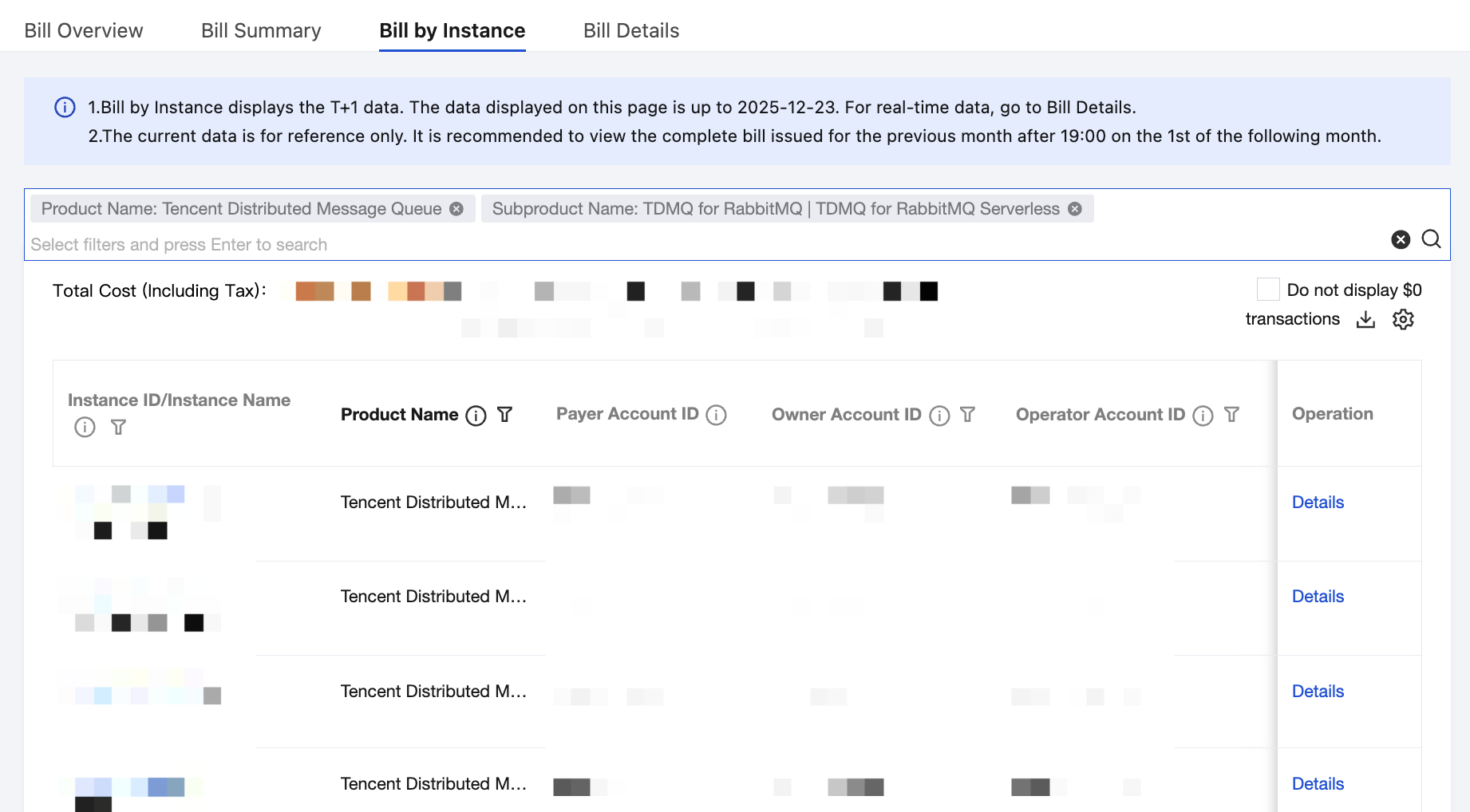
Bill by Instance: On the Bill Details page, select Bill by instance tab. For Product Name, select Tencent Distributed Message Queue; for Sub-product under the Managed Edition clusters, select TDMQ for RabbitMQ; for Sub-product under the Serverless Edition clusters, select TDMQ for RabbitMQ Serverless Edition. This allows you to view consumption details for each cluster. Click Details in the Operation column to see detailed billing information for that cluster.
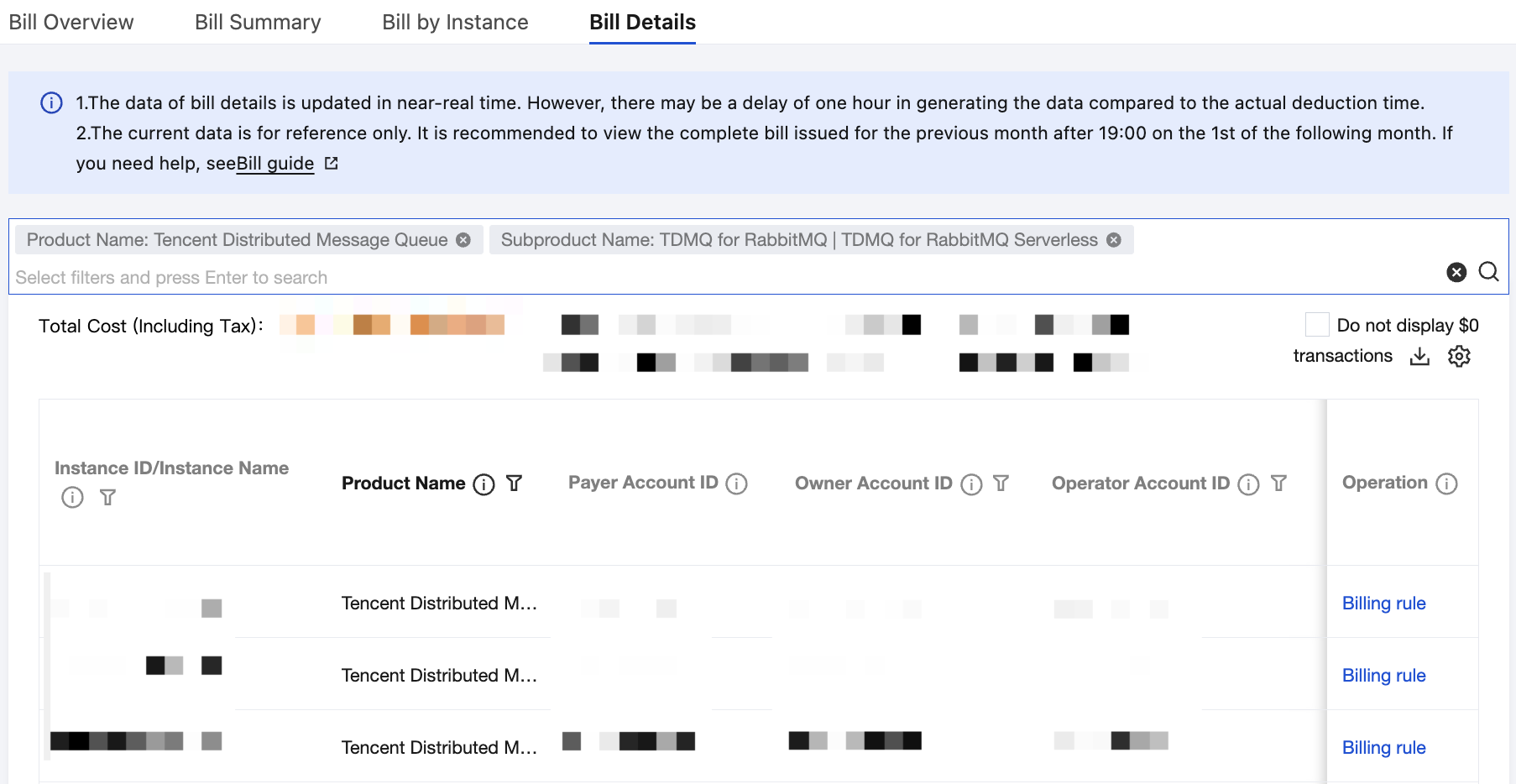
Bill Details: On the Bill Details page, select the Bill Details tab. For Product Name, select Tencent Distributed Message Queue; for Sub-product under the Managed Edition clusters, select TDMQ for RabbitMQ; for Sub-product under the Serverless Edition clusters, select TDMQ for RabbitMQ Serverless Edition. This allows you to view detailed fees for each billable item within the billing cycle for every cluster.
Ajuda e Suporte
Esta página foi útil?
Você também pode entrar em contato com a Equipe de vendas ou Enviar um tíquete em caso de ajuda.
comentários