The Bill Export Center feature was launched in January 2022 and supports exporting bill data from Billing 3.0 (July 2021) onward. It has the following features:
Users can export bill package, L0-PDF Bills, L1-Bill Summary, L2-Bill by lnstance, and L3-Bill Details.
Supports exporting data for multiple months.
Supports exporting data that includes member accounts of the group.
Support monthly aggregate for bill details(Monthly aggregate can combine hourly settlement and daily billed product bill details into one entry, reducing the number of bill details).
Operation Steps
Export Bill Package
Export L0 PDF Bills
Export L1 - Bill Summary
Export L2 Bill by Instance
Export L3 Bill Details
Note:
A bill package contains bills with all data across four levels: L0-PDF bills, L1-bill summary, L2-bill by lnstance, and L3-bill details.
Supports exporting bill packages for multiple months at a time, with each month in a separate compressed package.
Supports exporting bill packages that include data of member accounts in the group.
2. In the left sidebar, choose Bills > Bill Export Center to go to the Bill Export Center page.
3. Click Export bill package.
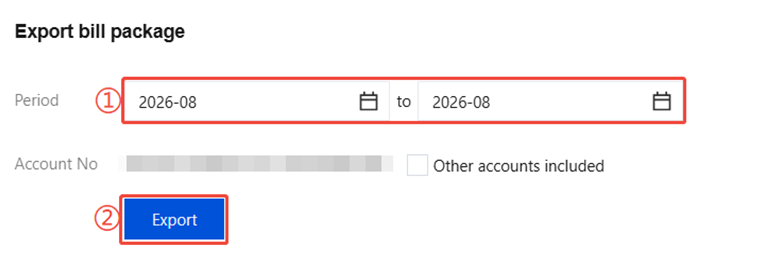
To export the bill package of the current account: In the pop-up window, select the Period as needed, and then click Export.
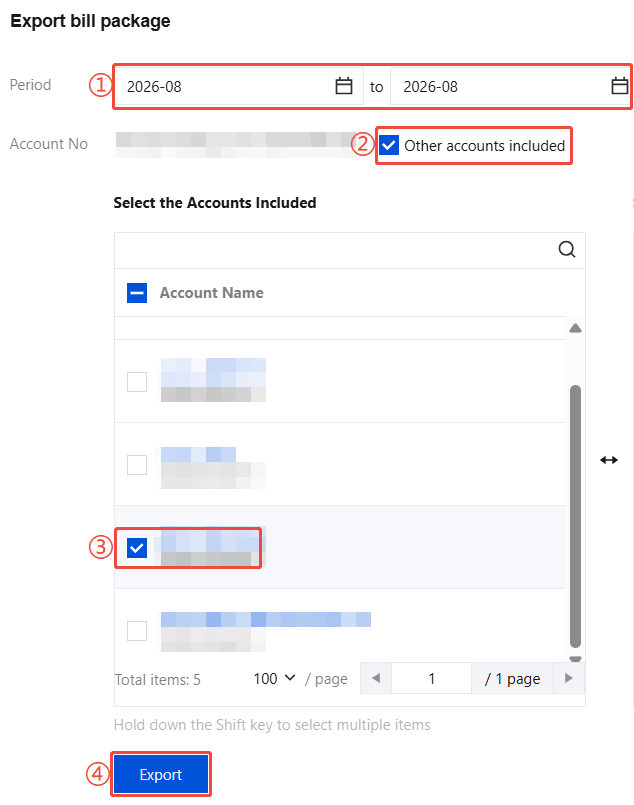
Export a bill package that includes data of member accounts in the group:
In the pop-up window, select the Period as needed, select Other accounts Included, select the member accounts to include, and then click Export.
Note:
Export bill packages that include data of member accounts in the group. For multi-month exports, each month is packaged in a separate compressed file. For exports of multiple accounts in the same month, bill files L0-L2 are merged, and L3 is packaged in a separate compressed file for each month.
Note:
L0-PDF bill is an electronic bill in PDF format, convenient for users' financial requisition or archiving.
Supports exporting PDF bills for multiple months at a time, with each month in a separate PDF file.
Supports exporting PDF bills that include data of member accounts in the group.
2. In the left sidebar, choose Bills > Bill Export Center to go to the Bill Export Center page.
3. Select the L0- PDF Bills tab to export L0-PDF bills.
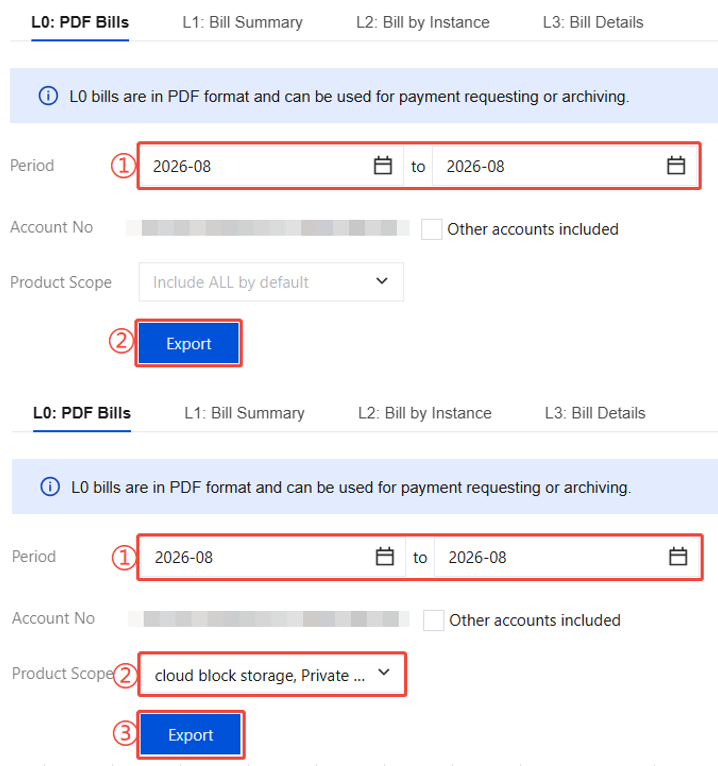
Export the L0-PDF bills of the current account:
Period: The default value is last month, and you can manually select it as needed.
Product scope: All products are included by default. You can filter products as needed and then click Export.
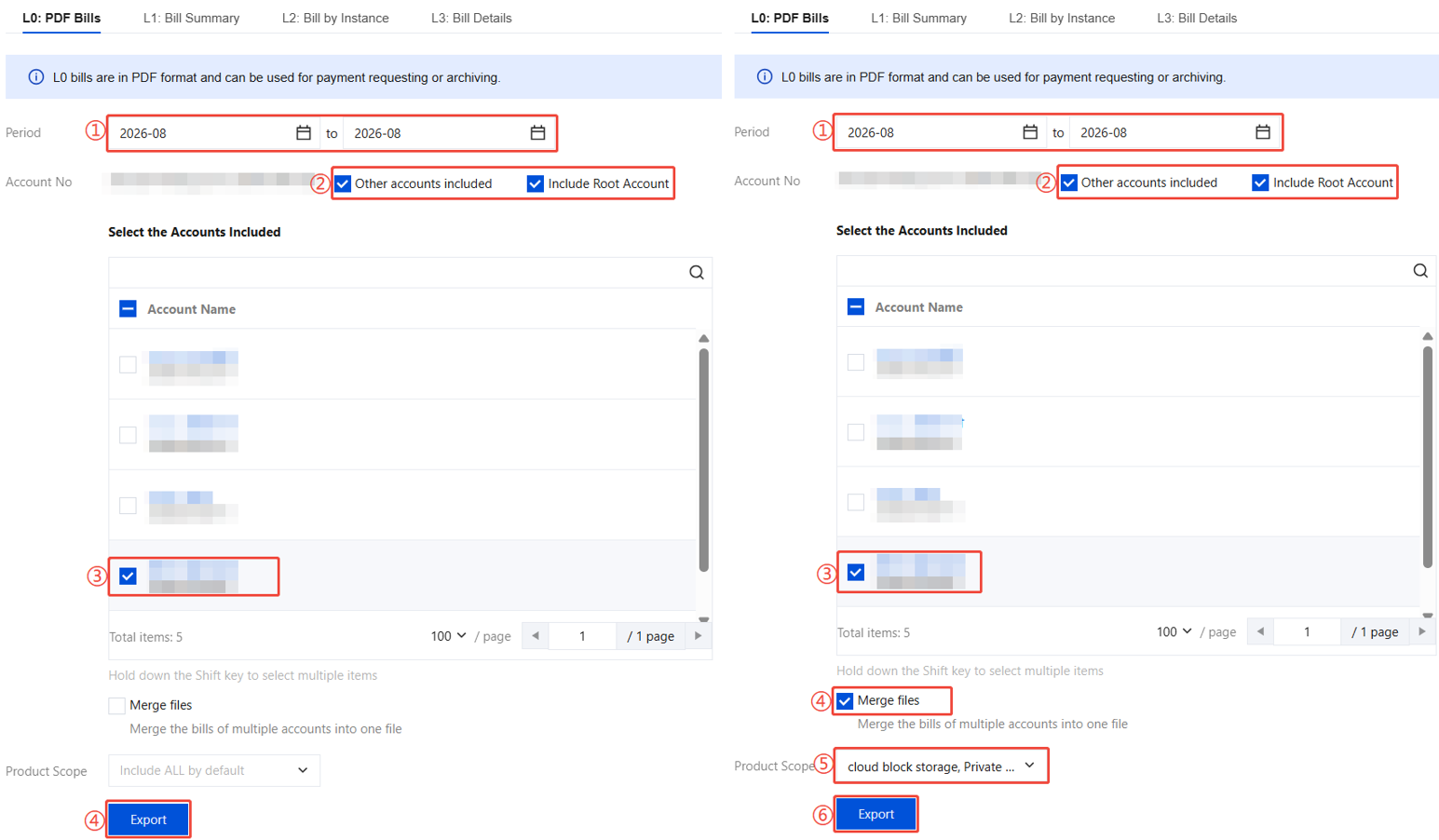
Export the L0-PDF bills that includes data of member accounts in the group:
Period: The default value is last month, and you can manually select it as needed.
Account No: Select "other accounts Included" (not selected by default), and then select the member accounts to include.
Merge files : Merging is not performed by default. You can select Merge files as needed.
Product scope: All products are included by default. You can filter the product scope as needed and then click Export.
Note:
In this step, you can clear Include root account to export only the bills of member accounts in the group. After you clear this option, Merge files is not supported.
Export PDF bills that include data of member accounts in the group. For multi-month exports, each month is exported as a separate PDF file. For exports of multiple accounts in the same month, you can select Merge files to merge the exported data into a single PDF file.
Note:
L1-multidimensional summary bills provide bill data from the following perspectives:summary By Product,summary By Project, summary By Region, summary By Tag And Product , and summary By Product And Project, allowing you to view bills by category.
You can export summary bills for multiple months at a time, and the exported bill files for multiple months are merged into a single file.
Supports exporting multidimensional summary bills that include data of member accounts in the group.
2. In the left sidebar, choose Bills > Bill Export Center to go to the Bill Export Center page.
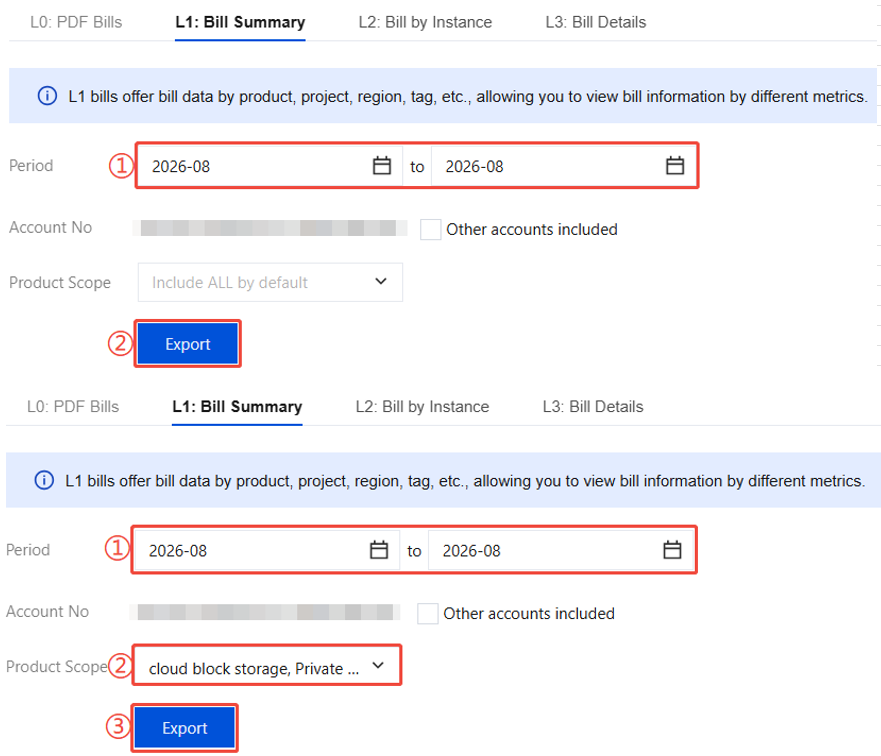
3. Select the L1-Bill Summary tab to export L1-multidimensional summary bills.
Export the L1-multidimensional summary bills of the current account:
Period: The default value is last month, and you can manually select it as needed.
Product scope: All products are included by default. You can filter products as needed and then click Export.
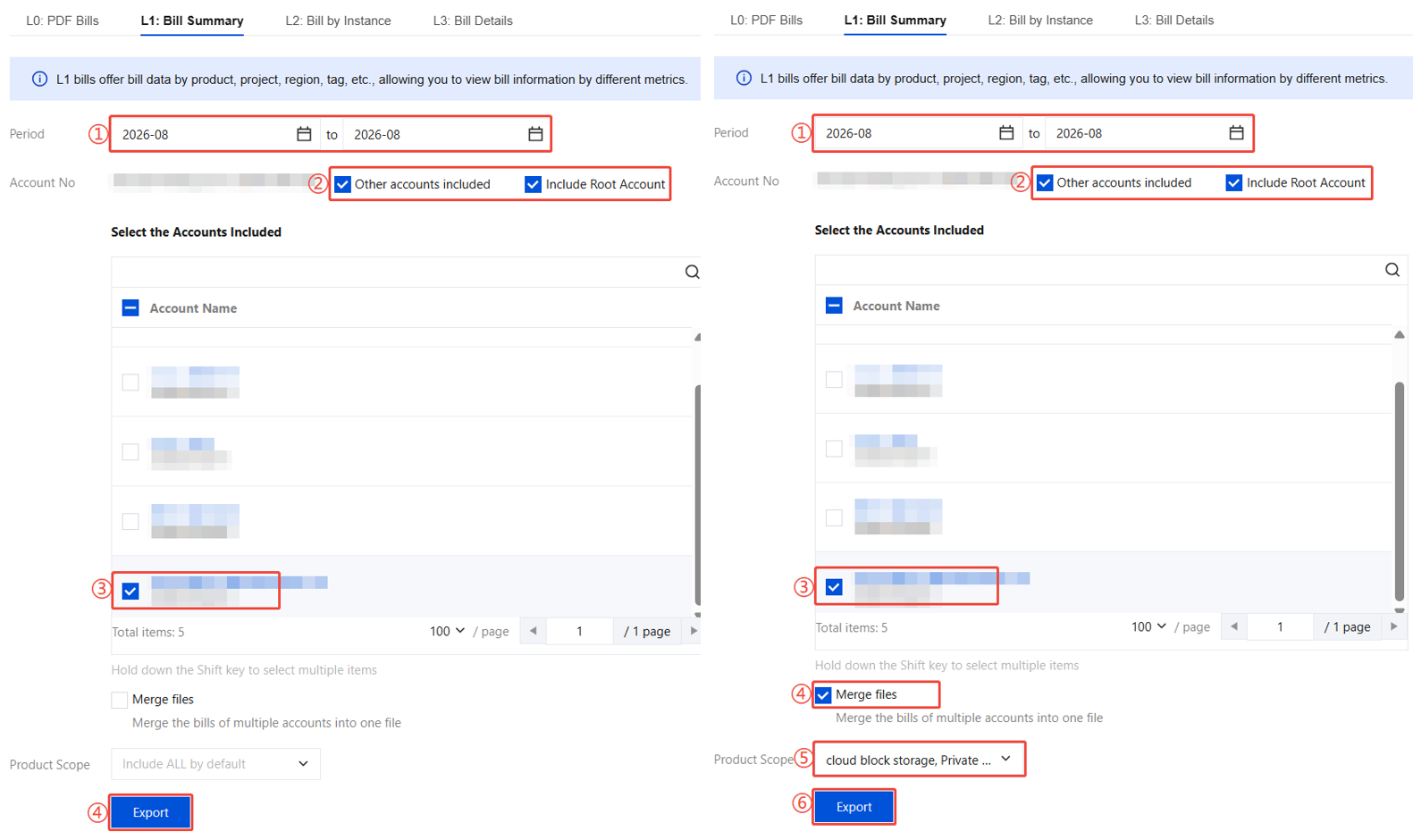
Export L1-multidimensional summary bills that include data of member accounts in the group:
Period: The default value is last month, and you can manually select it as needed.
Account No: Select "other accounts Included" (not selected by default), and then select the member accounts to include.
Merge files: Merging is not performed by default. You can select Merge files as needed.
Product scope: All products are included by default. You can filter the product scope as needed and then click Export.
Note:
In this step, you can clear Include root account to export only the bills of member accounts in the group. After you clear this option, Merge files is not supported.
Export multidimensional summary bills that include data of member accounts in the group. For multi-month exports or exports of multiple accounts in the same month, you can select Merge files to merge the exported data into a single file.
Note:
L2-Resource billing provides dimensional bill data for resources (instance).
You can export resource bills for multiple months at a time, and the exported bill files for multiple months are merged into a single file.
You can export resource bills that include data of member accounts in the group.
2. In the left sidebar, choose Bills > Bill Export Center to go to the Bill Export Center page.
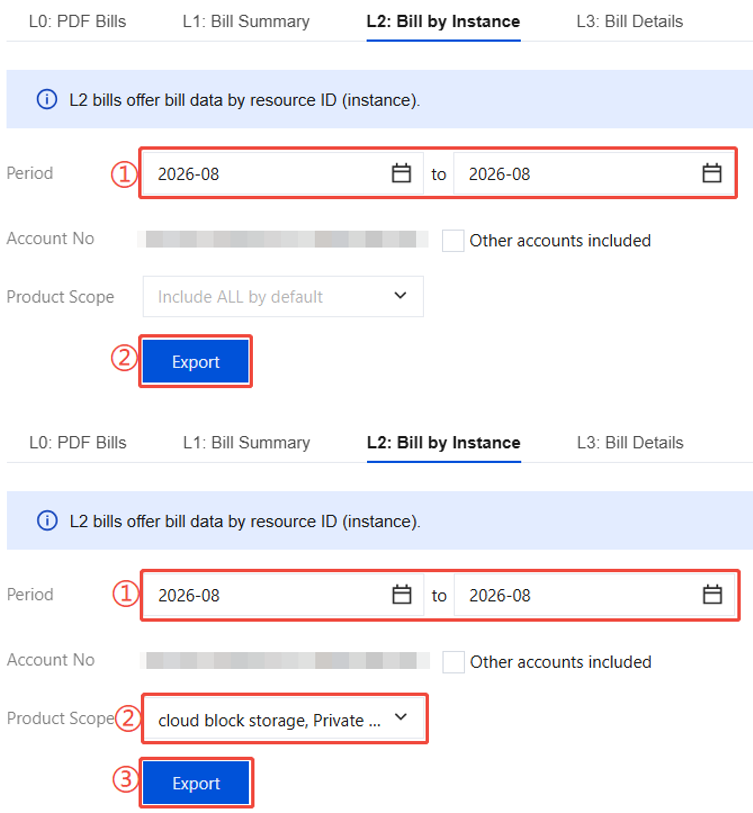
3. Select the L2-Bill by lnstance tab to export L2-resource bills.
Export the L2-resource bills of the current account:
Period: The default value is last month, and you can manually select it as needed.
Product scope: All products are included by default. You can filter products as needed and then click Export.
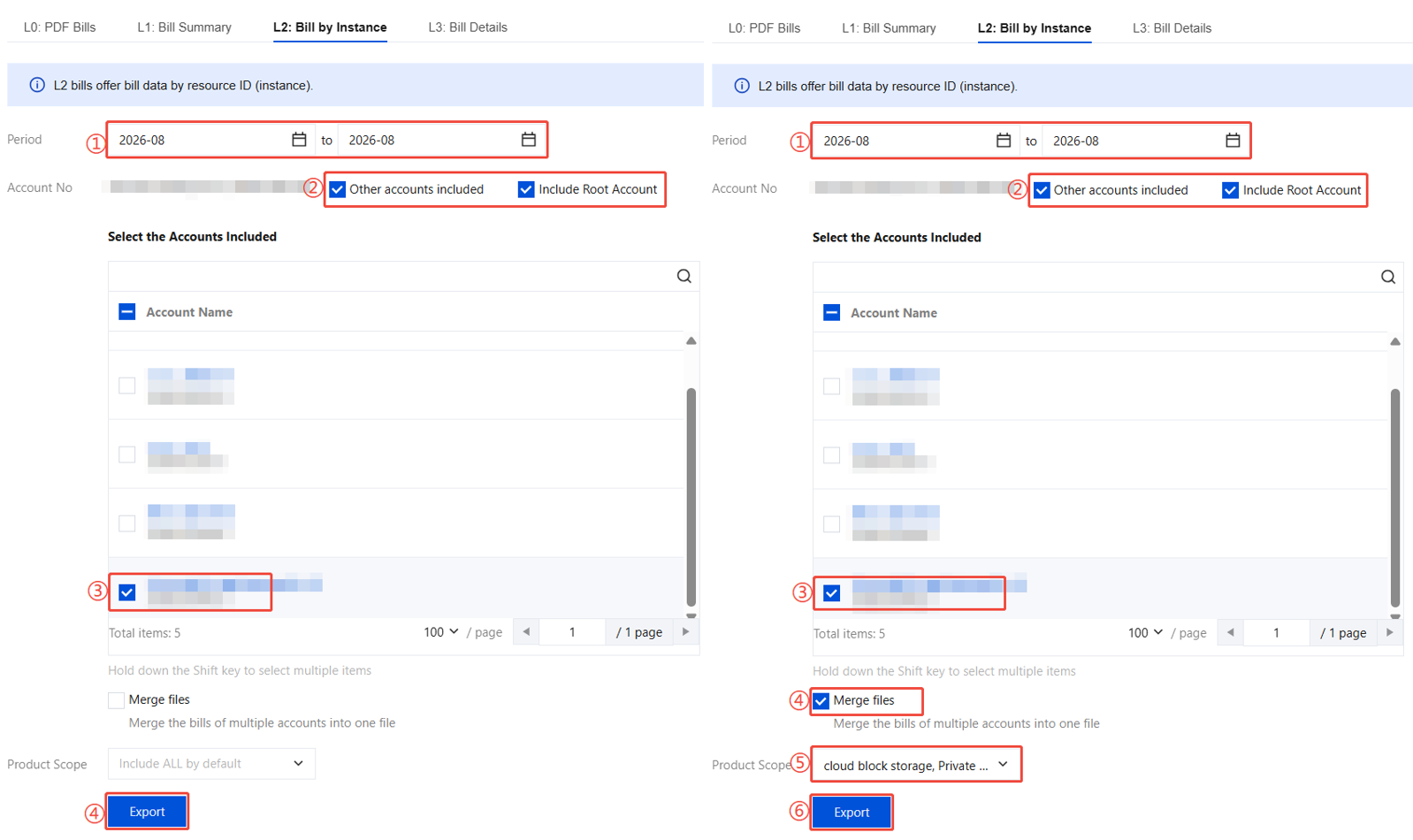
Export L2-resource bills that include data of member accounts in the group:
Period: The default value is last month, and you can manually select it as needed.
Account No: Select "other accounts Included" (not selected by default), and then select the member accounts to include.
Merge files : Merging is not performed by default. You can select Merge files as needed.
Product scope: All products are included by default. You can filter the product scope as needed and then click Export.
Note:
In this step, you can clear Include root account to export only the bills of member accounts in the group. After you clear this option, Merge files is not supported.
Export resource bills that include data of member accounts in the group. For multi-month exports or exports of multiple accounts in the same month, you can select Merge files to merge the exported data into a single file.
Note:
L3-Detailed bill provides bill data at the component level.
You can export detailed bills for multiple months at a time. For multiple months, bill files are aggregated by month and merged into a single file. For detailed aggregation, a compressed package is generated for each month.
Supports exporting detailed bills that include data of member accounts in the group.
2. In the left sidebar, choose Bills > Bill Export Center to go to the Bill Export Center page.
3. Select the L3-Bill Details tab to export L3-detailed bills.
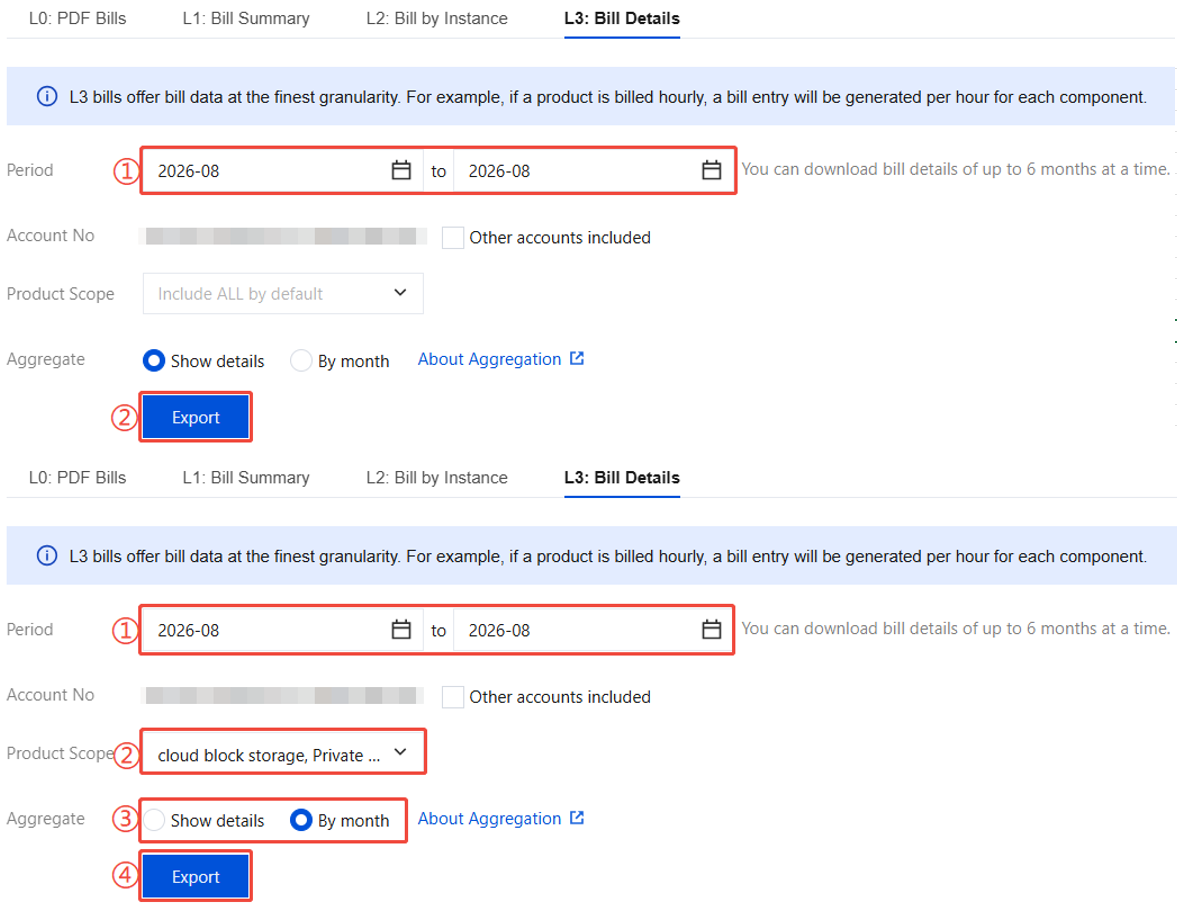
Export L3-detailed bills of the current account:
Period: The default value is last month, and you can manually select it as needed.
Product scope: All products are included by default, and you can filter them as needed.
Aggregate: Aggregated by detail by default. Select "By month" as needed and then click Export.
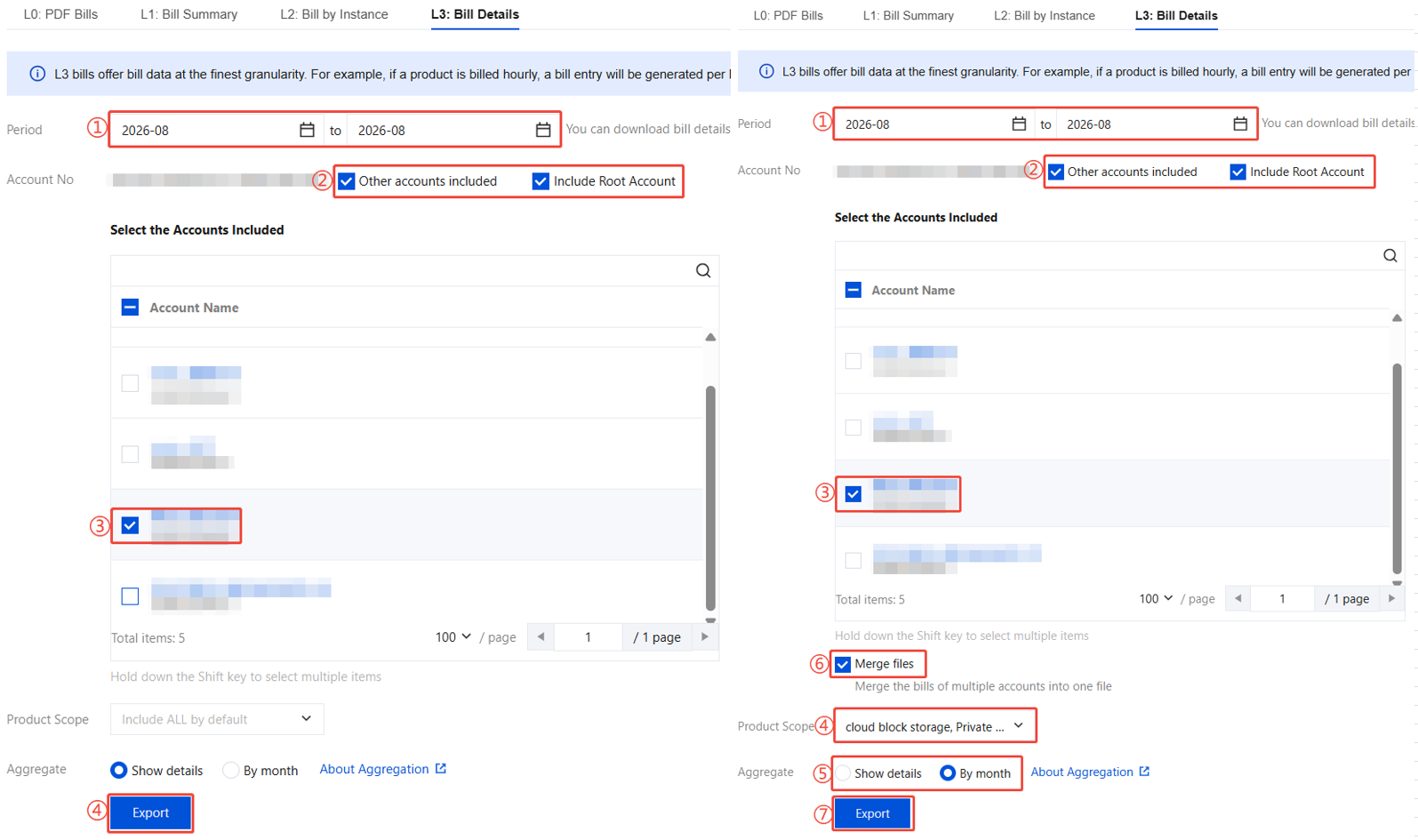
Export L3-detailed bills that include data of member accounts in the group:
Period: The default value is last month, and you can manually select it as needed.
Account No: Select "other accounts Included"(not selected by default), and then select the member accounts to include.
Merge files: Merging is not performed by default. You can select "Merge Files" as needed.
Product scope: All products are included by default, and you can filter the product scope as needed.
Aggregate: Aggregated by detail by default. Select "By month" as needed and then click Export.
Note:
In this step, you can clear Include root account to export only the bills of member accounts in the group. After you clear this option, Merge files is not supported.
When exporting detailed bills that include data of member accounts in the group, you can merge the exported data into a single file for multi-month exports or exports of multiple accounts in the same month aggregated By month by selecting Merge files. Merging is not supported for aggregation by detail.
References
Detailed Bill Aggregate by Month Logic Description
Cumulative Amount Products
Some cloud product components (such as those with names containing "bandwidth") have fixed durations and are usage-sensitive. When the bill details are aggregated by month, the cumulative usage and amount of bill details with the same resource ID are combined into one entry. The specific logic is as follows:
Aggregation is performed only when the transaction type is "Hourly settlement, Daily settlement, Spot , Hourly RI fee, Hourly Savings Plan fee, Adjustment - deduction, or Adjustment - compensation".
Components with cumulative amount range: component names containing "traffic", "bandwidth", "storage", or "count".
Note:
Some components are adjusted to cumulative duration based on actual conditions.
Calculation logic for each field after aggregating:
"Component usage", "Original price", "Discounted total price (before tax)", "Voucher expenditure", "Pre-tax actual amount", "Tax deduction", "Cash payment (tax included)", add up the bill detail amounts before aggregation.
"Usage start time": the earliest time of all detailed data that make up this item of aggregate data.
"Usage end time": the latest time of all detailed data that make up this item of aggregate data.
"Order ID", "Transaction ID", and "Deduction time" are displayed as "-".
Other fields: remain consistent.
Cumulative Duration Products
Some cloud products (such as CVM) have fixed usage and are duration-sensitive. When the bill details are aggregated by month, the cumulative duration and amount of bill details with the same resource ID are combined into one entry. The specific logic is as follows:
Aggregation is performed only when the transaction type is "Hourly settlement, Daily settlement, Spot , Hourly RI fee, Hourly Savings Plan fee, Adjustment - deduction, or Adjustment - compensation".
Components of cumulative duration range: components not in the range of cumulative amount are considered as cumulative duration.
Calculation logic for each field after aggregating:
"Usage duration" and "Component usage": are summed up using the corresponding field values from the bill details before aggregation.
"Original price", "Discounted total price (before tax)", "Voucher expenditure", "Pre-tax actual amount", "Tax deduction", and "Cash payment (tax included)" are summed up using the bill detail amounts before aggregation.
"Usage start time": the earliest time of all detailed data that make up this item of aggregate data.
"Usage end time": the latest time of all detailed data that make up this item of aggregate data.
"Order ID", "Transaction ID", and "Deduction time" are displayed as "-".
Other fields: remain consistent.
Non-Aggregated Data
If the transaction type is not Hourly settlement, Daily settlement, Spot , Hourly RI fee, Hourly Savings Plan fee, Adjustment - deduction, or Adjustment - compensation, aggregation is not performed, and all fields remain consistent with the L3-detailed bill.
Adding a Member Account
See the Add Organization Member feature in TCO. The system selects the View Bill permission by default, so you can select this member account when exporting bills.