tencent cloud

Bastion Host

Product Introduction
Overview
Strengths
Scenarios
Differences between SaaS BH Standard Edition and Pro Edition
Purchase Guide
Billing Overview
Purchase Method
Upgrade Subscription Plan
Upgrade Bandwidth
Upgrade Extension Pack
Renewal
Payment Overdue
Refund
Getting Started
First Login of Admin
Admin Manual
First Login of Ops Engineer
Ops Engineer Manual
Operation Guide
Admin Guide
Operations Guide
Practical Tutorial
Blocking High-risk Commands
File Transfer Control
Tracing Security Incidents
Cross-VPC Asset Management
Access Bastion Host O&M Page Via Intranet Domain
Troubleshooting
Windows Resource Login Connection Timeout
Windows Resource Login Prompting Wait Active
Linux Resource Login via Mac Prompting No Matching Host Key Type Found
Windows Resource is Inaccessible for Mac Users
iTerm Client Displaying Unrecognizable Characters to Mac Users During Ops
Unable to Invoke Local XShell or SecureCRT
Ops Members Cannot Receive SMS Verification Code
Ops Members Cannot Load the Account When Logging in to Resources
Linux Resource Login Prompting Host Unreachable
Linux Resource Login Failure Prompting Password Error
FAQs
Usage
Consultation
BH Policy
Privacy Policy
Data Processing And Security Agreement

Auditing Character Sessions

PDF
Focus Mode
Font Size
Last updated: 2025-04-18 10:58:51

Overview

When Ops personnel access resources through the BH, corresponding historical session records will be generated. Administrators can use the session audit feature to check for any non-compliant operations performed by the Ops personnel.
Note
A script session refers to a session generated when Ops personnel access Linux hosts via the SSH protocol.

Directions

1. Log in to the BH console.
2. In the left sidebar, choose Cloud Audit > Session Records.
3. On the Session Records page, click the Script recording tab.
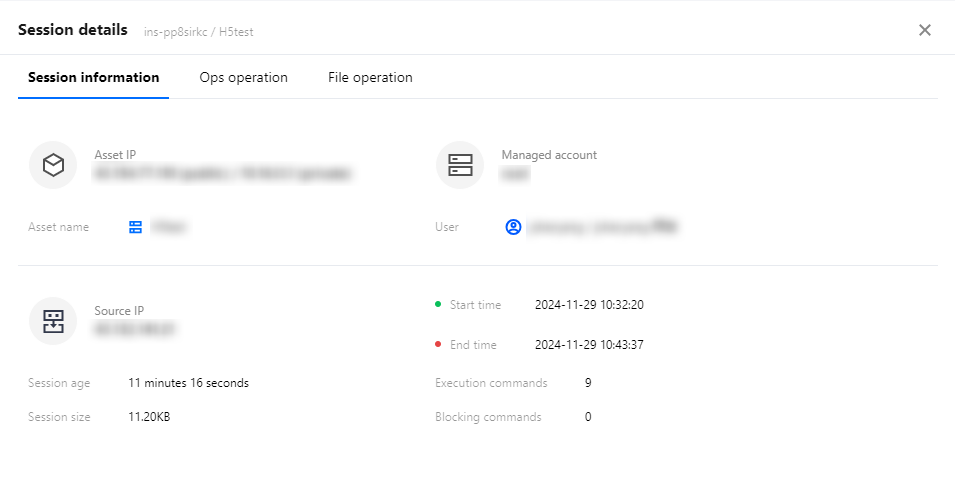
4. On the Script recording page, click Details on the right of the corresponding session to open the Session Details page.


5. On the Session Details page, you can view the session's basic information, keyboard operations, clipboard operations, and file operation records.

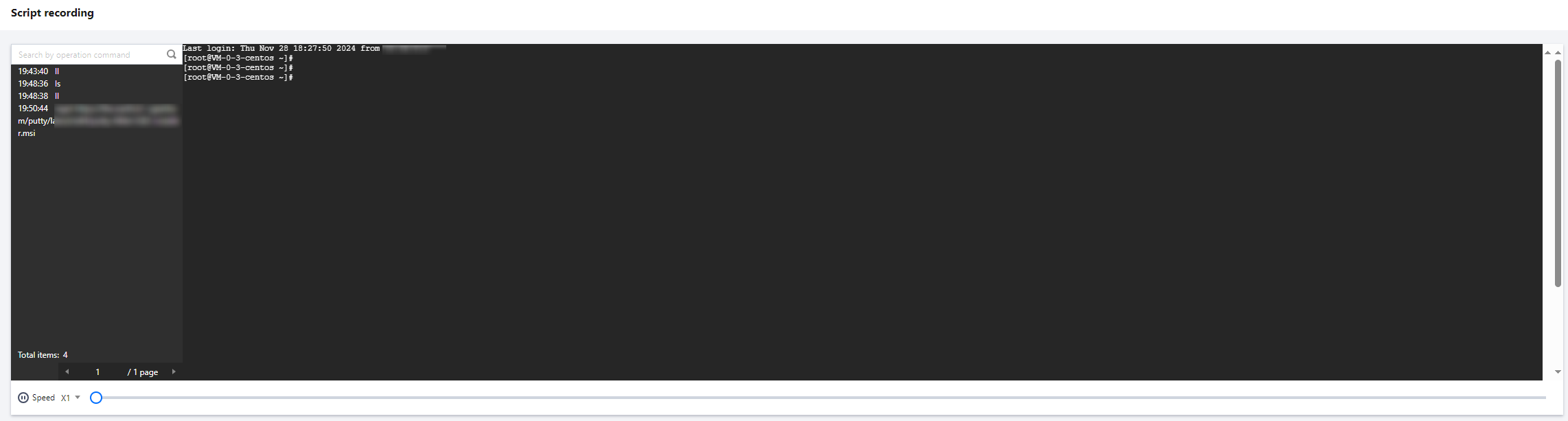
6. On the Script recording page, click Replay on the right side of the corresponding session to replay the historical session in a new page, restoring the user's actual operations.


7. On the Historical Session Replay page, you can search for operation commands using the search box and locate the user's executed commands.

8. You can adjust the playback speed in the lower-left corner of the Historical Session Replay page.


Help and Support

Was this page helpful?

Help us improve! Rate your documentation experience in 5 mins.

Feedback
