NAT Gateway is a service that supports IP address translation and provides the SNAT (Source Network Address Translation)and DNAT (Destination Network Address Translation)capabilities. It provides secure and high-performance Internet access for resources in VPCs. NAT Gateway supports a high availability of up to 99.99%, 5 Gbps bandwidth, and more than 10 million concurrent connections. Its typical application scenarios are as follows:
1. Large bandwidth and high-availability public network egress services, such as web crawlers and access to Internet public services.
2. Secure public network egress services, for example, you would like to have a CVM communicates with internet but don’t want to bind the CVM to a public IP address for security reasons.
Network Topology
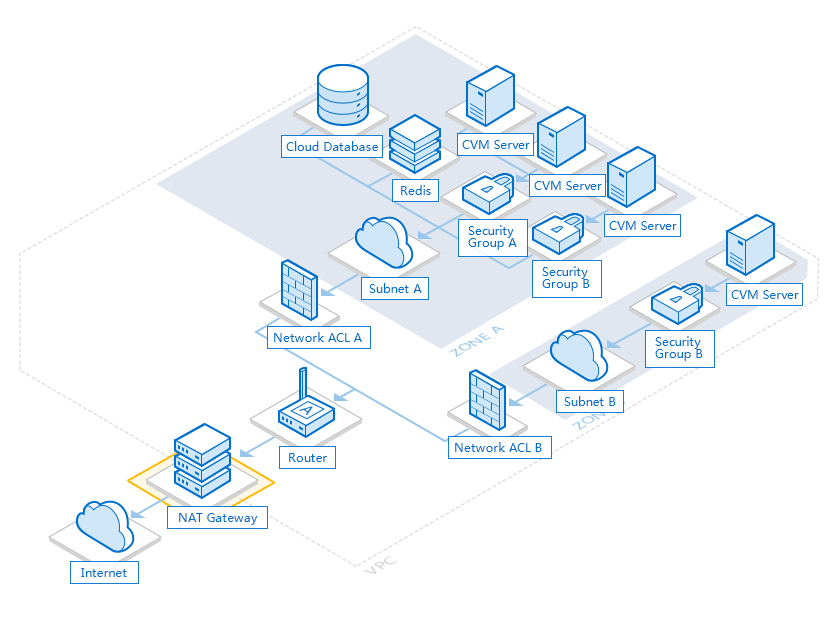
As shown in the following figure, when resources in the VPC, such as CVMs, send outbound data packets through the NAT gateway, these data packets first travel through the router and then are routed according to the routing policy. Finally, the NAT gateway sends the traffic to the Internet by using the bound EIP as the source IP address.
Differences Between the NAT Gateway and the Public Gateway
CVMs in a VPC can access the Internet through a NAT gateway or a public gateway. The following table lists the differences between both types of gateways.
Attribute
NAT Gateway
Public Gateway
Availability
Master/Slave hot backup and automatic hot switching
Manually switches the failed gateway.
Public network bandwidth
Maximum of 5 Gbps
Depends on the network bandwidth of the CVM.
Public IP address
A maximum of 10 EIPs can be bound
Supports one EIP or ordinary public IP address.
Rate limit of the public network
5 Gbps (The bandwidth cap is 50 Gbps, which is not available until you submit a ticket)
Depends on the rate limit of the CVM.
Max concurrent connections
10,000,000
500,000
Private IP address
Private IP addresses of VPC users are not consumed
Private IP addresses of subnets are consumed.
Security group
Binding a security group to a NAT gateway is not supported. Instead, you can bind a security group to the backend CVM.
Binding a security group is supported.
Network ACL
Binding a network ACL to a NAT gateway is not supported. Instead, you can bind a network ACL to the subnet where the backend CVM resides.
Binding a network ACL is not supported. Instead, you can bind a network ACL to the subnet where the public gateway resides.
Fees
Chinese mainland:
Small (up to 1 million connections): 0.09 USD/hr
Medium (up to 3 million connections):0.27 USD/hr
Large (up tp 10 million connections): 0.89 USD/hr
You only need to pay for the CVM configurations, without paying extra fees
The NAT gateway has the following advantages:
Large capacity
It supports a maximum of 10,000,000 concurrent connections, 5 Gbps bandwidth, and 10 EIPs, meeting the demands of customers with a large business scale.
Highly available master/slave hot backup
It supports automatic failover in case of a single point of failure to implement automatic disaster recovery and 99.99% service availability, which is superior to the manual switching of a public gateway.
Cost effectiveness
Three configuration types (small, medium, and large) are available for users to purchase as needed, offering flexibility in billing and high cost-effectiveness.