tencent cloud

Serverless Cloud Function

Release Notes and Announcements
Release Notes
Announcements
User Guide
Product Introduction
Overview
Related Concepts
How It Works
Strengths
Scenarios
Related Products
Purchase Guide
Billing Overview
Billing Mode
Billable Items and Billing Modes
Function Computing Power Support
Free Tier
SCF Pricing
Billing Example
Payment Overdue
Getting Started
Creating Event Function in Console
User Guide
Quota Management
Managing Functions
Web Function Management
Log Management
Concurrence Management
Trigger Management
Function URL
A Custom Domain Name
Version Management
Alias Management
Permission Management
Running Instance Management
Plugin Management
Managing Monitors and Alarms
Network Configuration
Layer Management
Execution Configuration
Extended Storage Management
DNS Caching Configuration
Resource Managed Mode Management
Near-Offline Resource Hosting Model
Workflow
Triggers
Trigger Overview
Trigger Event Message Structure Summary
API Gateway Trigger
COS Trigger
CLS Trigger
Timer Trigger
CKafka Trigger
Apache Kafka Trigger
MQTT Trigger
Trigger Configuration Description
MPS Trigger
CLB Trigger Description
TencentCloud API Trigger
Development Guide
Basic Concepts
Testing a Function
Environment Variables
Dependency Installation
Using Container Image
Error Types and Retry Policies
Dead Letter Queue
Connecting SCF to Database
Automated Deployment
Cloud Function Status Code
Common Errors and Solutions
Developer Tools
Serverless Web IDE
Calling SDK Across Functions
Third-Party Tools
Code Development
Python
Node.js
Golang
PHP
Java
Custom Runtime
Deploying Image as Function
Web Framework Development
Deploying Framework on Command Line
Quickly Deploying Egg Framework
Quickly Deploying Express Framework
Quickly Deploying Flask Framework
Quickly Deploying Koa Framework
Quickly Deploying Laravel Framework
Quickly Deploying Nest.js Framework
Quickly Deploying Next.js Framework
Quickly Deploying Nuxt.js Framework
Quickly Deploying Django Framework
Use Cases
Overview
Solutions with Tencent Cloud Services
Business Development
TRTC Practices
COS Practices
CKafka Practice
CLS
CLB Practice
MPS
CDN
CDWPG
VOD
SMS
ES
Scheduled Task
Video Processing
Success Stories
Tencent Online Education
Online Video Industry
Tencent Online Education
Best Practice of Tencent IEG Going Global
API Documentation
History
Introduction
API Category
Making API Requests
Other APIs
Namespace APIs
Layer Management APIs
Async Event Management APIs
Trigger APIs
Function APIs
Function and Layer Status Description
Data Types
Error Codes
SDK Documentation
FAQs
General
Web Function
Billing FAQs
Network FAQs
Log FAQs
SCF utility class
Event Handling FAQs
API Gateway Trigger FAQs
Related Agreement
Service Level Agreement
Contact Us
Glossary

Scheduled Provisioned Concurrency

PDF
포커스 모드
폰트 크기
마지막 업데이트 시간: 2024-12-02 20:07:18

Overview

Scheduled provisioned concurrency is an elastic policy for provisioned concurrency. You can reasonably configure provisioned concurrency based on the business conditions and upgrade/downgrade it at specified times to improve the utilization of provisioned concurrent instances and reduce the fees incurred by idle resources. If the number of concurrent instances actually required by a function exceeds that configured in scheduled provisioned concurrency, auto scaling will be performed as needed. This feature supports the following task types: one time, daily, Monday to Friday, Saturday and Sunday, and custom.

Use Cases

Functions with regularly fluctuating traffic, such as data processing functions.
Functions whose business traffic peaks can be predicted, such as functions for events or other scheduled businesses.

Features and Limits

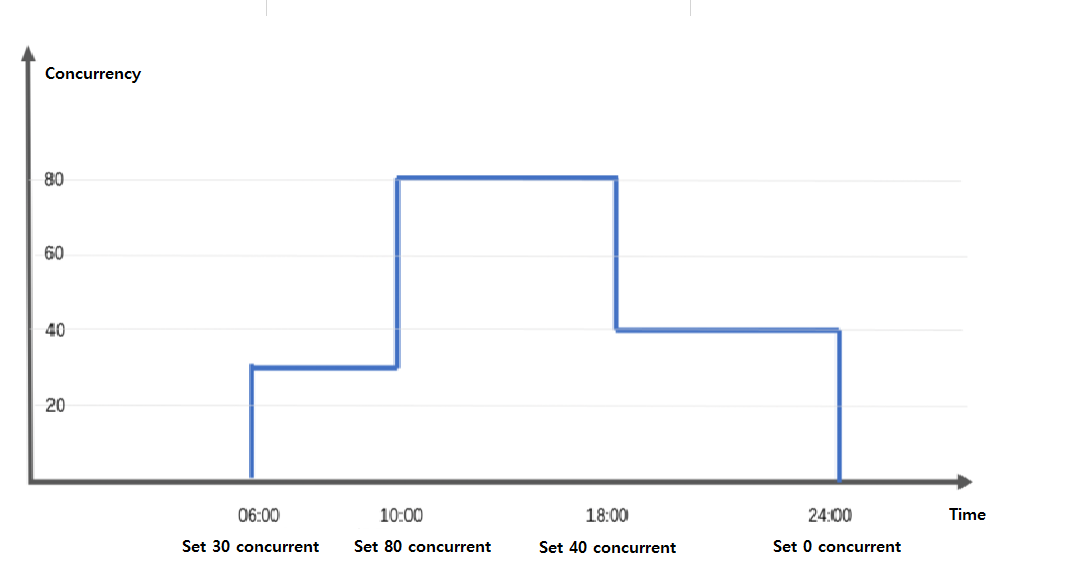
The configured value in scheduled provisioned concurrency is the target number of concurrent instances during task execution; for example, if you need to configure four scheduled tasks for your business, i.e., starting 30 concurrent instances at 6:00, 80 at 10:00, 40 at 18:00, and 0 at 24:00, the final provisioned concurrency fluctuation will be as follows:


Notes

A cron expression for scheduled provisioned concurrency has seven required fields separated with spaces. For more information, see Timer Trigger Description.
There is a limit to the number of scheduled provisioned concurrency tasks under one user account on one function version. For more information, see Quota Limits. To increase the maximum number of scheduled tasks (i.e., quota limit), you can submit a ticket for application.
SCF will adjust the speed of starting provisioned concurrency based on your business, which is 100 concurrent instances per minute by default. You should reasonably configure the start time of scheduled provisioned concurrency. For more information, see Concurrency Overview.
If two scheduled provisioned concurrency tasks are scheduled for the same time, the new one will overwrite the old one.

Example

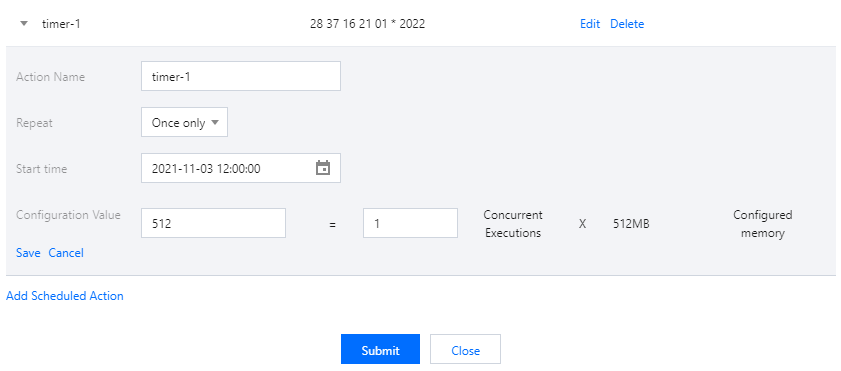
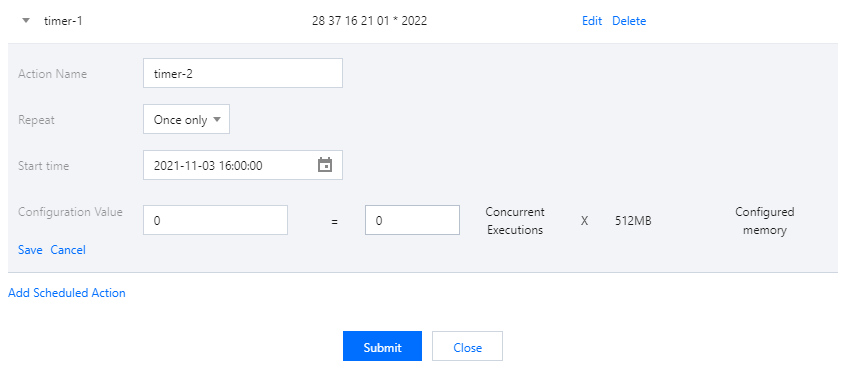
To start a scheduled provisioned concurrency task at 12:00 on November 13, 2021 to sustain your business traffic peak and end the task at 16:00 on the same day, perform the following operations:

Starting scheduled task

To start a provisioned concurrency task as scheduled, you need to add a scheduled task. Select the start time and configure the target number of concurrent instances as shown below:


Ending scheduled task

To end a provisioned concurrency task as scheduled, you need to add another scheduled provisioned concurrency task. Select the desired end time of the previous task as the start time of the new task and configure the target number of concurrent instances to 0 as shown below:
도움말 및 지원

문제 해결에 도움이 되었나요?

피드백