Introduction to EMR Serverless TCBase
다운로드
포커스 모드
폰트 크기
EMR Serverless TCBase is a fully managed, lightweight data service platform that integrates a cloud-native database kernel with high-performance analytical capabilities. This product aims to provide users with an integrated experience from data storage and real-time processing to application building. It not only supports diverse data storage and access for AI model training and inference, but also enables hybrid OLTP and OLAP analysis. Additionally, it delivers exceptional single-instance analytical performance in a lightweight, low-barrier manner.
Product Architecture
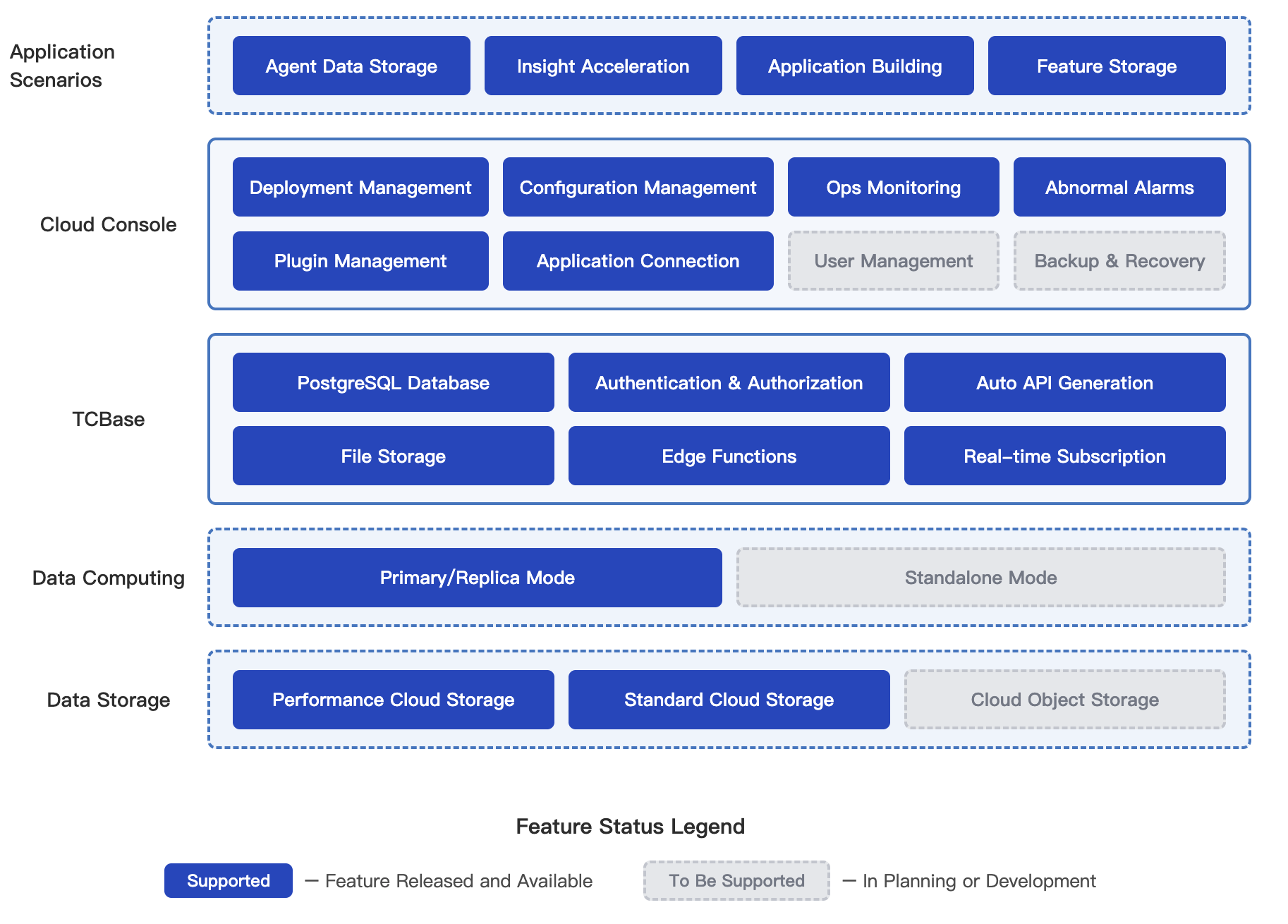
Note:
Data storage: EMR Serverless TCBase supports both integrated and decoupled storage-compute scenarios, offering various storage methods such as cloud storage and Cloud Object Storage (COS). Users can store data in these data sources, though only cloud storage is supported during the beta period.
Data computing: The instance computing unit architecture supports primary/replica and standalone modes. The primary/replica mode provides primary/replica dual nodes, and only the primary/replica mode is supported during the beta period.
TCBase: Provides visual database management, authentication configuration, storage management, function deployment, API documentation, monitoring logs, and other features.
Cloud console: Provides visual instance Ops features such as management, configuration, and monitoring/alarming for EMR Serverless TCBase instances.
Application scenarios: EMR Serverless TCBase is suitable for scenarios such as the efficient construction of lightweight AI applications (Agents) and real-time analysis of HTAP hybrid workloads.
Advantages
Out-of-the-box application development platform: Fully compatible with open-source Supabase capabilities, providing auto-generated APIs, file storage, real-time subscriptions, user authentication, and edge functions. This enables developers to rapidly release applications without building a backend, significantly improving development efficiency.
HTAP (Hybrid Transactional/Analytical Processing) integration and high-performance analytics: Unified support for transactional processing and complex analytics. By embedding a DuckDB high-performance engine, it achieves lightning-fast OLAP queries on massive data at the single-machine level without data migration.
Native AI application support: Built-in vector database extensions support data demands in the AI era. Deeply integrated with Tencent Cloud AI development tools, it supports database design and application development via natural language interaction, making it an ideal foundation for building AI Agents and intelligent applications.
Enterprise-grade fully managed service: Provides high availability, second-level elastic scaling, multiple payment modes, and security compliance guarantees. This eliminates the high Ops costs and technical risks of self-built open-source solutions, thus delivering reliable, low-cost data services.
피드백