tencent cloud

SSL Certificates

Release Notes
Announcements
Notice on price adjustment of DigiCert and its affiliated brands'SSL certificates​
Price Change to DigiCert SSL Certificates
TrustAsia Root Certificate Update
Domain Validation Policy Update
SSL Certificate Service Console
Multi-Year SSL Certificate and Automatic Review
Notice on Stopping the Issuance of 2-Year SSL Certificates by CAs Starting from September 1, 2020
Announcement on Stop Using the Symantec SSL Certificate Name After 30 April 2020
Notice on Certificate Revocation Due to Private Key Compromises
Notice on Application Limits for DV SSL Certificates
Notice on Adjustment of Free SSL Certificates Policy
Let's Encrypt Root Certificate Expired on September 30, 2021
Product Introduction
Overview
Introduction to Tencent Cloud SSL Certificates
Strengths
Advantages of HTTPS
Browser Compatibility Test Report
Multi-Year SSL Certificate and Automatic Review Overview
SSL Certificate Security
Purchase Guide
Pricing
SSL Certificate Purchase Process
SSL Certificate Selection
Paid SSL Certificates Renewal
SSL Certificate Renewal Process
SSL Certificate Refund Process
Getting Started
Certificate Application
Information Submission Process for Paid SSL Certificates
Domain Ownership Validation
Domain Validation Method Selection
Automatic DNS Addition
DNS Validation
File Validation
Automatic DNS Validation
Automatic File Validation
Validation Result Troubleshooting Guide
Operation Guide
Domain Ownership Verification
Uploading Certificates
Secured Seal
CSR Management
Certificate Installation
Installing an SSL Certificate on a Tencent Cloud Service
Installation of International Standard Certificates
Selecting an Installation Type for an SSL Certificate
Certificate Management
Instructions on SSL Certificate Auto-Renewal
Certificate Hosting
Uploading (Hosting) an SSL Certificate
Reminding Reviewers to Review an SSL Certificate Application
Revoking an SSL Certificate
Deleting an SSL Certificate
Reissuing an SSL Certificate
Ignoring SSL Certificate Notifications
Customizing SSL Certificate Expiration Notifications
API Documentation
History
Introduction
API Category
Making API Requests
Certificate APIs
Certificate Renewal (Certificate ID Unchanged) APIs
CSR APIs
Data Types
Error Codes
Use Cases
Automatic Solution for Implementing and Issuing Multi-Year Certificates and Binding Resources
Apple ATS Server Configuration
Quickly Applying for a Free SSL Certificate via DNSPod
Enabling Tencent Cloud DDNS and Installing Free Certificates for Synology NAS
Batch Applying for and Downloading Free Certificates Using Python-based API Calls
Profile Management
Adding Organization Profile
Adding Administrator
Adding Domain
Troubleshooting
Domain Validation Failed
Domain Security Review Failed
Website Inaccessible After an SSL Certificate is Deployed
404 Error After the SSL Certificate is Deployed on IIS
“Your Connection is Not Secure” is Displayed After the SSL Certificate is Installed
Message Indicating Parsing Failure Is Displayed When a Certificate Is Uploaded
Automatic DNS Validation Failed for a Domain Hosted with www.west.cn
Host Name Field Cannot Be Edited in IIS Manager When Type Is Set to https
Message Indicating Intermediate Certificates Missing in Chain Is Displayed When a Free SSL Certificate Is Deployed on IIS
FAQs
SSL Certificate Selection
SSL Certificate Application
SSL Certificate Management
SSL Certificate Installation
SSL Certificate Region
SSL Certificate Review
SSL Certificate Taking Effect
SSL Certificate Billing and Purchase
SSL Certificate Validity Period
Related Agreement
SSL Service Level Agreement
Contact Us
Glossary
DocumentationSSL CertificatesPurchase GuidePaid SSL Certificates Renewal

Paid SSL Certificates Renewal

PDF
Focus Mode
Font Size
Last updated: 2024-03-06 16:57:28
Renewing an SSL certificate is equivalent to applying for a new certificate in the console, so you need to install and deploy the new certificate to your server. The new certificate does not affect the usage of the existing one.
Note:
If you want to modify the certificate information, apply for a new one.
After renewal, a new certificate will be issued. Replace the website certificate with the new certificate. For information about how to install a certificate, see Certificate Installation.

Advantages of Renewal

Renewing the existing certificate holds the following advantages over purchasing a new one:

Simplifying renewal procedure

Instead of entering the application information again, you only need to confirm the original certificate application data pulled automatically by the system and proceed to the payment process. After making the payment, upload the confirmation letter and wait for review.

Prolonging certificate validity after renewal

After renewal, the remaining available time of the original certificate and an extra 1 to 90 days roll to the validity time of the new certificate for free. You will not experience any loss in certificate validity period due to renewal.

Certificate Renewal Procedure

1. Going to the certificate renewal page

1. A quick renewal feature will be enabled 30 days before your certificate expires. On the Certificate Management page of the SSL Certificate Service console, click Quick Renewal in the Operation column of the certificate you want to renew.
2. On the pop-up window, confirm the information and click Renew Now to enter the renewal page.

2. Confirming the renewal information and make the payment.

1. When renewing a certificate, you do not need to enter the certificate information again. A new certificate will be generated after renewal, so you need to create a CSR file for the new certificate.
You can automatically generate a CSR file through the system (this option is recommended, and the CSR and private key can be generated).
Or, upload a CSR file (no private key can be generated with this option).
2. After confirming the information, select the renewal period, and click Quick Payment to go to the payment page.
3. Confirm the certificate information and click Purchase for payment.

3. Confirming the certificate application

For an OV/EV paid certificate, upload the confirmation letter and wait for review.

1. After you complete payment, on the Certificate Management page in the SSL Certificate Service console, you can find a new certificate with the status of Pending confirmation letter upload in the certificate list. Click Upload confirmation letter to go to the confirmation letter details page.
2. Click Download Confirmation Letter as prompted, fill in the information, and seal the letter. Scan the confirmation letter to a file and click Upload for Review, as shown in the following figure.


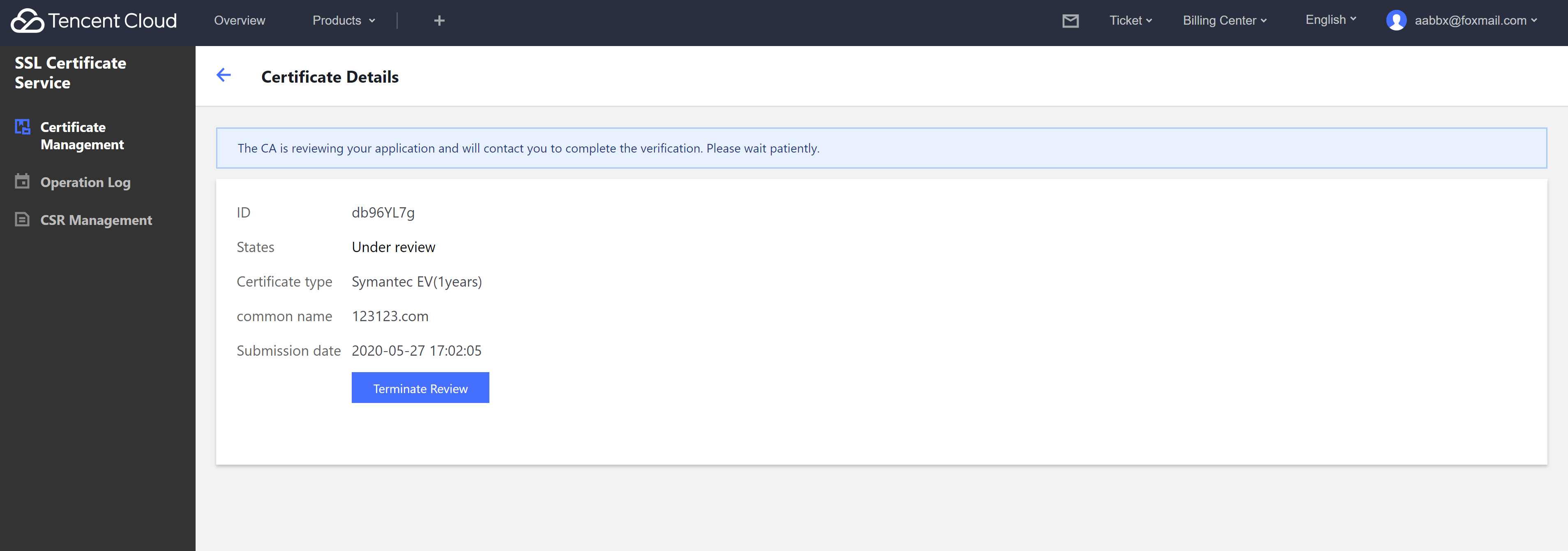
3. After you submit the confirmation letter, the certificate status changes to Pending verification. Wait for the reviewer to verify your information by phone and confirm the domain information email.
Note:
For OV certificates, certificate issuance takes 3 to 5 business days. For EV certificates, certificate issuance takes 5 to 7 business days.

For paid DV certificates, verify the domain name.

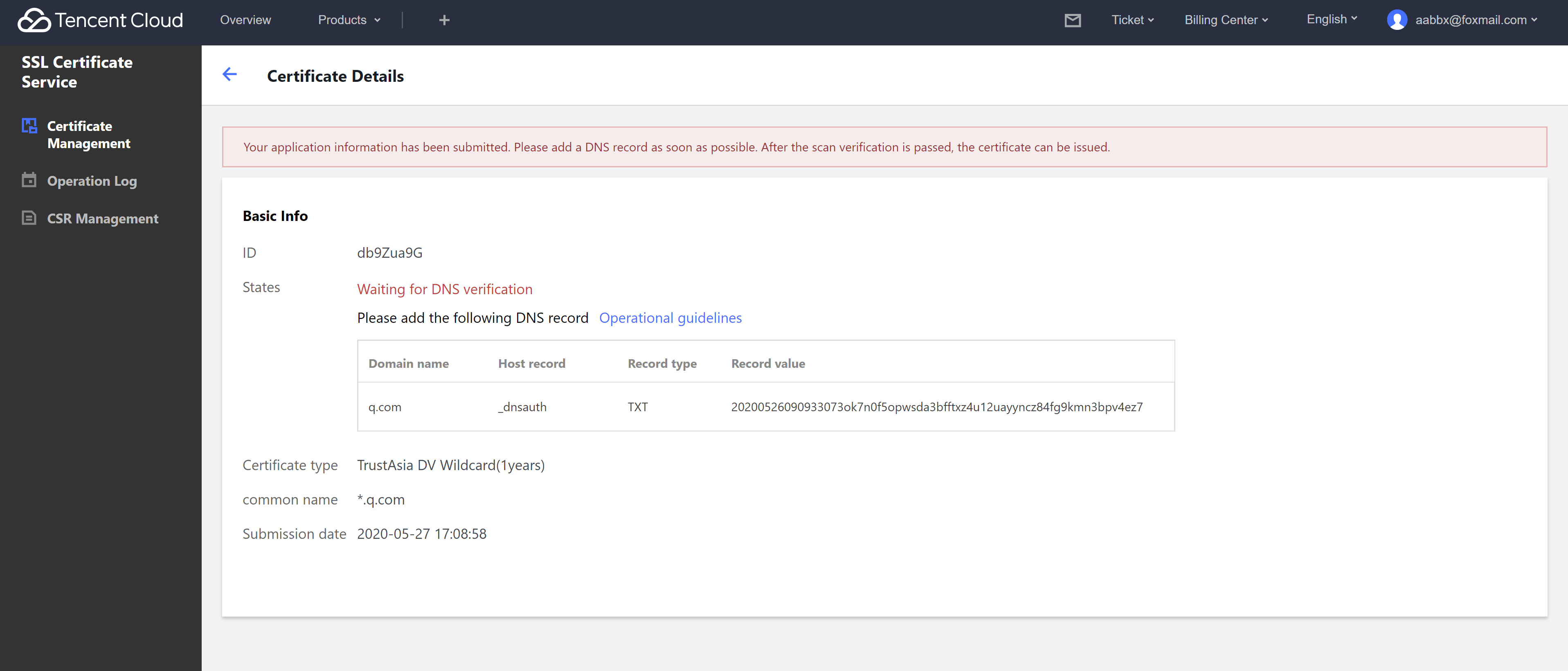
1. After you complete payment, on the Certificate Management page of the SSL Certificate Service console, you can find a new certificate with the status of Pending verification in the certificate list. Click Details to go to the Certificate Details page.
2. The DNS verification value is displayed on the Certificate Details page. Add this DNS record and wait for scan and verification by the CA. The certificate will be issued after approval.
Note:
Issuance of DV certificates takes 10 minutes to 24 hours.


Certificate Installation

After the certificate is issued, install the certificate based on your server type. For more information about certificate installation, see the following:
Note:
If there is no certificate installation tutorial for the sever you use, go to the Tencent Cloud MARKET, search for certificate installation services, and select a vendor for certificate installation service.

Help and Support

Was this page helpful?

Help us improve! Rate your documentation experience in 5 mins.

Feedback