
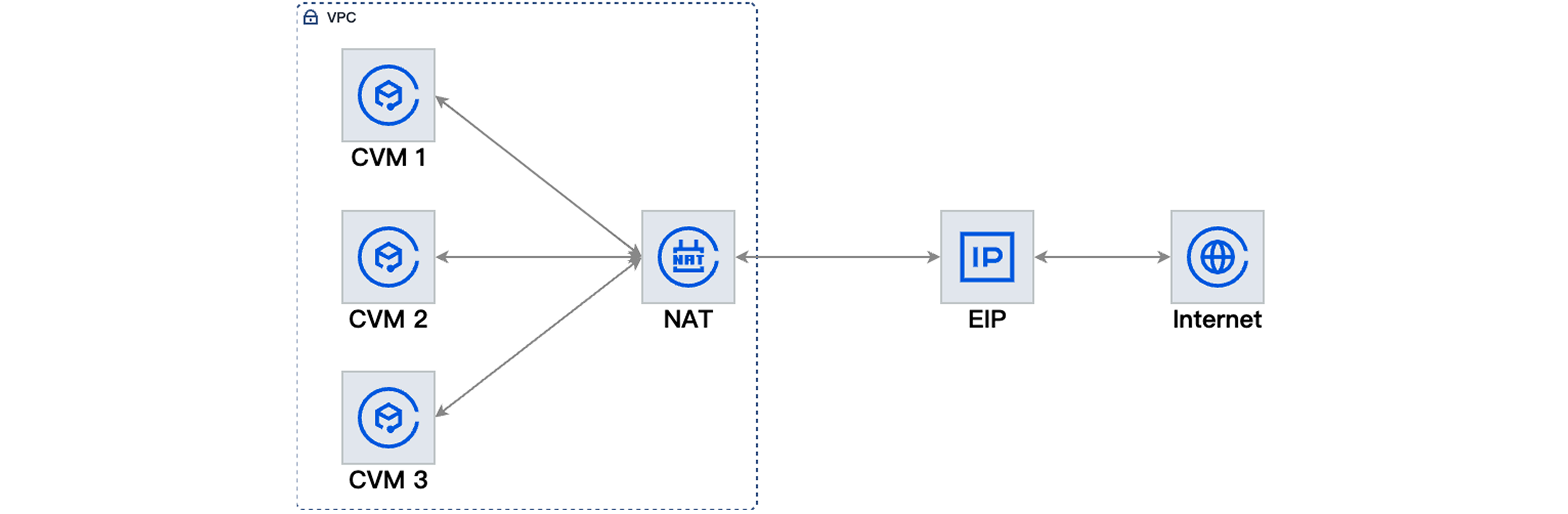
EIP is an independent public IP address resource that belongs to your Tencent Cloud account, not to any cloud resource. It can be bound to and unbound from CVMs, NAT Gateways, ENIs, and HAVIPs at any time, and can be used flexibly and take effect in real-time.
EIP is an independent public IP address resource that belongs to your Tencent Cloud account, not to any cloud resource. It can be bound to and unbound from CVMs, NAT Gateways, ENIs, and HAVIPs at any time, and can be used flexibly and take effect in real-time.

EIP supports on-demand purchases, configuration changes take effect in real time, and can be managed and operated through a variety of methods, such as the console and Cloud API.
EIP supports on-demand purchases, configuration changes take effect in real time, and can be managed and operated through a variety of methods, such as the console and Cloud API.

EIPs in certain billing modes can be added to a Bandwidth Package (BWP) to improve the utilization of bandwidth resources, significantly reducing your usage cost of public networks.
EIPs in certain billing modes can be added to a Bandwidth Package (BWP) to improve the utilization of bandwidth resources, significantly reducing your usage cost of public networks.
EIP is an independent public IP address resource that belongs to your Tencent Cloud account, not to any cloud resource. It can be bound to and unbound from CVMs, NAT Gateways, ENIs, and HAVIPs at any time, and can be used flexibly and take effect in real-time.
EIP supports on-demand purchases, configuration changes take effect in real time, and can be managed and operated through a variety of methods, such as the console and Cloud API.
EIPs in certain billing modes can be added to a Bandwidth Package (BWP) to improve the utilization of bandwidth resources, significantly reducing your usage cost of public networks.
Frequently
asked questions
Yes, you can change the public IP address for the CVM. For the specific operations, see Changing the Public IP Address for an Instance.
EIP is suitable for the following scenarios:
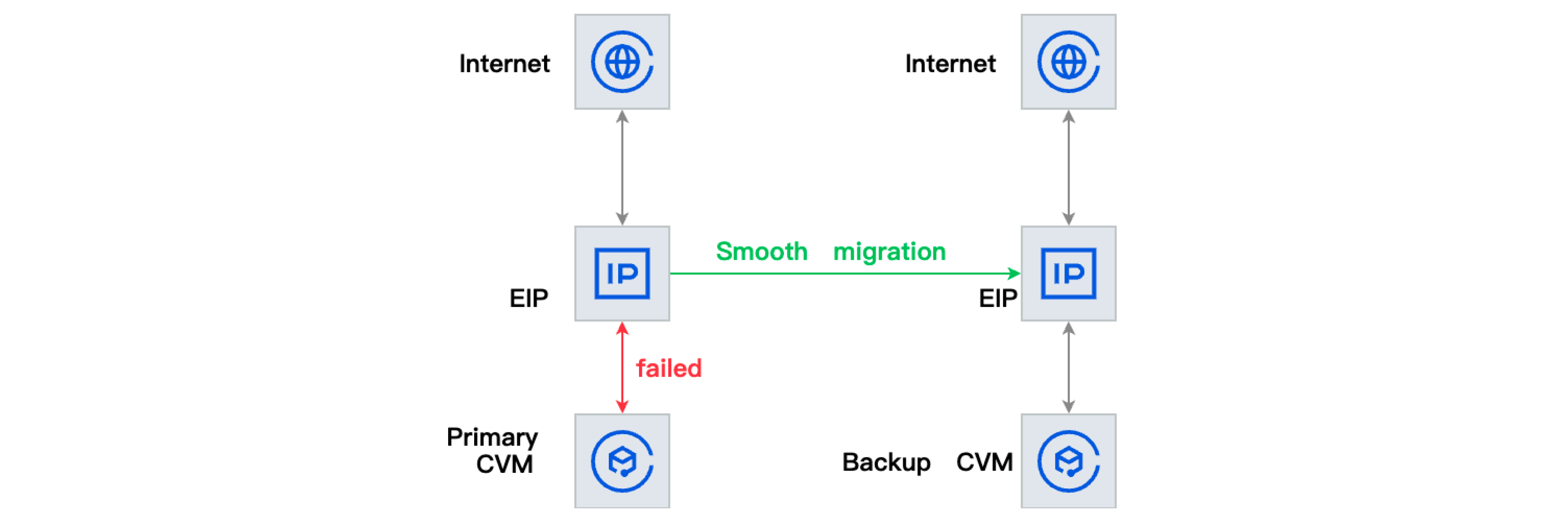
- Disaster recovery. In multi-active disaster recovery scenarios, applications and resources on the primary and standby servers are synchronized in real time. When the primary server is bound to an EIP, if the primary server fails, you can unbind the EIP from the primary server and rebind it to the standby server. This enables smooth migration of the EIP used by services from the failed server to the standby server without modifying DNS or other mapping configurations, ensuring business continuity.
- Specific public IP address retaining. If you want to retain a specific public IP address in your account, convert it into an EIP. After binding/unbinding the EIP from a device, you can use it for public network access. As long as you do not perform a "release" operation, this EIP permanently retains in your account.
- Other special scenarios. If you need to replace an IP address in other special scenarios, convert a regular public IP address into an EIP and then binding/unbinding the EIP. However, EIP resources are valuable with regional quota limits for a single account. It is recommended that you plan and use them rationally.
Using Cloud Firewall (CFW) helps you quickly identify assets and vulnerabilities exposed to the Internet and enables protection with one click. For details, see Cloud Firewall.
1. The fee displayed in the console applies to EIPs that have been idle for more than 1 hour. Currently, IP address resources can be charged accurately to seconds. For EIPs that have been bound/unbound for multiple times, IP address resources are charged based on the total duration for which they are unbound.
2. For EIPs that have been idle for less than 1 hour, IP address resources are charged based on the proportion of idle time.
For details about how IP address resource fees are charged for EIP, see IP Address Resource Fees.
If you no longer require an EIP in the Unbound and Charging status, release the EIP. No IP address resource fees are generated for a released EIP. For detailed operations, see Releasing an EIP.
If you want to retain an EIP in the Unbound and Charging status but do not want the IP address resource fees to be generated, bind the EIP to cloud resources such as CVM, NAT Gateway, ENI, and HAVIP resources. No IP address resource fees are generated for an EIP that is bound to cloud resources.
Frequently
asked questions
Yes, you can change the public IP address for the CVM. For the specific operations, see Changing the Public IP Address for an Instance.
EIP is suitable for the following scenarios:
- Disaster recovery. In multi-active disaster recovery scenarios, applications and resources on the primary and standby servers are synchronized in real time. When the primary server is bound to an EIP, if the primary server fails, you can unbind the EIP from the primary server and rebind it to the standby server. This enables smooth migration of the EIP used by services from the failed server to the standby server without modifying DNS or other mapping configurations, ensuring business continuity.
- Specific public IP address retaining. If you want to retain a specific public IP address in your account, convert it into an EIP. After binding/unbinding the EIP from a device, you can use it for public network access. As long as you do not perform a "release" operation, this EIP permanently retains in your account.
- Other special scenarios. If you need to replace an IP address in other special scenarios, convert a regular public IP address into an EIP and then binding/unbinding the EIP. However, EIP resources are valuable with regional quota limits for a single account. It is recommended that you plan and use them rationally.
Using Cloud Firewall (CFW) helps you quickly identify assets and vulnerabilities exposed to the Internet and enables protection with one click. For details, see Cloud Firewall.
1. The fee displayed in the console applies to EIPs that have been idle for more than 1 hour. Currently, IP address resources can be charged accurately to seconds. For EIPs that have been bound/unbound for multiple times, IP address resources are charged based on the total duration for which they are unbound.
2. For EIPs that have been idle for less than 1 hour, IP address resources are charged based on the proportion of idle time.
For details about how IP address resource fees are charged for EIP, see IP Address Resource Fees.
If you no longer require an EIP in the Unbound and Charging status, release the EIP. No IP address resource fees are generated for a released EIP. For detailed operations, see Releasing an EIP.
If you want to retain an EIP in the Unbound and Charging status but do not want the IP address resource fees to be generated, bind the EIP to cloud resources such as CVM, NAT Gateway, ENI, and HAVIP resources. No IP address resource fees are generated for an EIP that is bound to cloud resources.