Cluster Architecture
다운로드
포커스 모드
폰트 크기
Architecture Overview
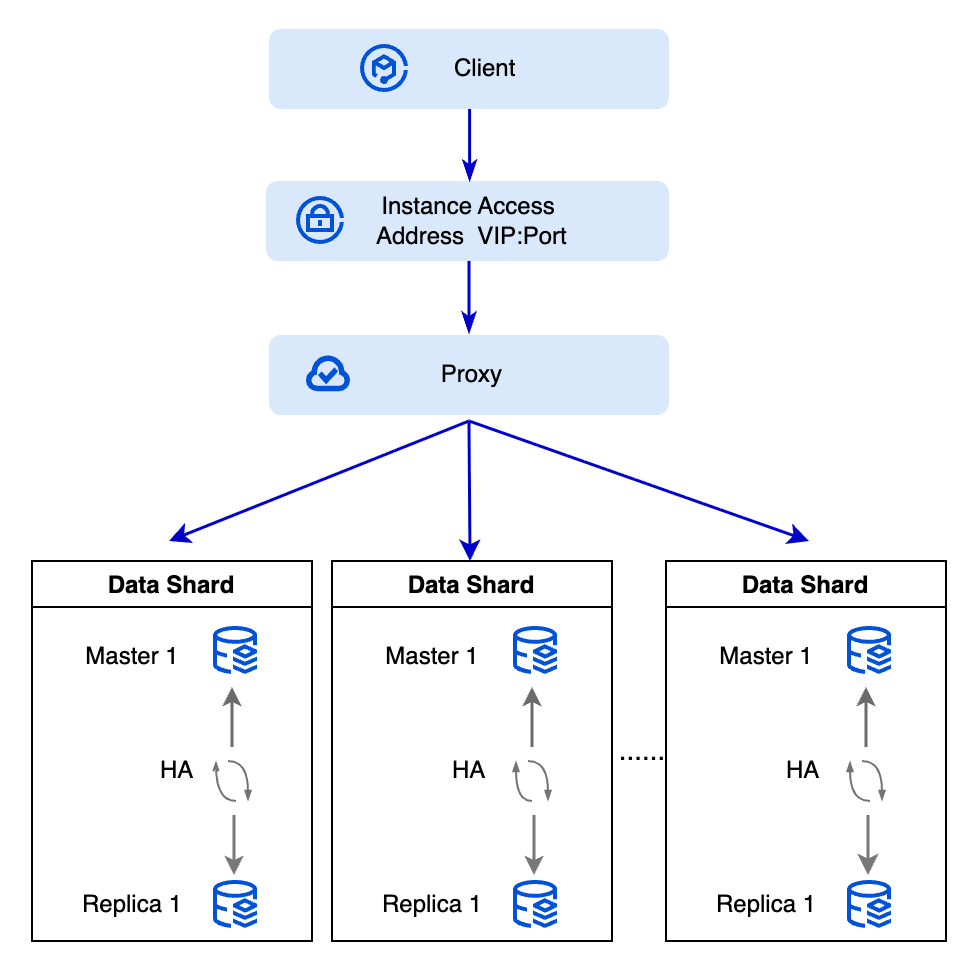
The cluster architecture is a distributed cache architecture built on the community edition of Redis Cluster. It is compatible with Redis 4.0, 5.0, 6.2, 7.0, and Valkey 8.0 and later protocol versions. The system uses a distributed sharding design and supports horizontal scaling from 1 to 128 shards and vertical scaling from 1 to 5 replicas, delivering high performance of tens of millions of QPS. Capacity expansion, scale-in, and migration processes are nearly transparent to business, ensuring high service availability. For specific performance data, see Specifications and Performance.
Core Components
Component | Description |
Shard | The smallest logical unit of distributed storage. A cluster allocates 16,384 hash slots to shards. Each shard consists of one master node and multiple replica nodes, stores data for the corresponding slots, and supports online data balancing and dynamic migration. |
Master node | The core node in a shard that handles read/write requests. Each shard has exactly one master node, which handles data writes and synchronizes them to its replica nodes in real time. |
Replica node | A node in a shard that ensures data redundancy and high availability. It synchronizes data from the master node in real time. When the master node fails, the system automatically promotes one of the replica nodes to the new master node. |
Proxy cluster | A built-in proxy component receives client requests and routes them to the corresponding shards. It provides load balancing, read/write separation, and cross-shard command processing capabilities while hiding cluster topology details. For details about Proxy routing rules, command compatibility, and connection limits, see Proxy Features. |
Implementation Introduction
The instance provides a unified virtual IP address access address (VIP:Port) externally. Clients can connect directly using standard Redis clients such as redis-cli, Jedis, and Lettuce. The built-in Proxy component parses commands and routes them to the corresponding shards by slot. Proxy supports aggregated processing of some cross-slot commands and transparently handles topology changes such as scale-out, scale-in, and failover, requiring no awareness from the business side.
Connection Example
The cluster architecture connection mode supports mainstream multilingual Redis clients in the industry. The following table lists the recommended clients for each development language and the connection classes used in proxy mode. Click a language to navigate to detailed connection examples. For general instructions on preparations before connection, authentication methods, and connection verification, see Connection Preparation.
Development Language | Recommended Client | Recommended Edition | Connection Class | Connection Example |
Java | Jedis | 5.1.2 or later | JedisPool | |
Java | Lettuce | 6.3.0 or later | RedisClient | |
Python | redis-py | Latest stable version | redis.Redis | |
Go | go-redis | v9 | redis.NewClient | |
Node.js | node-redis / ioredis | Latest stable version | createClient / new Redis() | |
PHP | phpredis | 5.0 or later | Redis | |
C | hiredis | Latest stable version | redisConnect | |
.Net | StackExchange.Redis / ServiceStack.Redis | Latest stable version | ConnectionMultiplexer |
Shard and Replica Configuration
A larger number of shards provides higher capacity and performance. All shards participate in data storage and request processing. When the number of shards is greater than or equal to 1, data is automatically distributed based on hash slots, enabling horizontal scaling of storage capacity and throughput.
A larger number of replicas provides higher availability. All replica nodes participate in high-availability failover. When the number of replicas is greater than or equal to 1, you can enable the read/write separation feature to vertically scale read performance. For more information, see Read/Write Separation.
Note:
Commands that span multiple hash slots have certain compatibility limitations. For details, see Command Reference Overview.
Configuration Item | Optional Specifications |
Shard specifications (GB): | 1,2,4,8,12,16,20,24,32,40,48,64GB |
Shard quantity | 1, 3, 5, 8, 12, 16, 24, 32, 40, 48, 64, 80, 96, and 128 |
Replica quantity | 1, 2, 3, 4, and 5 |
Upper Limits of Specifications
Item | Upper Limit | Description |
Total storage capacity | 8TB | 128 shards × 64 GB/shard |
Concurrent performance | Tens of millions of QPS | Tencent Cloud conducts multiple stress tests in standard testing environments and uses stable values as official references. For details, see Specifications and Performance. |
피드백