GooseFS (Data Accelerator Goose FileSystem) is a high-performance data accelerator designed to deliver fast and reliable storage access for various I/O-intensive applications. It offers multiple managed modes to cater to the needs of different users and use cases.
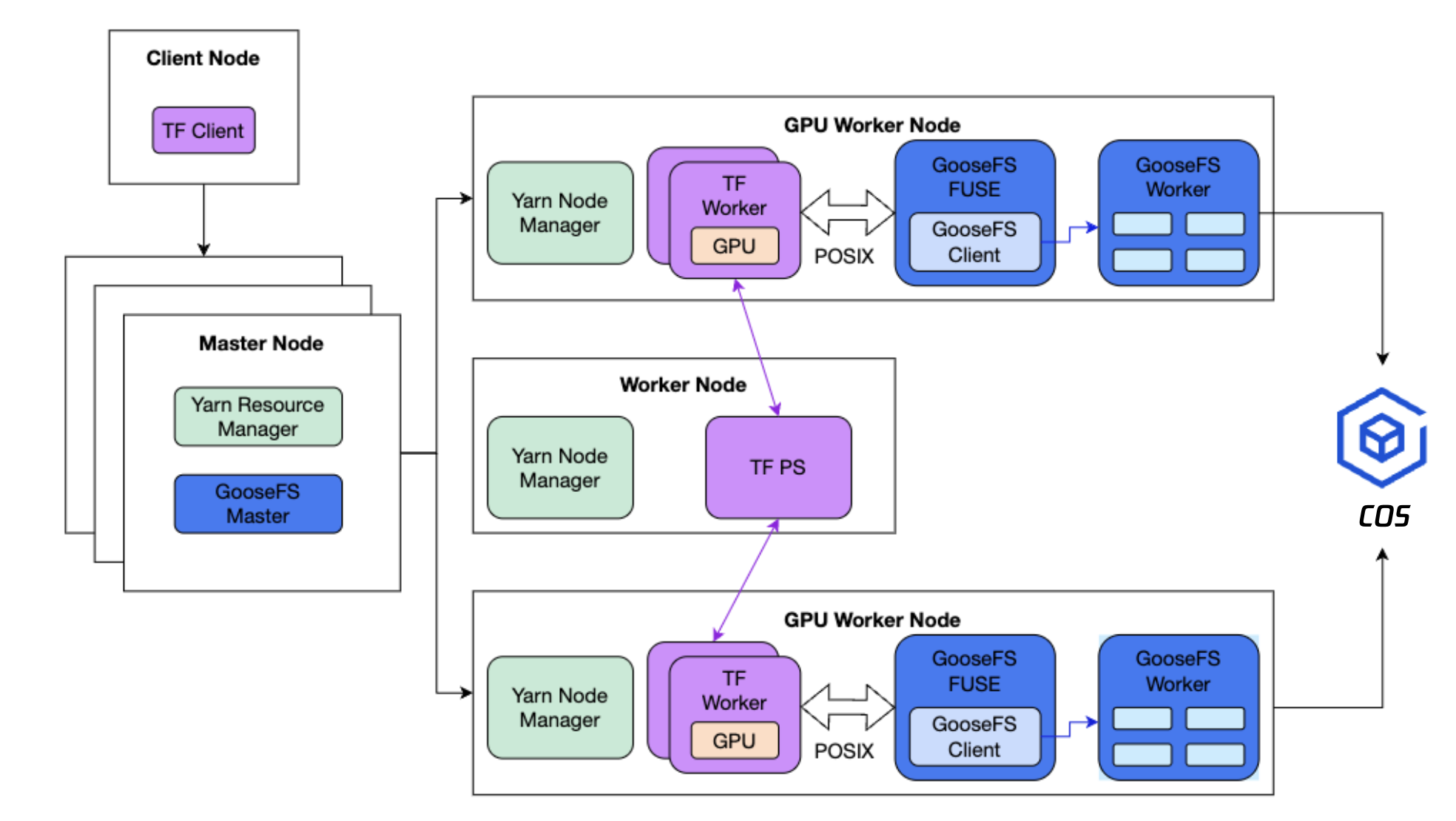
GooseFS uses a distributed storage architecture, with nodes divided into Master nodes and Worker nodes.
The Master node serves as the primary node, handling management of the entire file system, including assigning tasks to Worker nodes and storing metadata. To meet high availability requirements, it is typically equipped with 3 Master nodes—one as the Leader and the others on Standby.
The Worker node serves as the execution node, accepting tasks assigned by the Master node and performing data storage and computation work. Each GPU Worker Node deploys a GooseFS Worker.
Managed Mode Introduction
GooseFS has three management models: Fully Managed Hosting Mode, Master-Only Hosting Mode, and Management Plane Hosting Mode. The following introduces them one by one.
Fully Managed Hosting
Under the Fully Managed Hosting mode, users do not need to self-purchase Master nodes and Worker nodes. All nodes are hosted by Tencent Cloud. The Tencent Cloud team is responsible for the overall availability and stability of the cluster, ensuring users can focus on core business.
Master-Only Hosting
The Master-Only Hosting mode provides users with more convenience. In this mode, the Master node is hosted by Tencent Cloud, and the Tencent Cloud team is responsible for the availability and stability of the cluster. Users only need to purchase Worker nodes and add them to the cluster after creation.
Currently, the Master-Only Hosting mode offers three managed instance types.
Model
Overview
Meduim
Standard instance, suitable for scenarios with 100 million files
Large
High-performance instance type, suitable for scenarios with billions of files
XLarge
Flagship Instance Type, suitable for scenarios with billions of files
Management Plane Hosting
In Management Plane Hosting mode, users need to purchase Tencent Cloud virtual machine (CVM) instances as GooseFS Master nodes and Worker nodes, and deploy them to the designated cluster. Users can manage and configure the cluster and nodes through the GooseFS console to achieve efficient operation and maintenance.
Hybrid Cloud
In Hybrid Cloud Hosting mode, the Master nodes and Worker nodes are local IDC instances. Users need to register non-Tencent Cloud machines as Tencent Cloud hosted instances via Tencent Cloud Automation Tools (TAT). After completing instance registration, users can create a Management Plane Hosting, select Hybrid Cloud as the instance type, and host local IDC instances on the GooseFS management platform.
Specifications and Limits
Attribute
Fully Managed Hosting
Master-Only Hosting
Management Plane Hosting
Product Positioning
Provides advanced convenience, users do not need to purchase and manage any nodes, ALL work is handled by Tencent Cloud.
Provides a balanced solution that reduces user's operational burden while allowing users to flexibly expand storage resources as required.
Suitable for users with certain technical capabilities and resource allocation, requiring manual management and maintenance of GooseFS Master nodes and Worker nodes.
Applicable Scenario
Suitable for users who hope to reduce operational burden and focus on core business.
Suitable for users with high storage performance requirements but unwilling to invest excessive resources in cluster management.
Suitable for users with relatively high customization needs for the storage system or who want full control over the entire cluster.
throughput
200MB/s/TiB
Elastic scaling with the number of Worker nodes, supporting Tbps-level bandwidth.
Elastic scaling with the number of Worker nodes, supporting Tbps-level bandwidth.
OPS
Supports up to 200K
Medium model: 10W
Large model: 20W
XLarge model: 30W
Based on the customer's purchased CVM specification
Latency
sub-millisecond
sub-millisecond
Based on the customer's purchased CVM specification
Capacity
20TB-1000TB
Elastic scaling with the number of Worker nodes, supporting clusters up to hundreds of petabytes
Elastic scaling with the number of Worker nodes, supporting PB-level clusters.
number of files
Supports up to billion-scale
Model: SA2.MEDIUM2 Billion-scale
Large model: billion-scale
XLarge model: billion-scale
Based on the customer's purchased CVM specification