Mini Program Management
ダウンロード
フォーカスモード
フォントサイズ
Mini program list
Purpose
On this page, mini program developers can create or edit mini programs, view their release status, and remove them.
Roles and permissions
Feature | Role | Super admin | Platform admin | Mini program team admin | Senior mini program developer | Mini program developer | Mini program operator | Mini program release approver |
Mini program list | ✓ | ✓ | ✓ | ✓ | ✓ | ✓ | ✓ |
Create, edit, remove, and delete mini programs | Read-only | Read-only | ✓ | ✓ | - | - | - |
Super admins/platform admins: Have read-only access to the mini program list module. They cannot create, edit, remove, or delete mini programs.
Mini program team admins/senior mini program developers: Have full access to the mini program list module, including the permissions to create, edit, remove, and delete mini programs.
Mini program developers/mini program operators/mini program release approvers: Have view-only access to the mini program list module.
Key features
Create a mini program
On the mini program list page, click "Create mini program" to enter the mini program information page.
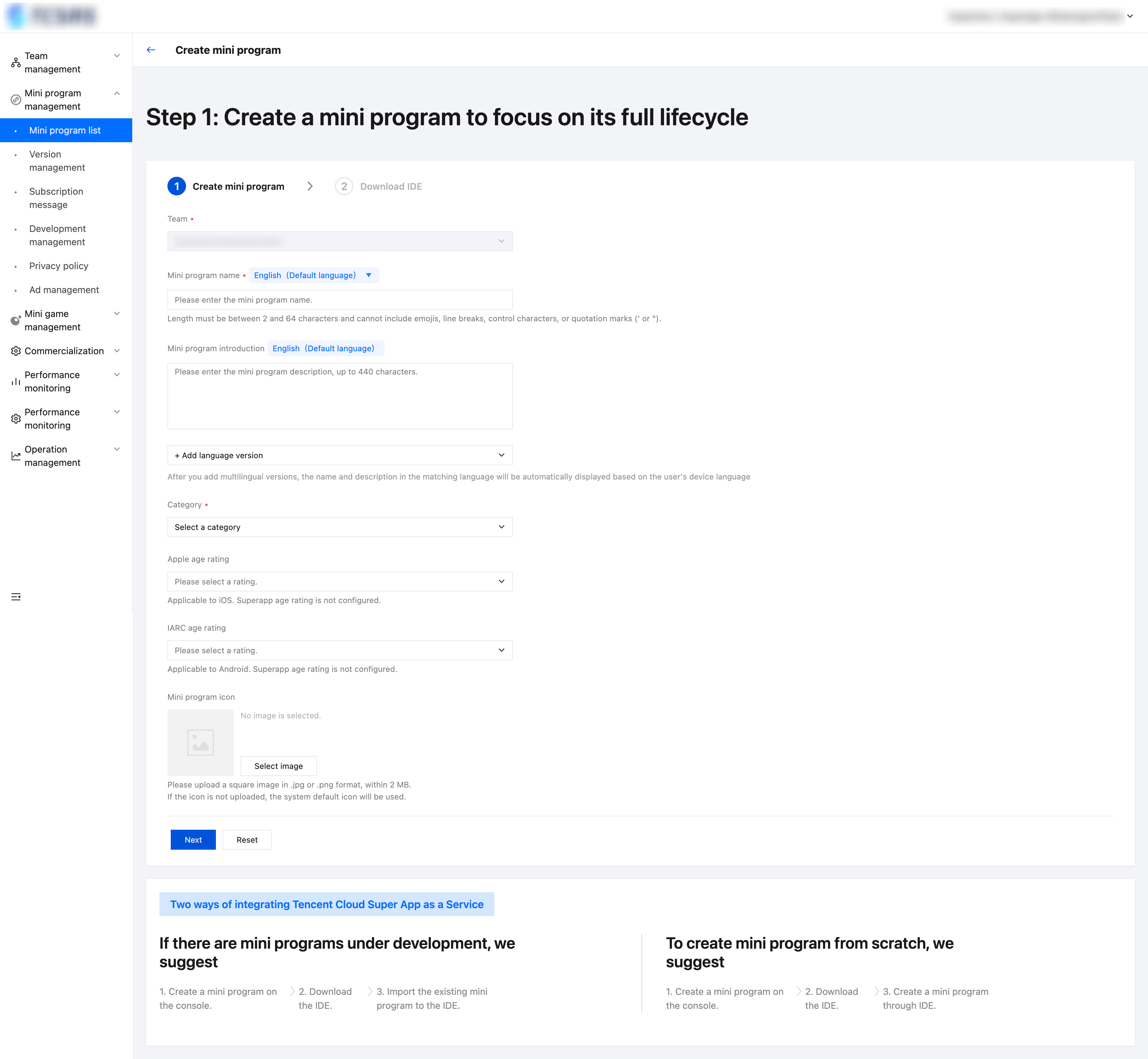
Field description
Field | Required | Validation rules/description |
Mini program name | Yes | Length must be between 2 and 64 characters and cannot include emojis, line breaks, control characters, or quotation marks (' or \\"). |
Mini program introduction | No | Up to 440 characters. |
Add language version | No | After you add multilingual versions, the name and description in the matching language will be automatically displayed based on the user's device language. |
Mini program category | Yes | Select a category for the mini program. |
Age rating | No | You can set the age rating for the mini program. Since the superapp is released in different app markets, there are two different age rating standards for iOS and Android. |
Mini program icon | No | Please upload a square image in .jpg or .png format, within 2 MB. If the icon is not uploaded, the system default icon will be used. |
Multi-language instructions
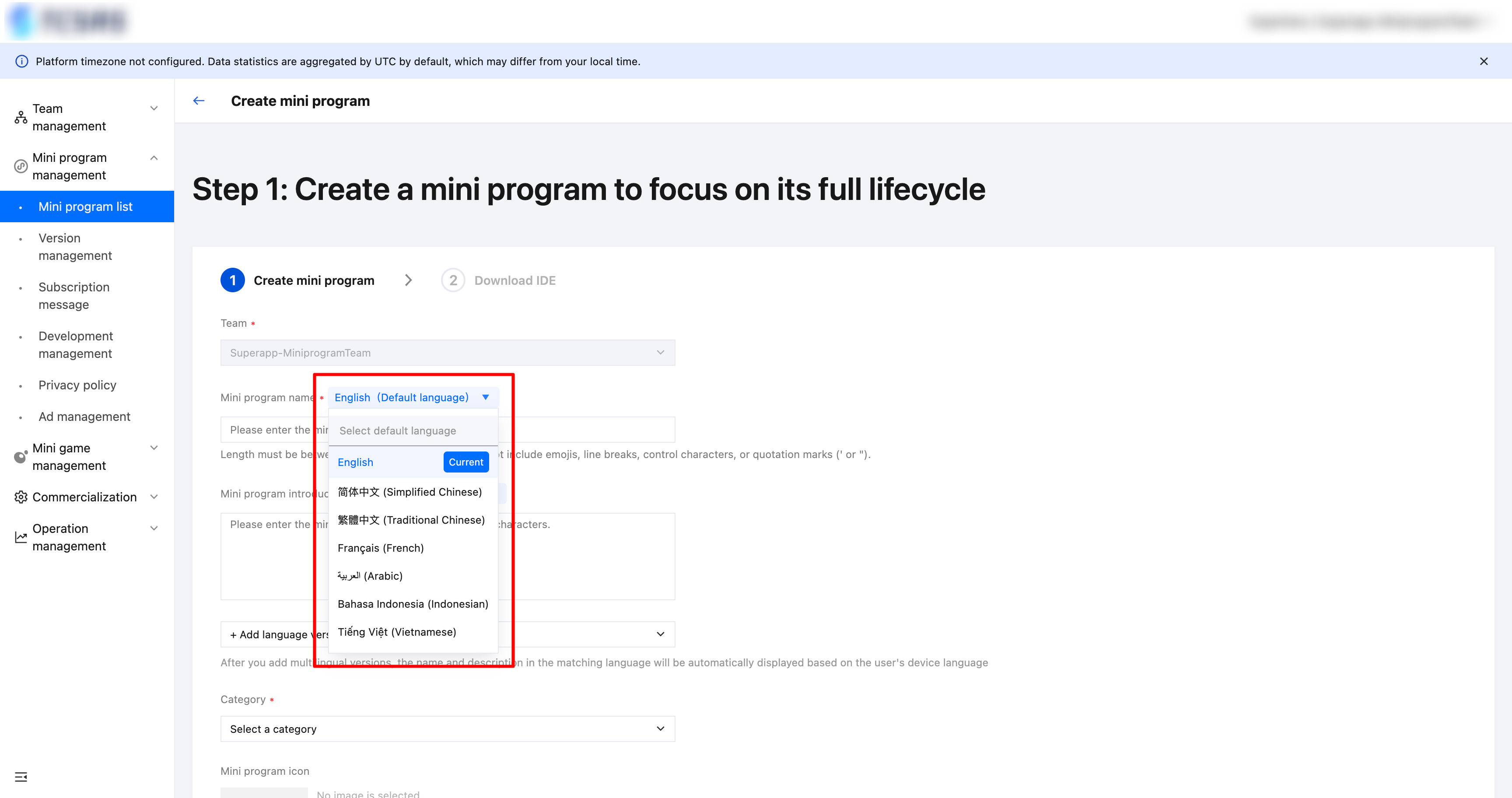
Default language
Click the item to the right of the mini program name: "Default language" drop-down list to switch the default language of the mini program. When querying or searching for a mini program, the superapp will return the default language if no specific language is requested or if the requested language has not been added to the mini program.
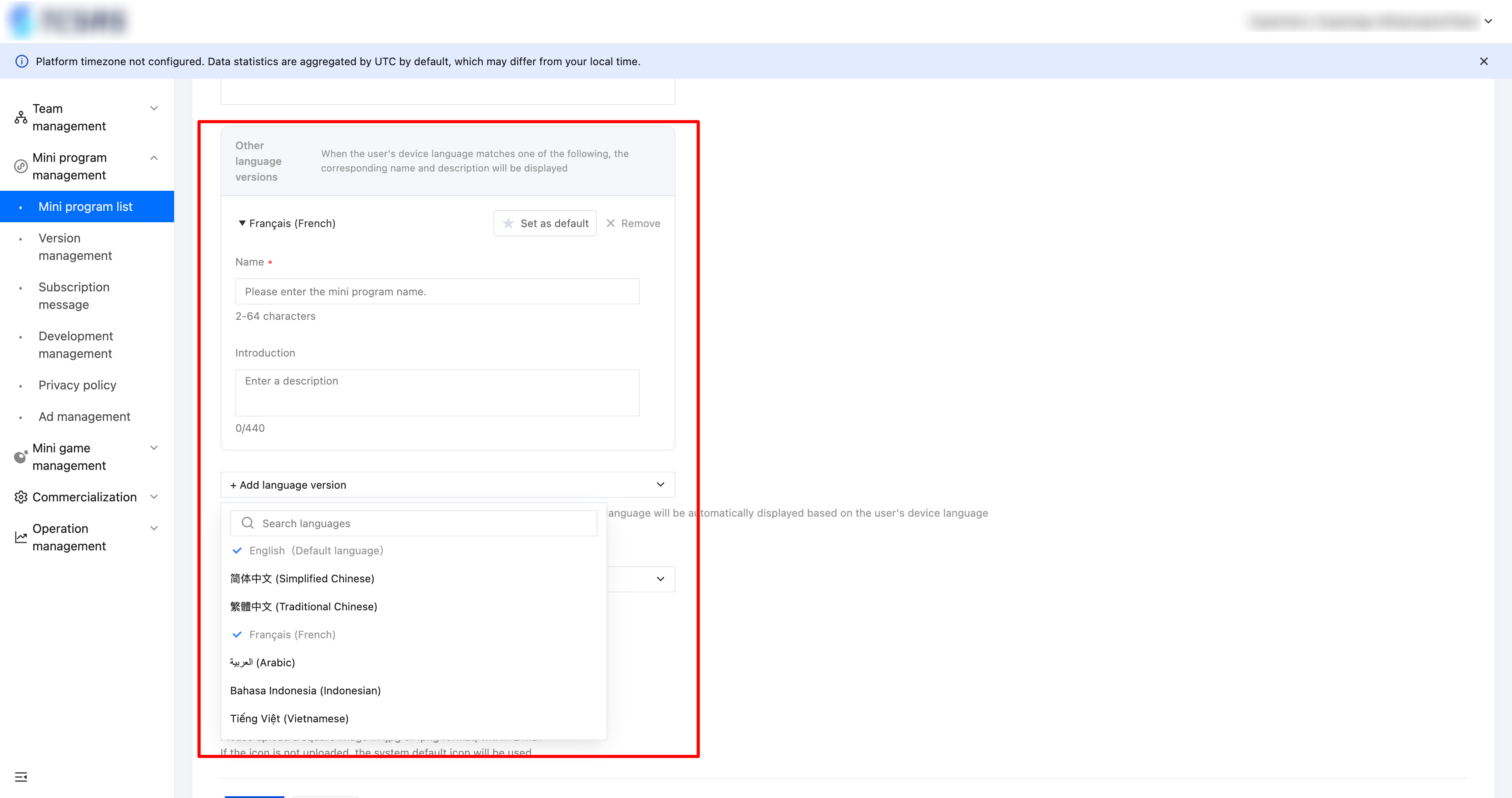
Add language version
You can add other language versions for the mini program besides the default language. When querying or searching for a mini program, the superapp can specify which language version to return.
Currently supported languages include: English, Simplified Chinese, Traditional Chinese, French, Arabic, Indonesian, and Vietnamese.
Other operations
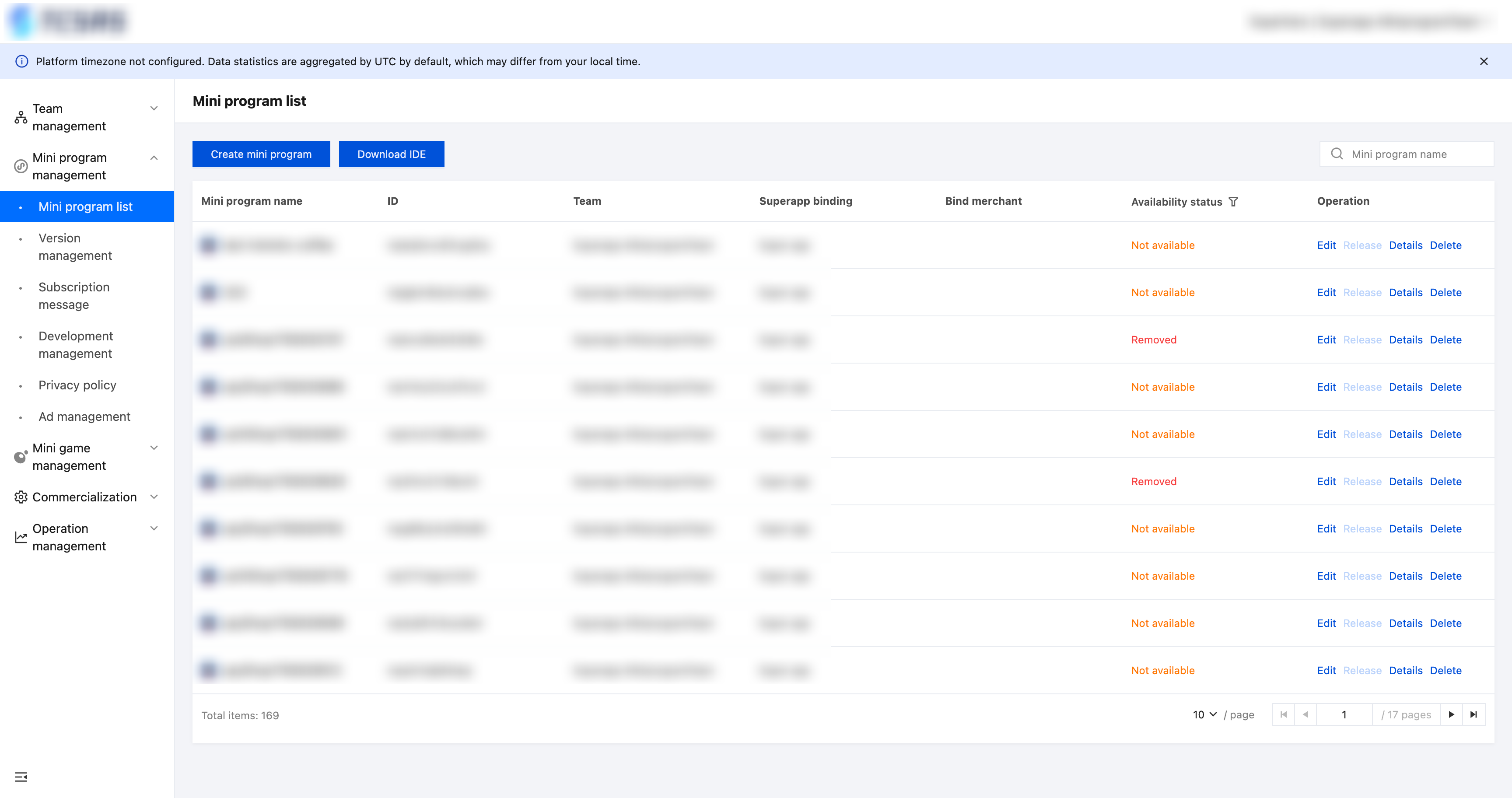
Filter: Use the filter box at the top to select the team and further filter the mini program list.
Edit: Authorized users can modify the basic description of the mini program.
Release/remove: Release or remove a mini program. Once a mini program is removed, its services will no longer be available on the superapp, and no new versions can be released. However, you can still submit versions for approval.
Details: Authorized users can view the mini program appid (please keep it properly), and download the latest version of the IDE.
Version management
Purpose
Mini program developers can manage the release of mini program versions.Please note that releases made here will take effect on the superapp bound to the mini program.
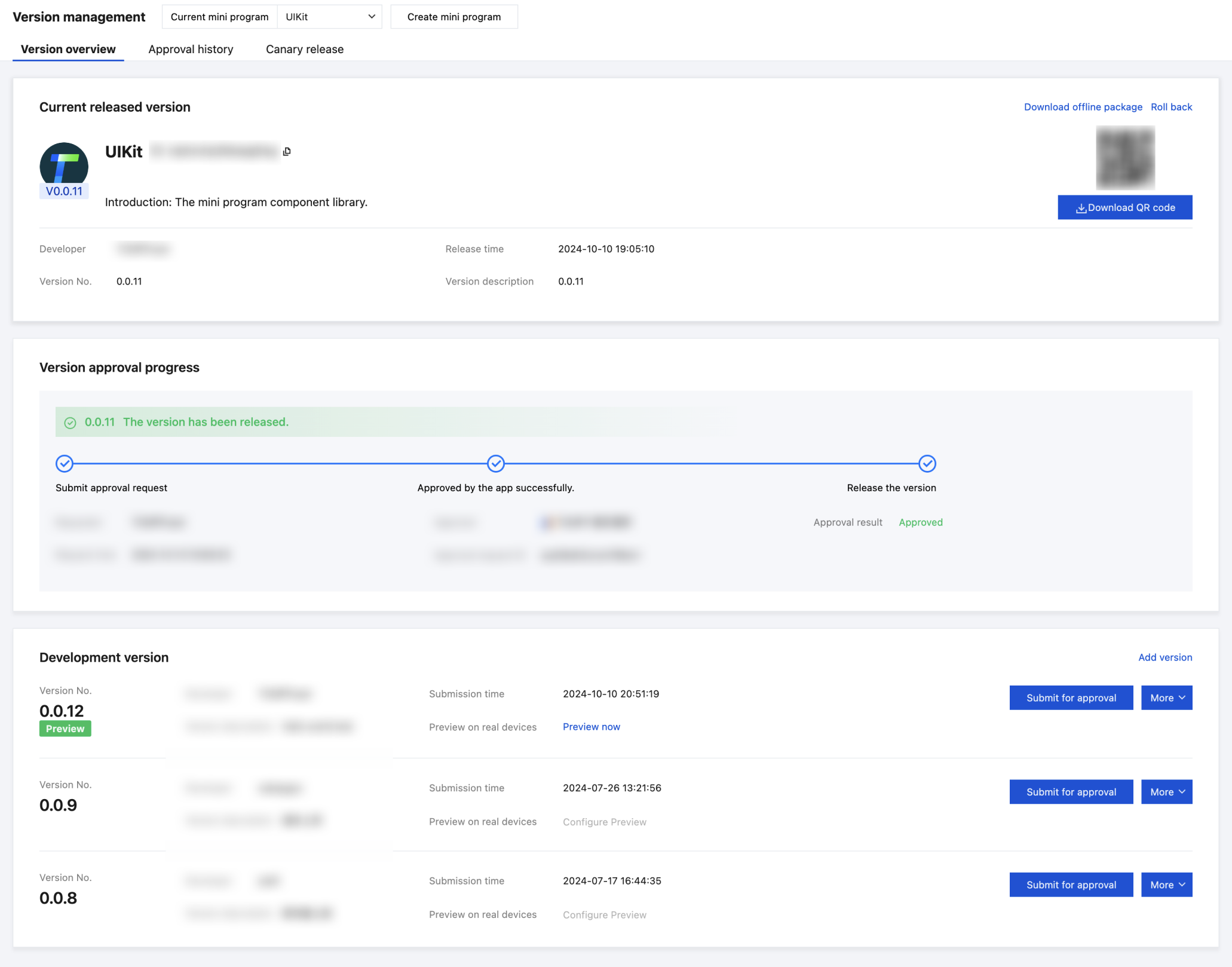
Specific operations
Create mini program: Authorized users can create mini programs, and the code resources will belong to the user's team.
Filter: Use the filter box at the top to select the team and further filter the mini program list.
Version overview: Display the current released version, version approval progress, and development version information of the mini program.
Approval history: Display the approval records for the release of mini program versions.
Release: Authorized users can release the versions of mini programs after the release is approved.
Version rollback: Roll back the released version of the mini program to a previously released version. Continuous rollback is not supported.
New version: Upload the code package generated by IDE for new version release.
Submit for approval: Submit the current development version to superapp admin for approval.
Configure the preview: Configure the opening page of the mini program using relative paths.
Roles and permissions
Feature | Role | Super admin | Platform admin | Mini program team admin | Senior mini program developer | Mini program developer | Mini program operator | Mini program release approver |
Submit mini program code/code package | Read-only | Read-only | ✓ | ✓ | ✓ | - | - |
Submit the version for approval | Read-only | Read-only | ✓ | ✓ | - | - | ✓ |
Mini program preview | Read-only | Read-only | ✓ | ✓ | ✓ | ✓ | ✓ |
Canary release | Read-only | Read-only | ✓ | ✓ | - | - | - |
Mini program release | Read-only | Read-only | ✓ | ✓ | - | - | ✓ |
Delete a development version | - | - | ✓ | ✓ | ✓ | - | - |
Super administrator/platform administrator: Has read-only permissions for the version management module and cannot delete development versions.
Mini program team administrator/mini program senior developer: Has permissions for the version management module, including Submit mini program code/code package, Submit the version for approval, Mini program preview, Canary release, Release mini program, and Delete a development version.
Mini program developer: Has permissions for the version management module, including Submit mini program code/code package, Mini program preview, and Delete a development version.
Mini program operator: Has permissions for the version management module, including Mini program preview.
Mini program release approver: Has permissions for the version management module, including Submit the version for approval, Mini program preview, and Mini program release.
Canary release
Developers can perform a canary release of a mini program to a subset of users before officially releasing a new version. Go to the console, navigate to "Version management" > "Canary release" , and click"Create canary release task".
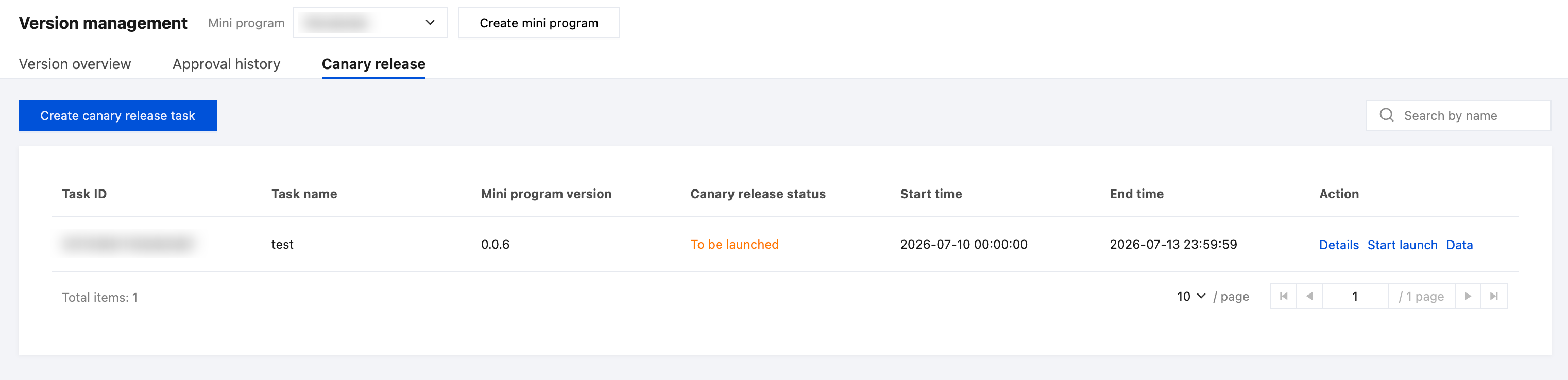
Canary release task settings
Canary release version: The canary release version must beapproved, not yet released, and the version must be later than the released version.
Canary release task name: Fill in the name of the canary release task with up to 20 characters.
Canary release time: Select the start and end time for the canary release task. The end time cannot be earlier than the creation time of the canary release task.
Canary release limit: Set a limit on the total number of users for the canary release.
Applicable platform: Choose between Android and iOS platforms, and specify the start and end version numbers for each.
Target users: Set filters for target users of the canary release versions. Currently, three conditions are supported: GUID, custom device ID, and user account. Developers can manually enter the target user information or batch upload target user allowlist in a .txt file.
Networking: Choose whether to pull the canary release version in WiFi environment.
Note:
Multiple canary conditions are intersected; once one condition limit is reached, the canary release will stop.
Canary release task management
In the canary release task list, multiple canary release tasks are sorted from latest to earliest based on the creation time. The status of a canary release task includes: Pending, In progress, Paused, and Completed. The status flow is shown in the following figure:
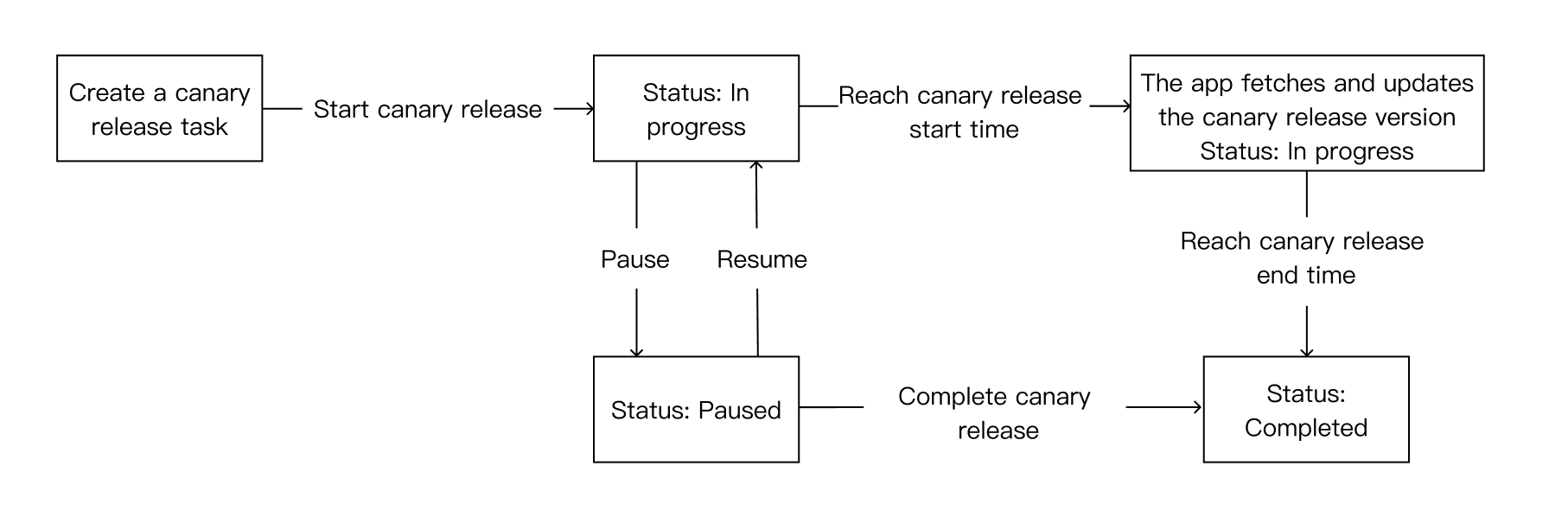
Click "Canary release progress" to view the current status of the canary release task.
Note:
When a mini program version is officially released, any canary tasks with the same or lower version number will automatically end, and all users will be updated to the latest version.
Development management
Purpose
Provides mini program developers with domain settings, sensitive API permission requests, and real-time log query.
Features
Domain settings
Add domain: A communication domain name is required to be preset for communication with the mini program, including ordinary HTTPS request (wx.request), file uploading (wx.uploadFile), file downloading (wx.downloadFile), and WebSocket communication (wx.connectSocket). Embedding webpages in a mini program is supported (H5 page) to facilitate flexible configuration of the mini program.
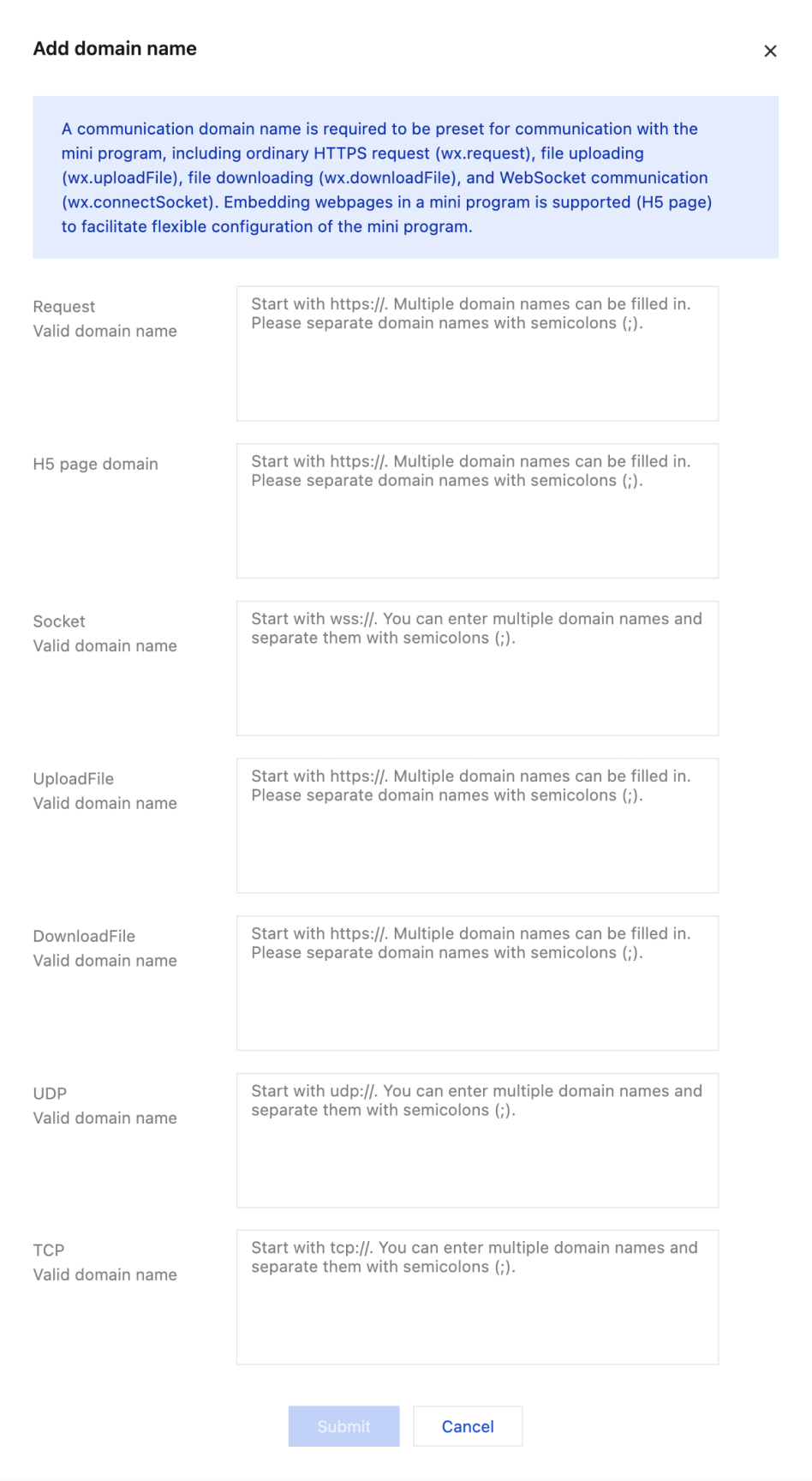
Skip domain verification
If the mini program’s domain configuration is inconvenient or changes frequently, the developer can request to skip domain verification. Once approved, the mini program can initiate network requests to its server without configuring the domain name in the console.
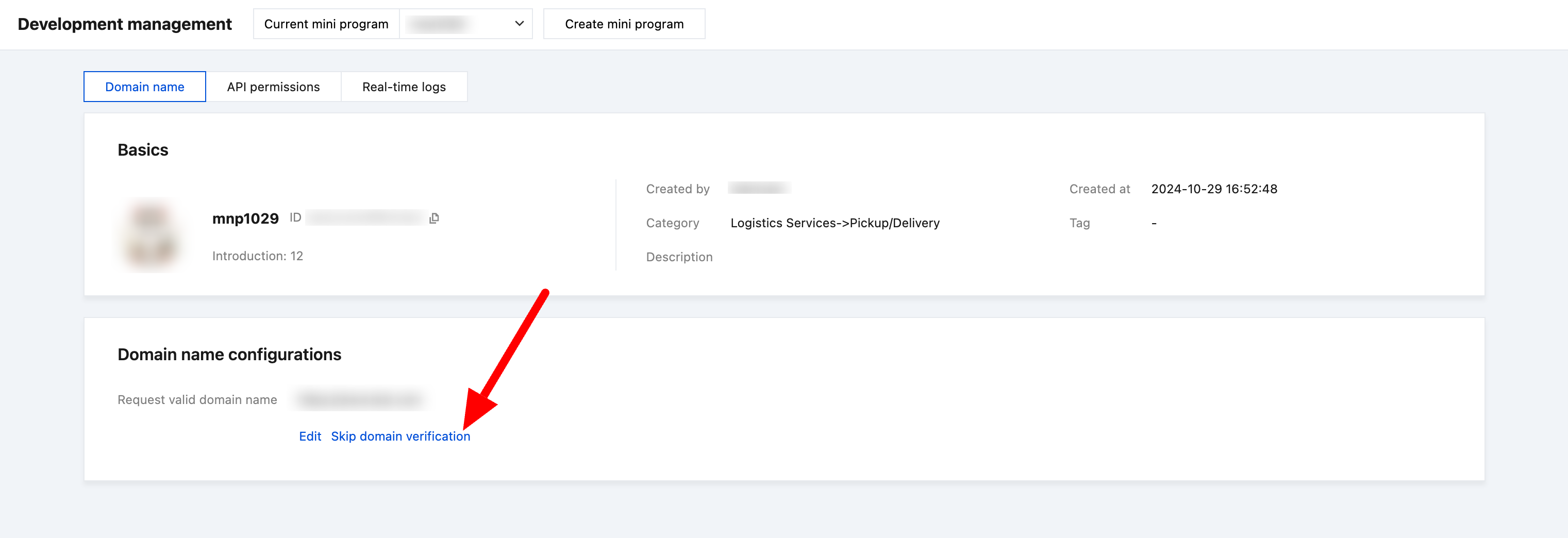
Note:
The mini program must comply with the Security Agreement on Skipping Domain Verification, and the service requests must not contain any malicious code, viruses, or other content that may harm user devices or data.
API permissions
When sensitive APIs are enabled on the superapp bound to the mini program, mini program developers must apply to the superapp for permission to use them. The mini program can only access these APIs after approval from the superapp's administrator or approvers.
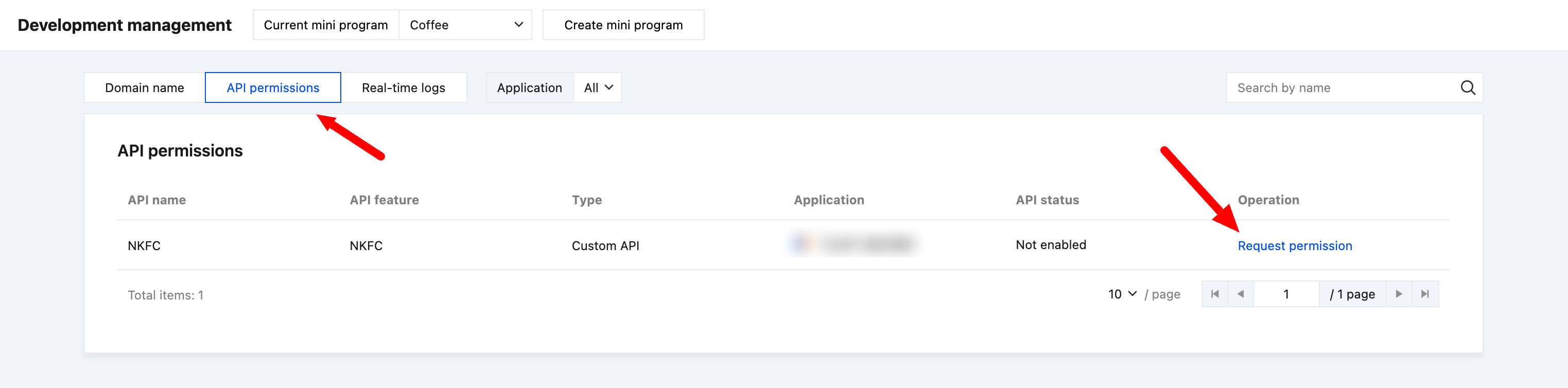
Specific operations:
Request permissions: Mini program developers apply to the superapp for permission to use the sensitive APIs.
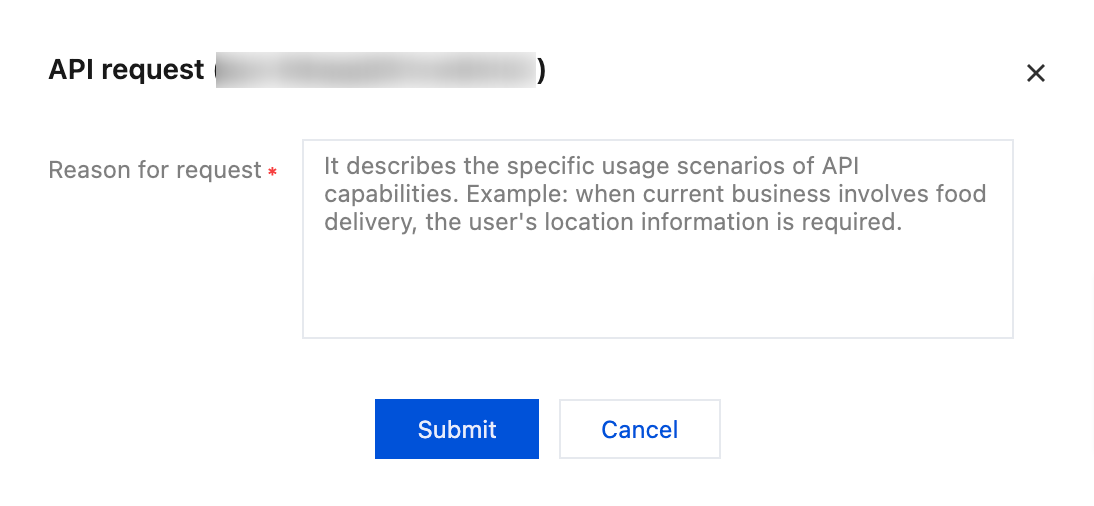
Real-time logs
Filters: Time, log level (All, info and above, Warn and above, Error and above), system type, GUID, page link, filterMsg content, base library version, and client version.
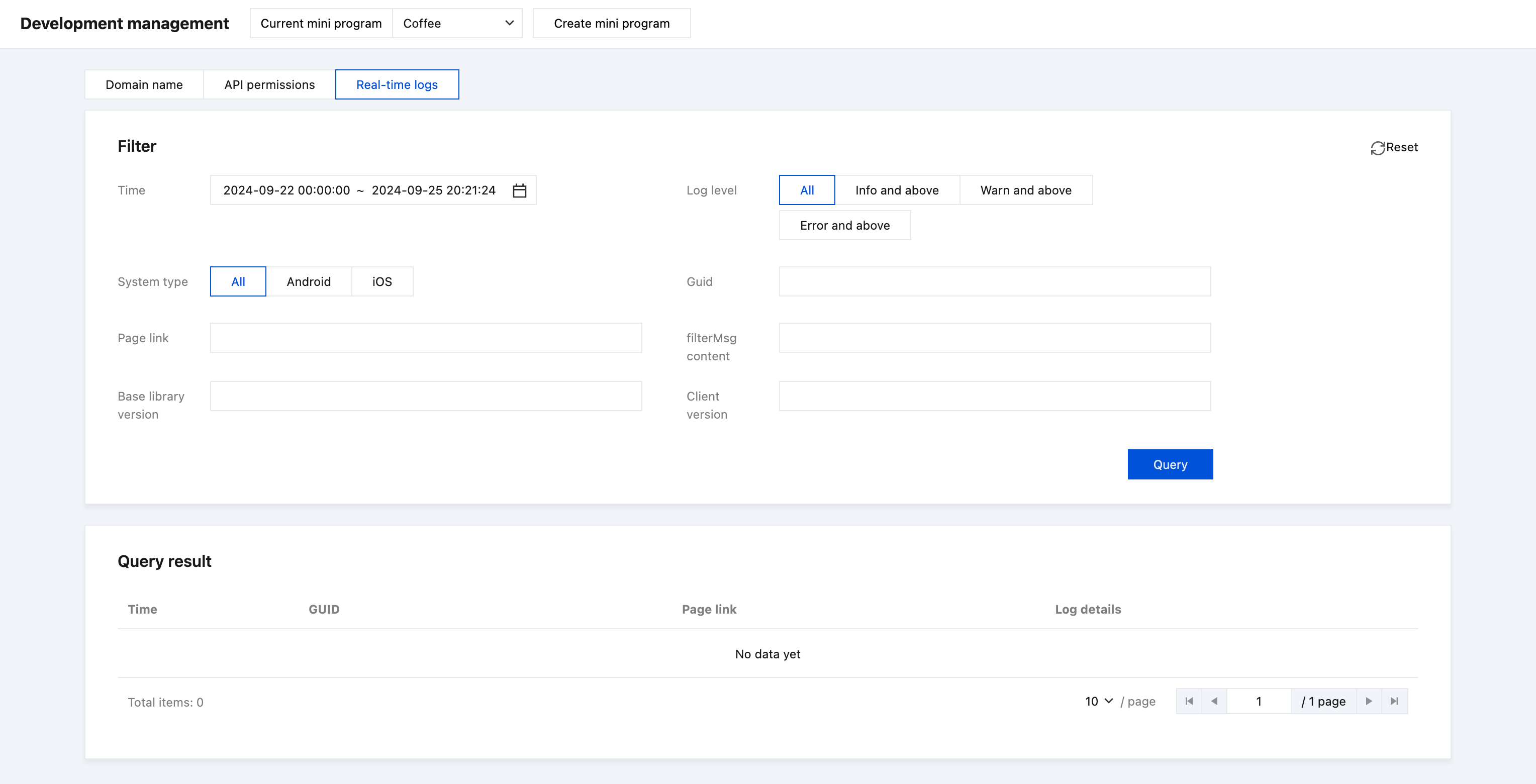
Basic configuration
AppSecret
AppSecret (the mini program key) is essential for authentication in important processes such as mini program login and payments. Only mini program team administrators have the authority to view and manage the keys. They can generate, reset, and freeze keys in the key management section.
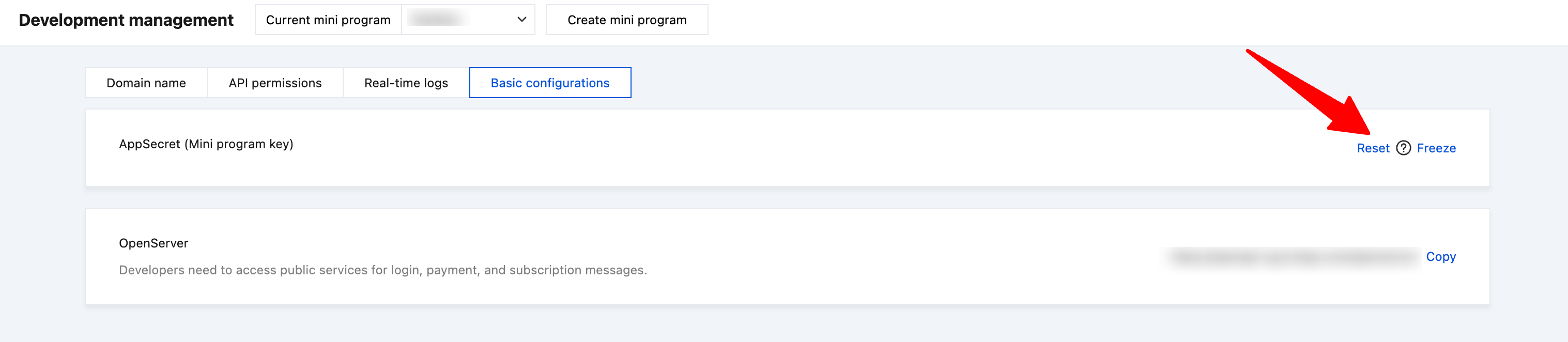
Specific operations:
Generate
After clicking "Generate," the mini program team admin needs to copy the key and securely save the key. Once the popup is closed, the key cannot be copied again. If the key is forgotten, it must be reset. The platform does not display or save the key in plain text.
Reset
The mini program team admin can reset the key. After you confirm to reset the AppSecret, the mini program features using the original AppSecret cannot work properly, so please update it promptly.
Freeze
To ensure the mini program service's security, if the key is leaked or suspected to be leaked and has not yet been replaced, developers should freeze the key to prevent any security incidents.
The mini program team admin can click "Freeze" to freeze the key. After that, the mini program features using the original AppSecret will not work properly, so please update it promptly.
OpenServer
OpenServer is the public service domain that developers need to access when integrating features such as login, payment, and subscription messages.

Roles and permissions
Feature | Role | Super admin | Platform admin | Mini program team admin | Senior mini program developer | Mini program developer |
Domain settings | Read-only | Read-only | ✓ | ✓ | - |
API permissions (sensitive APIs) application | Read-only | Read-only | ✓ | ✓ | - |
Real-time logs | Read-only | Read-only | ✓ | ✓ | ✓ |
Key management | Read-only | Read-only | ✓ | - | - |
Super admin/platform admin: Has read-only permissions for the development management module.
Mini program team administrators: Have permissions for the development management module, including Domain settings, API permissions (sensitive APIs) application, Real-time logs, and Key management.
Mini program senior developers: Have permissions for the development management module, including Domain settings, API permissions (sensitive APIs) application, and Real-time logs.
Mini program developers: Have permissions for the development management module, including Real-time logs.
Subscription message
Introduction
Messaging is a core mini program feature. The superapp provides subscription messages to help developers build closed-loop services and push timely business updates to users. To use this feature, go to the console, select "Mini program management," and "Message subscription." Then, pick suitable templates from the public library, configure the fields, and add them to "My templates."
Roles and permissions
Feature | Role | Super admin | Platform admin | Mini program team admin | Senior mini program developer | Mini program developer |
My templates - View | Read-only | Read-only | ✓ | ✓ | ✓ |
My templates - Delete | - | - | ✓ | ✓ | - |
Public template library - View | Read-only | Read-only | ✓ | ✓ | ✓ |
Public template library - Select | - | - | ✓ | ✓ | - |
Super administrators/platform administrators/mini program developers: Have read-only permissions for the subscription messages module, including view permissions for My templates and the Public template library.
Mini program team administrators/mini program senior developers: Have permissions for the subscription messages module, including view and delete permissions for My templates, and view and select permissions for the Public template library.
Mini program developers: Have permissions for the subscription messages module, including view permissions for My templates and the Public template library.
Console operations
Public template library
Developers can browse the public template library and select templates based on their business needs. Templates can also be searched by name.
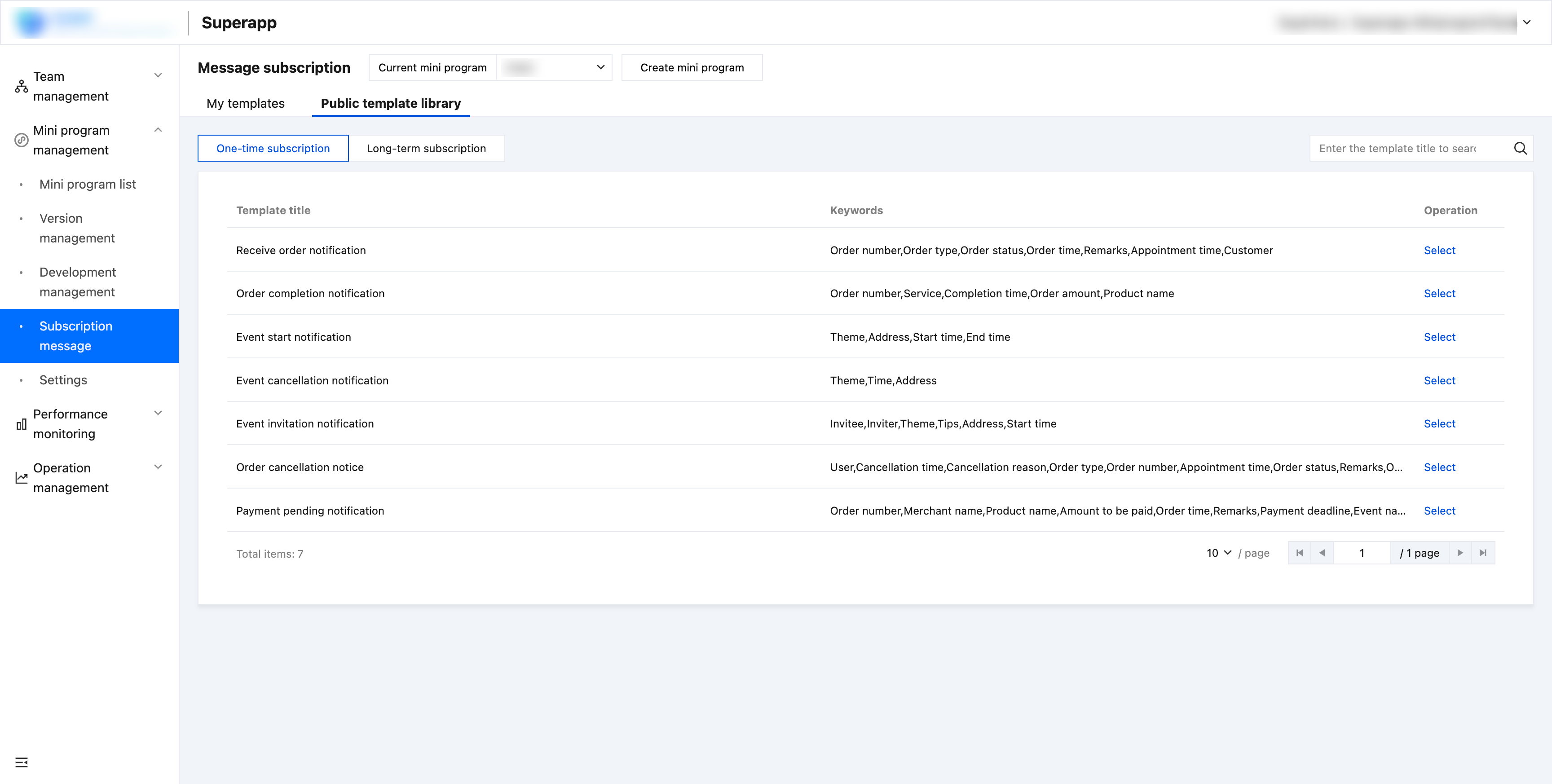
Subscription types
One-time subscription
One-time subscription messages notify users about follow-up service steps after using the mini program.
When developers call the requestSubscribeMessage, a popup lets users opt-in to receive messages. Once subscribed, developers can send one service message at any time.
Long-term subscription
While one-time subscriptions meet most service needs within mini programs, there are scenarios, especially in public services, where one-time subscriptions are insufficient. For example, flight delays require multiple real-time updates. To address this, we offer long-term subscription. After a user subscribes once, developers can send multiple messages over time. Long-term subscription is suitable for public services such as government, civil services, healthcare, transportation, finance, and education.
Note:
Note that while long-term subscription allows multiple messages to be sent, frequent messaging can be disruptive to users. Therefore, the platform limits each long-term subscription template to a maximum of 5 messages per day.
Template selection
In the public template library, find the target template and click "Select" to enter the template configuration page. There are multiple keywords under each public template. Developers can select 1 to 5 keywords from the keyword list. Refer to the preview on the left for the pop-up content displayed to users on the superapp. Drag and drop the sorting button on the right side of the selected keywords to arrange their orders.
Click "Submit" to save the template to "My templates."
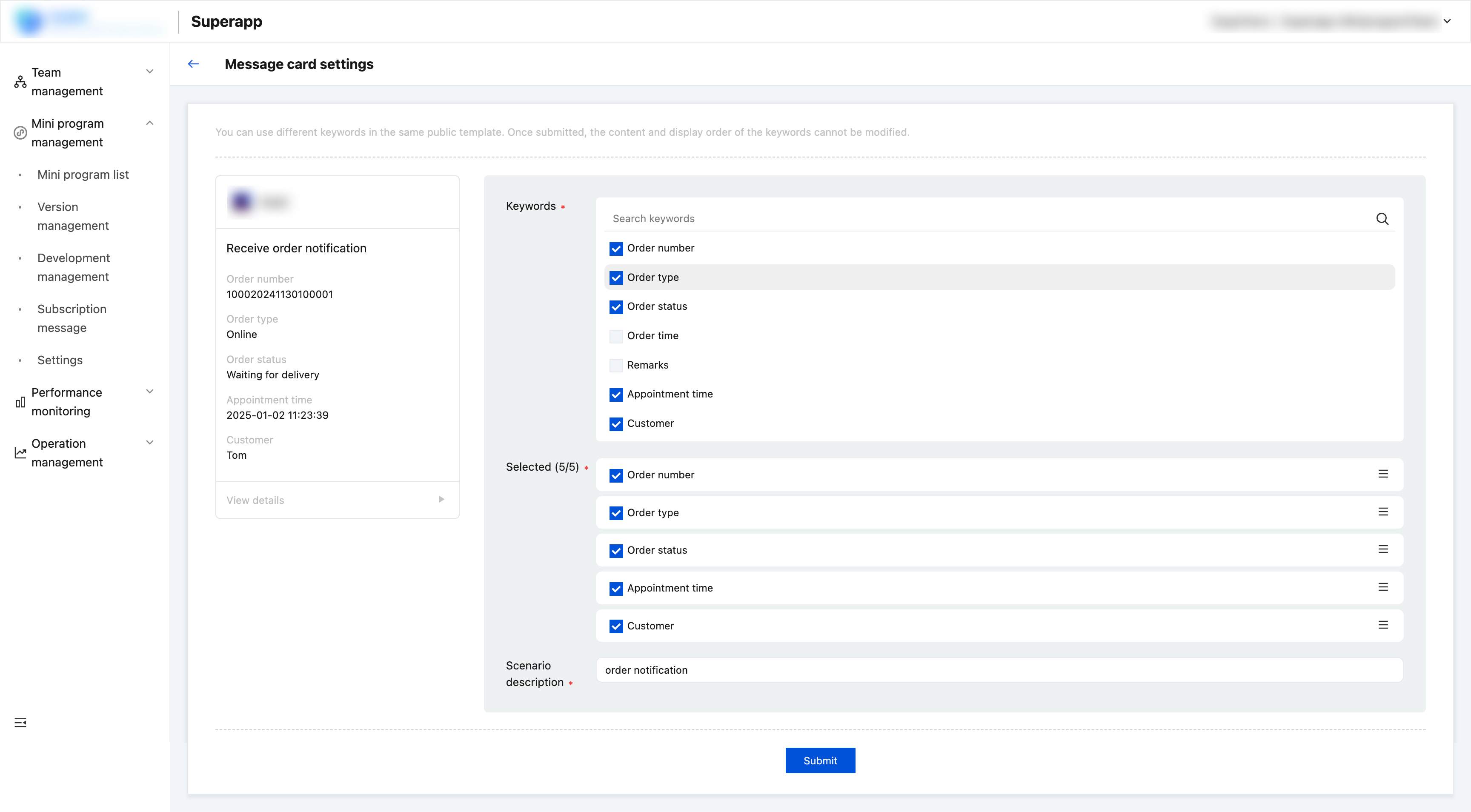
Notes:
If a same public template is added to "My templates," the keywords in the template cannot be the same as those in the already added templates.
My templates
Templates selected and configured from the public template library will be added to My templates. Developers can use these templates to develop the message subscription feature.
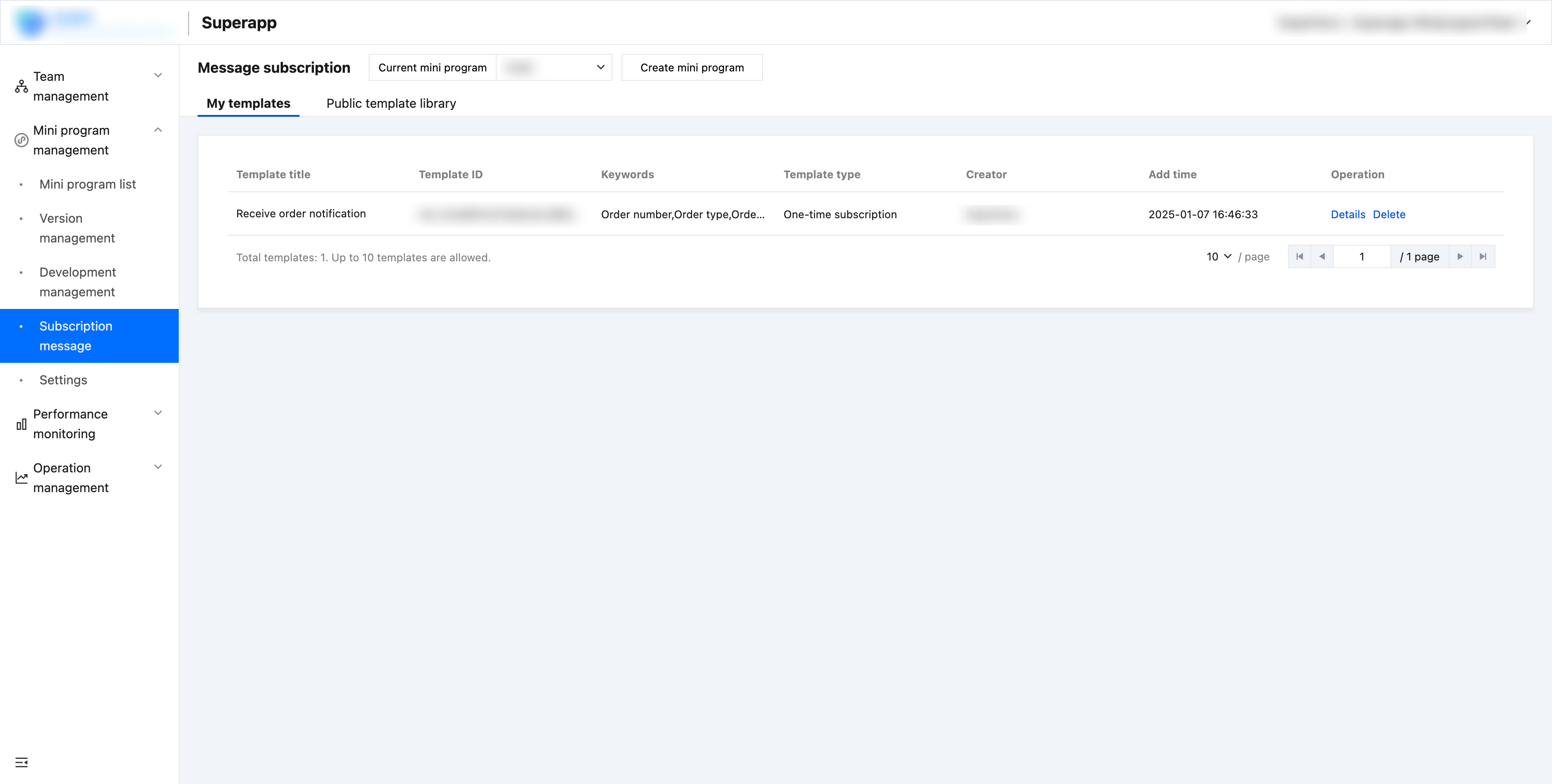
Note:
One-time template IDs and long-term template IDs cannot be used simultaneously.
Up to three messages can be subscribed to in a single call.
The subscription message page can only be triggered after the user has performed a click action.
In a single authorization call, each tmplId corresponding to a template title must be unique; if duplicates are found, only one will be retained.
Privacy agreement
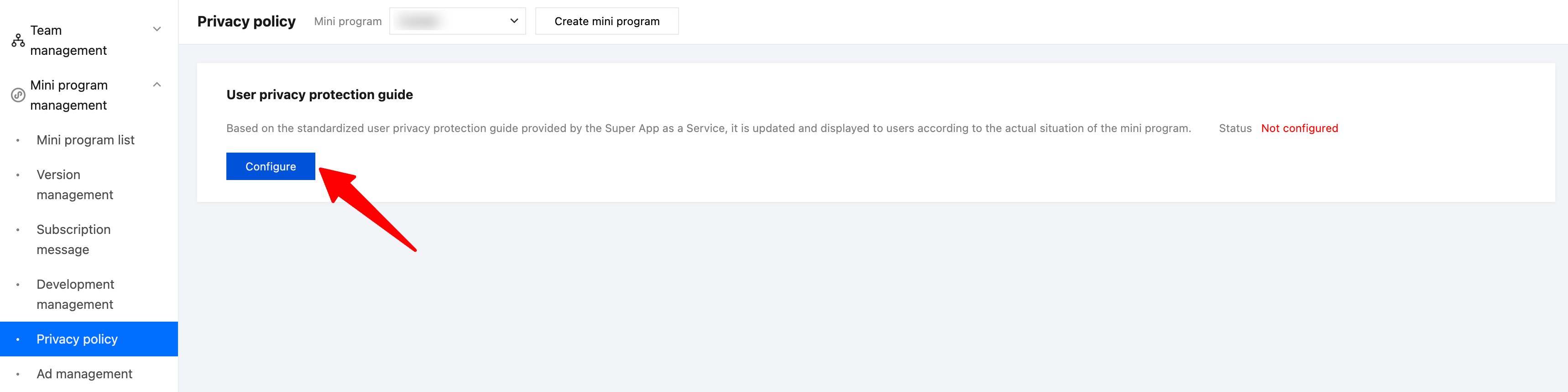
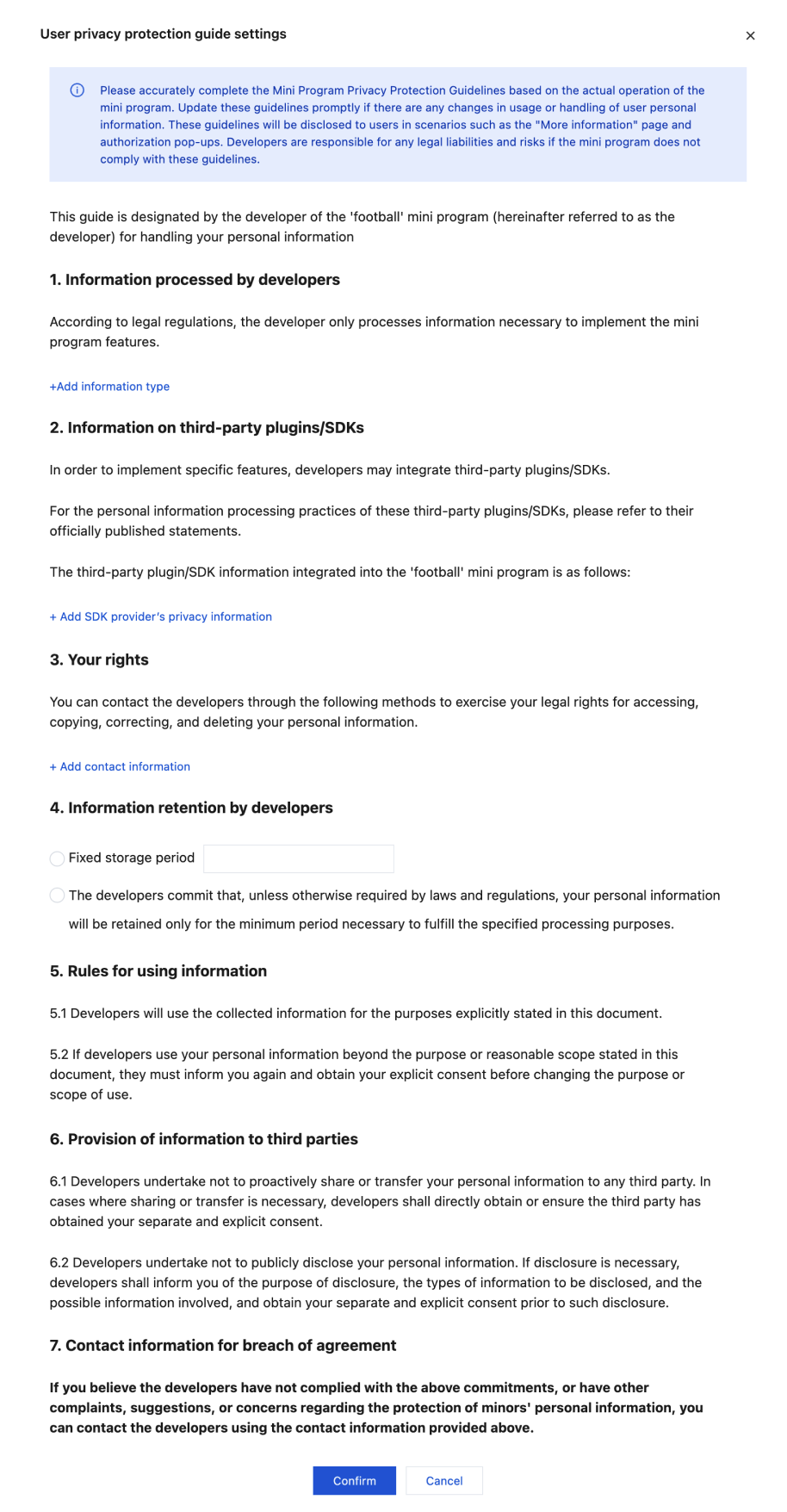
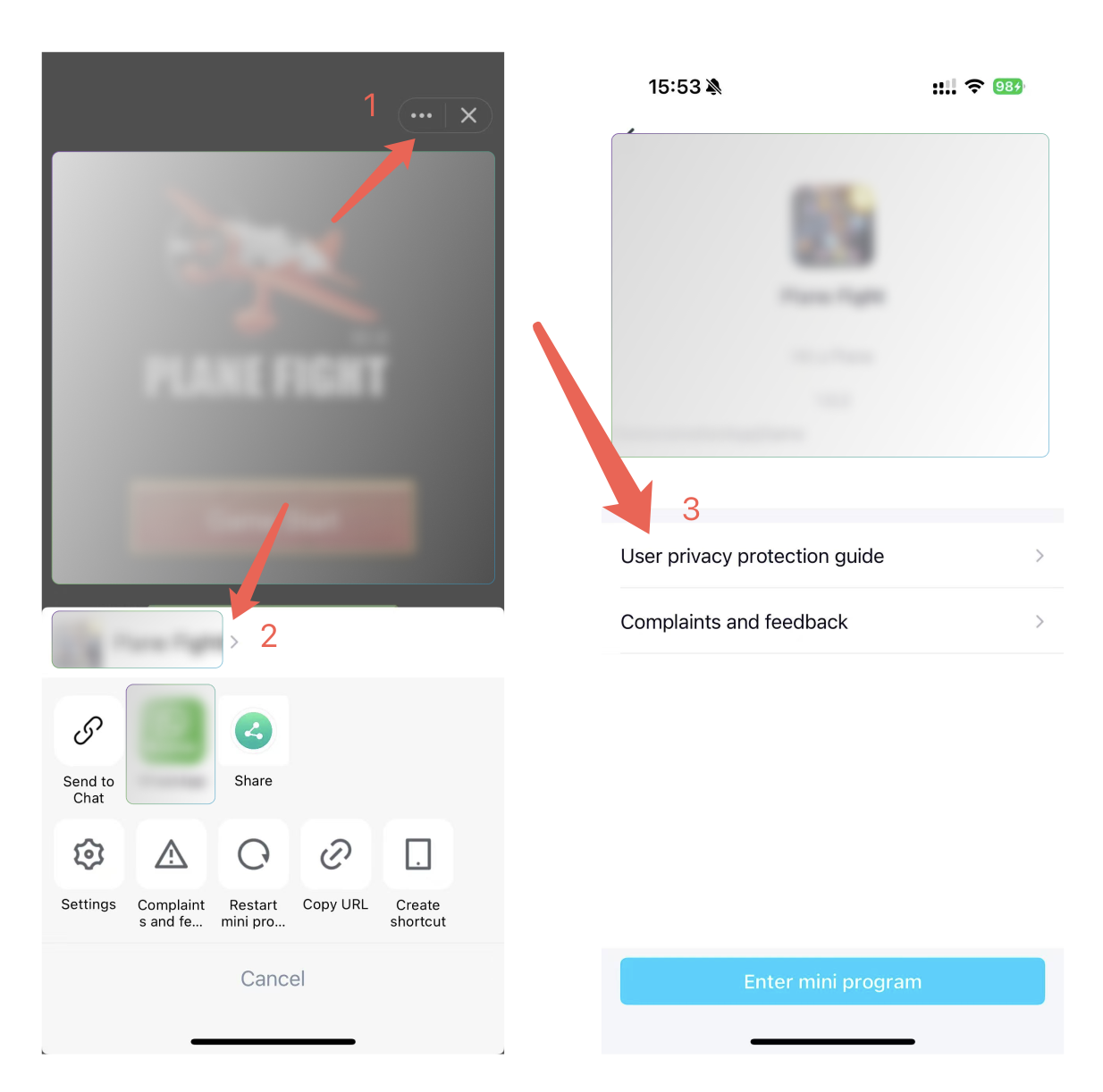
To configure the user privacy agreement in the settings, you can use the provided template to specify the personal privacy data collected by the mini program, and save it to generate the user privacy agreement for the mini program.
1. Click "Configure."
2. Fill in the privacy information.
After saving, you can view the generated policy in"More" > "Mini program details."
Offline mini program
Feature description
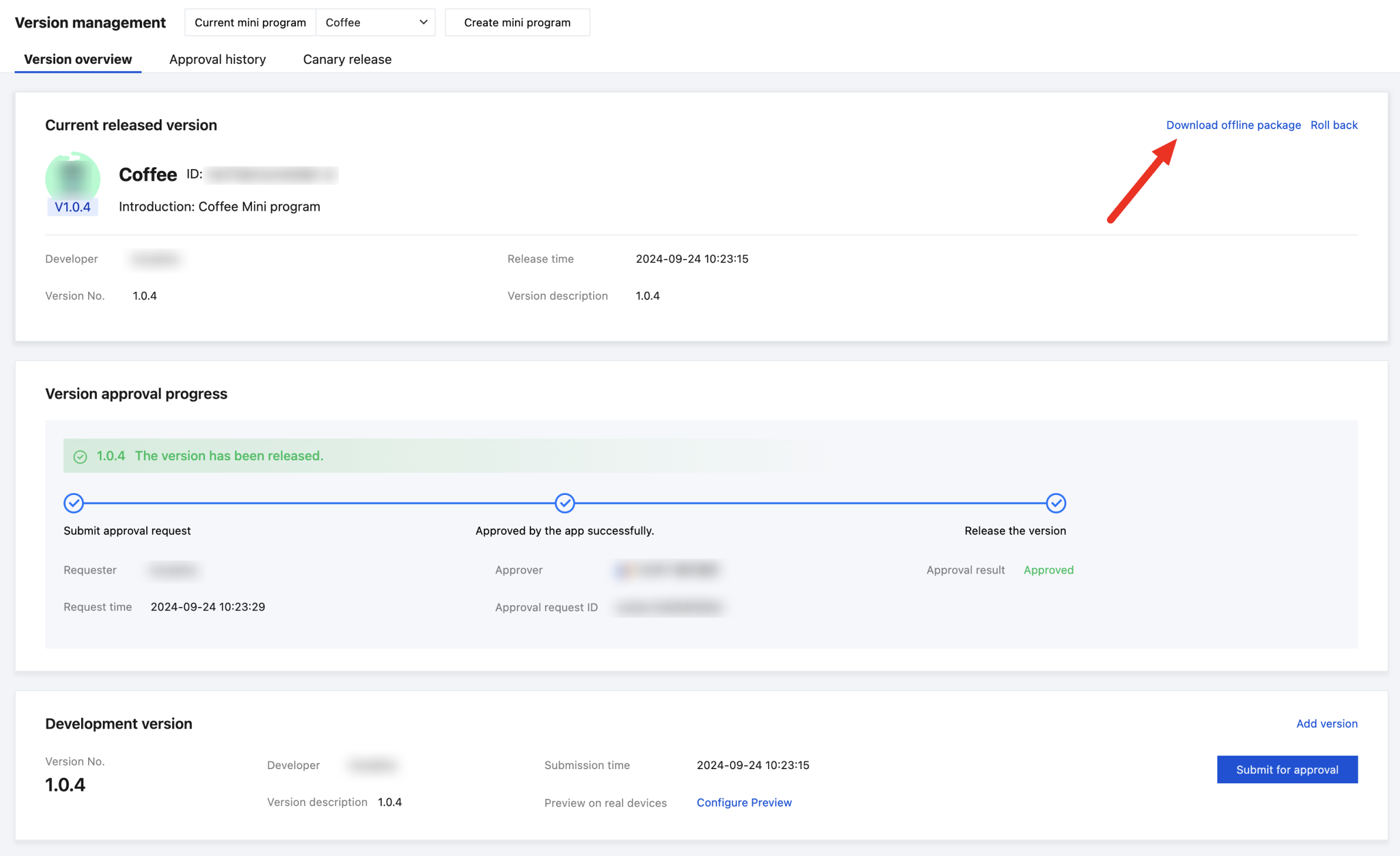
Offline mini programs are built in the superapp. Developers need to download the mini program package from the console and import it into the superapp project, where it gets packaged with the superapp. Users can open and run these mini programs without needing to download them from the backend, even without an internet connection.
Specific operations
1. Download the mini program that need to be preset from the console.
2. Copy the downloaded mini program package to a custom assets directory. Note that the offline mini programs must strictly follow naming rule and cannot be modified arbitrarily.
Note:
Naming rule for offline mini programs: {miniAppId}_{miniAppVersion}.apkg
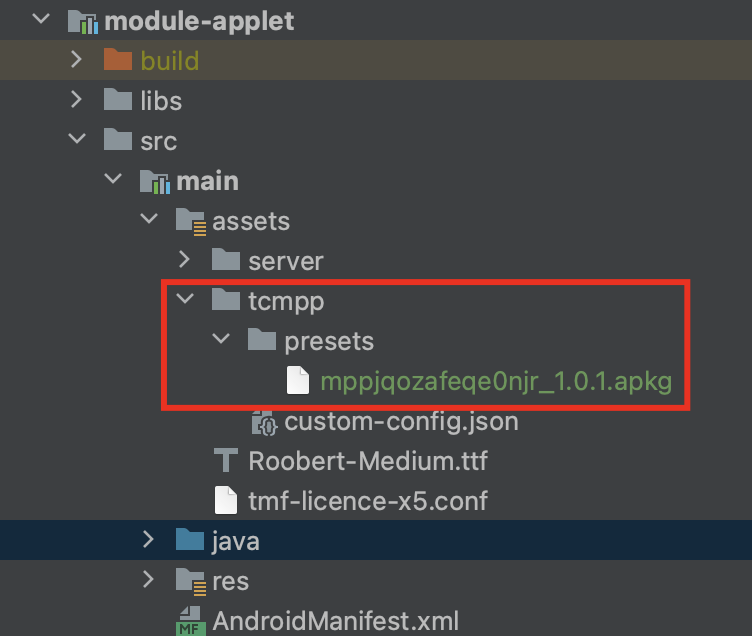
3. Specify the asset directory where the offline mini program is placed in the SDK initialization configuration.
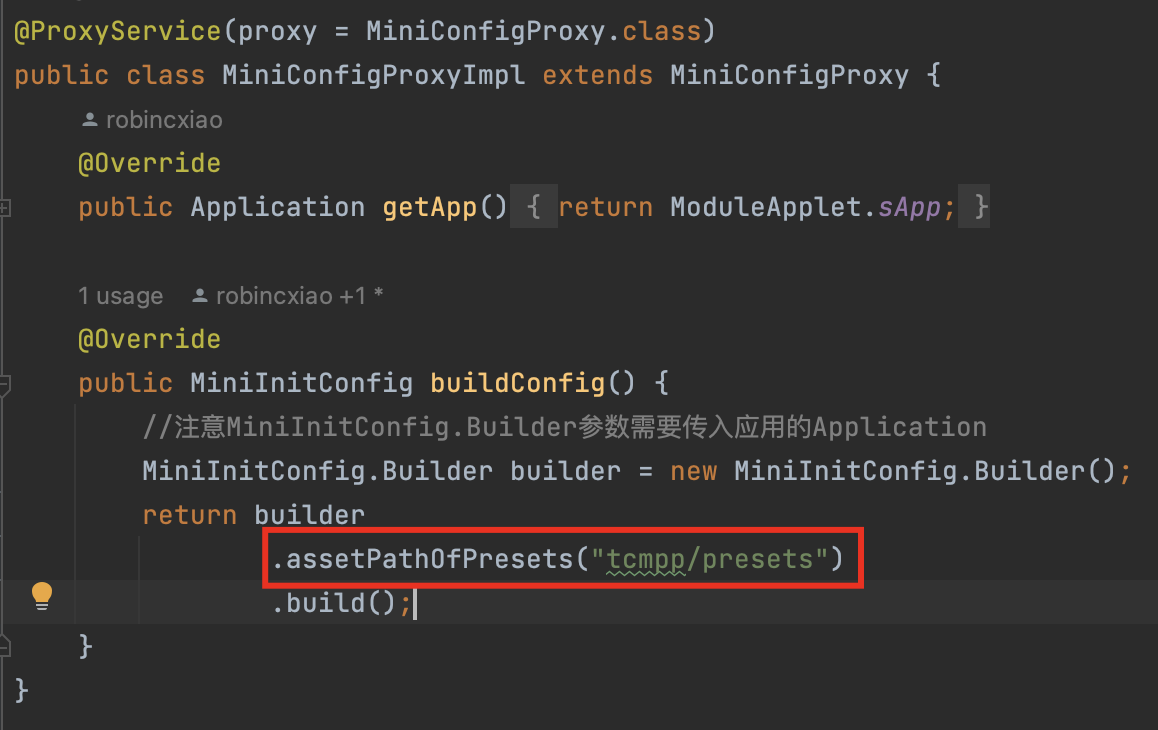
Note
Offline mini programs must go through the standard release process. Only offline packages of released mini programs can be downloaded.
Version management such as new version release, version rollback, and removal are applicable to offline mini programs. When the released version is inconsistent with the preset version, the client will fetch the released version.
The offline mini program preset in the superapp doesn't work when the corresponding mini program is removed.
フィードバック