tencent cloud

Elastic MapReduce

  • Release Notes and Announcements
  • Product Introduction
  • Purchase Guide
    • EMR on CVM Billing Instructions
    • EMR on TKE Billing Instructions
    • EMR Serverless HBase Billing Instructions
    • EMR Serverless TCBase Billing Overview
  • Getting Started
  • EMR on CVM Operation Guide
    • Planning Cluster
    • Administrative rights
    • Configuring Cluster
    • Managing Cluster
    • Managing Service
    • Monitoring and Alarms
    • TCInsight
  • EMR on TKE Operation Guide
  • EMR Serverless HBase Operation Guide
  • EMR Serverless TCBase Operation Guide
  • EMR Development Guide
    • Hadoop Development Guide
    • Spark Development Guide
    • Hbase Development Guide
    • Phoenix on Hbase Development Guide
    • Hive Development Guide
    • Presto Development Guide
    • Sqoop Development Guide
    • Hue Development Guide
    • Oozie Development Guide
    • Flume Development Guide
    • Kerberos Development Guide
    • Knox Development Guide
    • Alluxio Development Guide
    • Kylin Development Guide
    • Livy Development Guide
    • Kyuubi Development Guide
    • Zeppelin Development Guide
    • Hudi Development Guide
    • Superset Development Guide
    • Impala Development Guide
    • Druid Development Guide
    • TensorFlow Development Guide
    • Kudu Development Guide
    • Ranger Development Guide
    • Kafka Development Guide
    • StarRocks Development Guide
    • Flink Development Guide
    • JupyterLab Development Guide
    • MLflow Development Guide
  • Practical Tutorial
    • Practice of EMR on CVM Ops
    • Data Migration
    • Practical Tutorial on Custom Scaling
  • API Documentation
    • History
    • Introduction
    • API Category
    • Making API Requests
    • Cluster Resource Management APIs
    • Cluster Services APIs
    • User Management APIs
    • Information Query APIs
    • Scaling APIs
    • Configuration APIs
    • Other APIs
    • Cluster Lifecycle APIs
    • Serverless HBase APIs
    • YARN Resource Scheduling APIs
    • Data Types
    • Error Codes
  • FAQs
    • EMR on CVM
  • Service Level Agreement
  • Contact Us

Druid Overview

Download
Mode fokus
Ukuran font
Terakhir diperbarui: 2025-01-03 15:02:25
Apache Druid is a distributed data processing system supporting real-time and multi-dimensional online analytical processing (OLAP). It is used to implement quick and interactive query and analysis for large data sets.

Basic Characteristics

Characteristics of Apache Druid:
It supports interactive queries with a subsecond response time and has various features such as multi-dimensional filtering, ad hoc attribute grouping, and quick data aggregation.
It supports highly concurrent and real-time data ingestion to ensure real-timeliness for data ingestion and query.
It features high scalability. With the distributed shared-nothing architecture, it supports quick processing of petabytes of data with hundreds of billions of events and sustains thousands of concurrent queries per second.
It allows simultaneous online queries by multiple tenants.
It supports high availability (HA) and rolling update.

Use Cases

Druid is most frequently used for flexible, quick, multi-dimensional OLAP analysis on big data. In addition, as it supports ingestion of pre-aggregated data and analysis of aggregated data based on timestamps, it is usually used in time-series data processing and analysis, such as ad platform, real-time metric monitoring, recommendation model, and search model.

System and Architecture

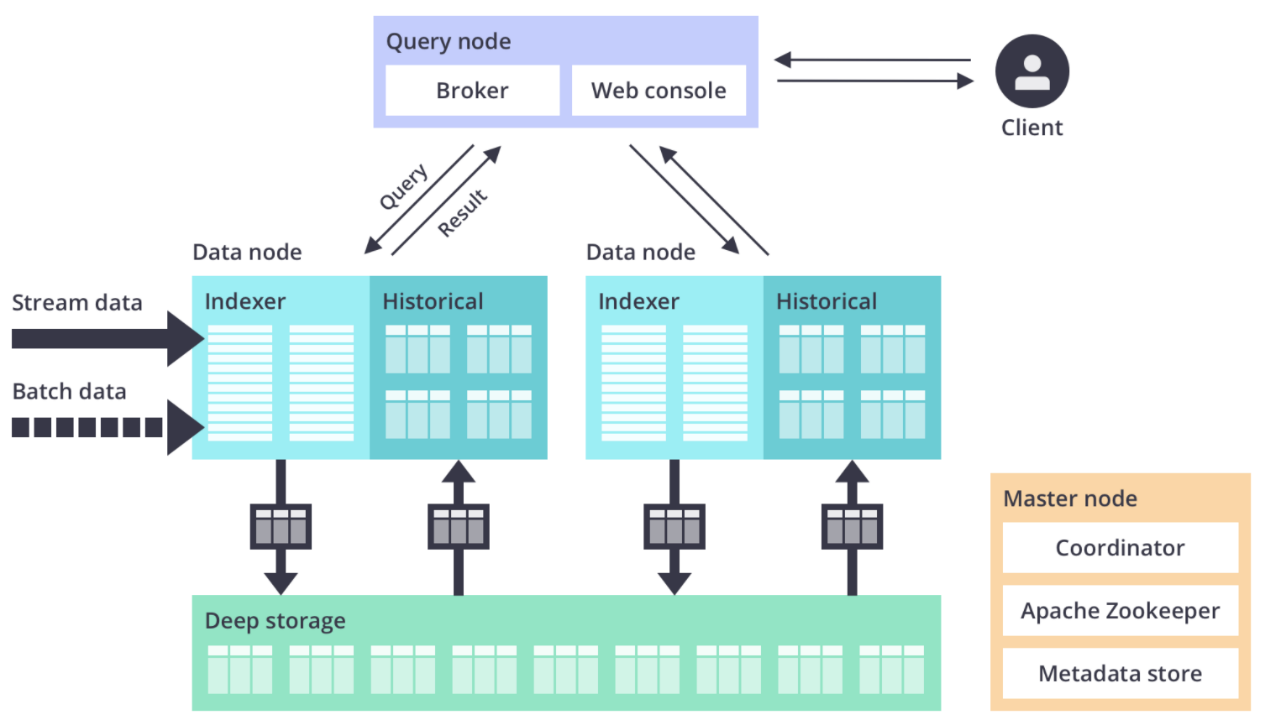
Druid uses a microservice-based architecture. All core services in it can be deployed on different hardware devices either separately or jointly.

Enhanced EMR Druid A lot of improvements have been made on EMR Druid based on Apache Druid, including integration with EMR Hadoop and relevant Tencent Cloud ecosystem, convenient monitoring and OPS, and easy-to-use product APIs, so that you can use it out of the box in an OPS-free manner.
Currently, EMR Druid supports the following features:
Easy integration with EMR Hadoop cluster
Easy and quick elastic scalability
HA
Using COS as deep storage
Using COS file as data source for batch indexing
Metadata storage in TencentDB
Integration with tools such as Superset
Various monitoring metrics and alarm rules
Failover
High security

Bantuan dan Dukungan

Apakah halaman ini membantu?

masukan