tencent cloud

Tencent Kubernetes Engine

Release Notes and Announcements
Release Notes
Announcements
Release Notes
Product Introduction
Overview
Strengths
Architecture
Scenarios
Features
Concepts
Native Kubernetes Terms
Common High-Risk Operations
Regions and Availability Zones
Service Regions and Service Providers
Open Source Components
Purchase Guide
Purchase Instructions
Purchase a TKE General Cluster
Purchasing Native Nodes
Purchasing a Super Node
Getting Started
Beginner’s Guide
Quickly Creating a Standard Cluster
Examples
Container Application Deployment Check List
Cluster Configuration
General Cluster Overview
Cluster Management
Network Management
Storage Management
Node Management
GPU Resource Management
Remote Terminals
Application Configuration
Workload Management
Service and Configuration Management
Component and Application Management
Auto Scaling
Container Login Methods
Observability Configuration
Ops Observability
Cost Insights and Optimization
Scheduler Configuration
Scheduling Component Overview
Resource Utilization Optimization Scheduling
Business Priority Assurance Scheduling
QoS Awareness Scheduling
Security and Stability
TKE Security Group Settings
Identity Authentication and Authorization
Application Security
Multi-cluster Management
Planned Upgrade
Backup Center
Cloud Native Service Guide
Cloud Service for etcd
TMP
TKE Serverless Cluster Guide
TKE Registered Cluster Guide
Use Cases
Cluster
Serverless Cluster
Scheduling
Security
Service Deployment
Network
Release
Logs
Monitoring
OPS
Terraform
DevOps
Auto Scaling
Containerization
Microservice
Cost Management
Hybrid Cloud
AI
Troubleshooting
Disk Full
High Workload
Memory Fragmentation
Cluster DNS Troubleshooting
Cluster kube-proxy Troubleshooting
Cluster API Server Inaccessibility Troubleshooting
Service and Ingress Inaccessibility Troubleshooting
Common Service & Ingress Errors and Solutions
Engel Ingres appears in Connechtin Reverside
CLB Ingress Creation Error
Troubleshooting for Pod Network Inaccessibility
Pod Status Exception and Handling
Authorizing Tencent Cloud OPS Team for Troubleshooting
CLB Loopback
API Documentation
History
Introduction
API Category
Making API Requests
Elastic Cluster APIs
Resource Reserved Coupon APIs
Cluster APIs
Third-party Node APIs
Relevant APIs for Addon
Network APIs
Node APIs
Node Pool APIs
TKE Edge Cluster APIs
Cloud Native Monitoring APIs
Scaling group APIs
Super Node APIs
Other APIs
Data Types
Error Codes
TKE API 2022-05-01
FAQs
TKE General Cluster
TKE Serverless Cluster
About OPS
Hidden Danger Handling
About Services
Image Repositories
About Remote Terminals
Event FAQs
Resource Management
Service Agreement
TKE Service Level Agreement
TKE Serverless Service Level Agreement
Contact Us
Glossary

General Cluster Overview

PDF
Focus Mode
Font Size
Last updated: 2024-12-11 17:49:59

Overview

Tencent Kubernetes Engine (TKE) is a container management service with high scalability and performance that enables you to easily run applications in a managed CVM instance cluster. This service frees you from installation, operations, and expansion of the cluster management infrastructure. In addition, it allows you to launch and terminate Docker applications, query the status of the cluster, and use various Tencent Cloud services through simple API calls. You can arrange containers in your cluster based on resource and availability requirements to meet your business or application-specific needs.
Based on native Kubernetes, TKE provides a container-oriented solution that solves operating environment issues during development, testing, and OPS and helps reduce costs and improve efficiency. TKE is fully compatible with the native Kubernetes APIs and extends Kubernetes plug-ins such as CBS and CLB on the Tencent Cloud. In addition, TKE provides network solutions with high reliability and performance based on Tencent Cloud VPC.

Glossary

The following describes the key terms related to TKE:
Cluster: The collection of cloud resources required to run containers, including several Tencent Cloud resources such as CVM instances and CLBs.
Pod: A group of one or more associated containers that share the same storage and network space.
Workload: A Kubernetes resource object that is used to manage the creation, scheduling, and automatic control of Pod replicas throughout the entire lifecycle.
Service: A group of microservices consisting of multiple Pods with the same configuration and the rules for accessing these Pods.
Ingress: A collection of rules for routing external HTTP(S) traffic to a Service.
Application: The features related to Helm 3.0 that are integrated in TKE. They enable you to create products and services such as Helm Chart, container images, and software services.
Image repository: It stores Docker images that are used to deploy TKE.

Directions

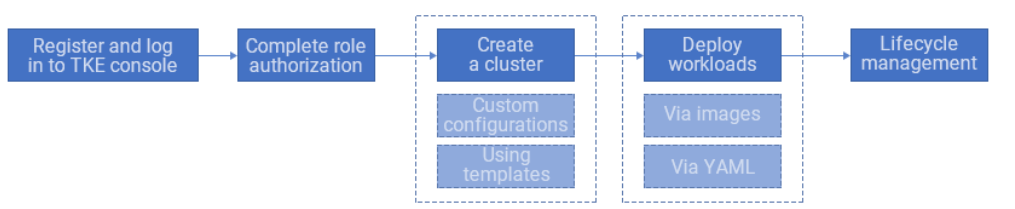
The following figure shows you how to use TKE:

1. Perform role authorization. Register and log in to the TKE console, perform authorization to obtain operation permissions on relevant resources.
2. Create a cluster. You can customize a cluster or create a cluster with a template.
3. Deploy workloads. You can deploy workloads by deploying images or orchestrating YAML files. For more information, see Workload.
4. Manage the lifecycle of Pods by performing operations such as monitoring, upgrade, and scaling.

Pricing

TKE charges cluster management fees based on the specifications of the managed clusters, and charges cloud resources fees based on the actual usage. For more information about the billing modes and prices, see TKE Billing Overview.

Additional Services

You can purchase several CVM instances to form a TKE cluster. The containers will run on the CVMs. For more information, see Cloud Virtual Machine.
A cluster can be created in a VPC. CVM instances in the cluster can be allocated to subnets in different availability zones. For more information, see Virtual Private Cloud.
You can use CLB to automatically allocate the request traffic of clients across CVM instances and then forward the traffic to the containers running on the CVM instances. For more information, see Cloud Load Balancer.
You can use Tencent Cloud Observability Platform to monitor the operation statistics of TKE clusters and Pods. For more information, see Tencent Cloud Observability Platform.

Help and Support

Was this page helpful?

Help us improve! Rate your documentation experience in 5 mins.

Feedback