tencent cloud

Video on Demand

Release Notes and Announcements
Release Notes
Announcements
Product Introduction
Overview
Product Features
Features
Strengths
Scenarios
Solutions
Professional Edition
Introduction to Video On Demand Professional Edition
Quick Start
Console Guide
Development Guide
Purchase Guide
Billing Overview
Billing Modes
Purchase Guide
Viewing Bills
Renewal
Overdue Policy
Refund Policy
Getting Started
Console Guide
Console Overview
Service Overview
Application Management
Media Management
Package Management
License Management
Real-Time Log Analysis
Practical Tutorial
Media Upload
Smart Cold Storage of VOD Media Asset Files
Video Processing
Distribution and Playback
How to Receive Event Notification
How to Migrate Files from Origin Server to VOD
Live Recording
How to Pull from Custom Origin Servers
How to Use EdgeOne to Distribute Content in VOD
Development Guide
Media Upload
Media Processing
Video AI
Event Notification
Video Playback
Media Encryption and Copyright Protection
Broadcast Channel
CAM
Media File Download
Subapplication System
Error Codes
Player SDK
Overview
Basic Concepts
Features
Free Demo
Free Trial License
Purchase Guide
SDK Download
Licenses
Player Guide
Integration (UI Included)
Integration (No UI)
Advanced Features
API Documentation
Player Adapter
Player SDK Policy
Server APIs
History
Introduction
API Category
Other APIs
Media Processing APIs
Parameter Template APIs
Task Management APIs
Media Upload APIs
Media Management APIs
Event Notification Relevant API
Media Categorization APIs
Domain Name Management APIs
Distribution APIs
AI-based Sample Management APIs
Region Management APIs
Data Statistics APIs
Carousel-Related APIs
Just In Time Transcode APIs
No longer recommended APIs
Making API Requests
AI-based image processing APIs
Task Flow APIs
Data Types
Error Codes
Video on Demand API 2024-07-18
FAQs
Mobile Playback
Fees
Video Upload
Video Publishing
Video Playback
Web Playback
Full Screen Playback
Statistics
Access Management
Cold Storage
Agreements
Service Level Agreement
VOD Policy
Privacy Policy
Data Processing And Security Agreement
Contact Us
Glossary

Real-Time Log Analysis

PDF
Focus Mode
Font Size
Last updated: 2024-12-05 15:10:26
This document will guide you on how to use the VOD Real-Time Log Analysis function to deliver VOD CDN logs to the Cloud Log Service(CLS) product to achieve comprehensive log analysis services such as log collection, log storage, and log retrieval.

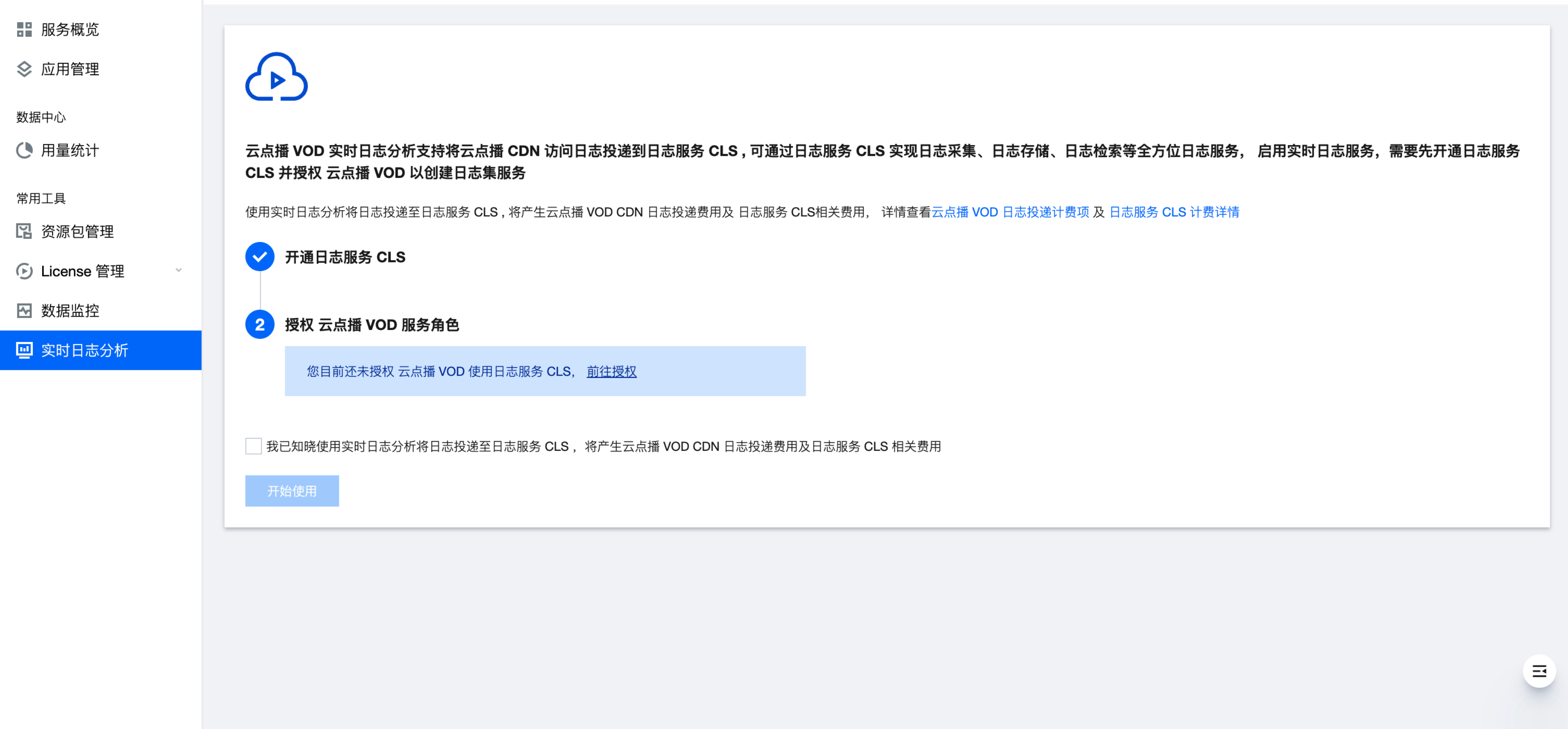
Step 1: Activate the VOD Real-Time Log Analysis function

1. Log in to the Cloud VOD console, click Real-time Log Analysis in the left menu bar, and enter the real-time log analysis page.
2. Activate the Cloud Log Service(CLS) product.
3. Authorize VOD service role
4. Check to know that using the Real-Time Log Analysis function will produce corresponding expenses
5. Click Get Started.


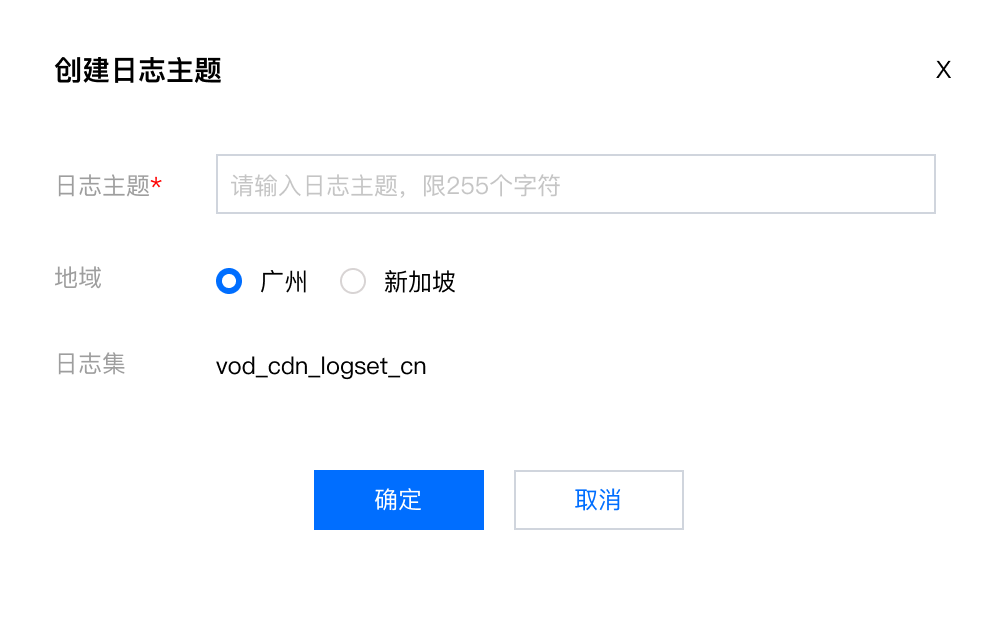
Step 2: Create a Log topic

1. Click Log Management.
2. In the log management pop-up window, click Create Log Topic.
3. Enter the Log Topic and select the Region.
4. Click Confirm to complete the creation of the Log Topic.


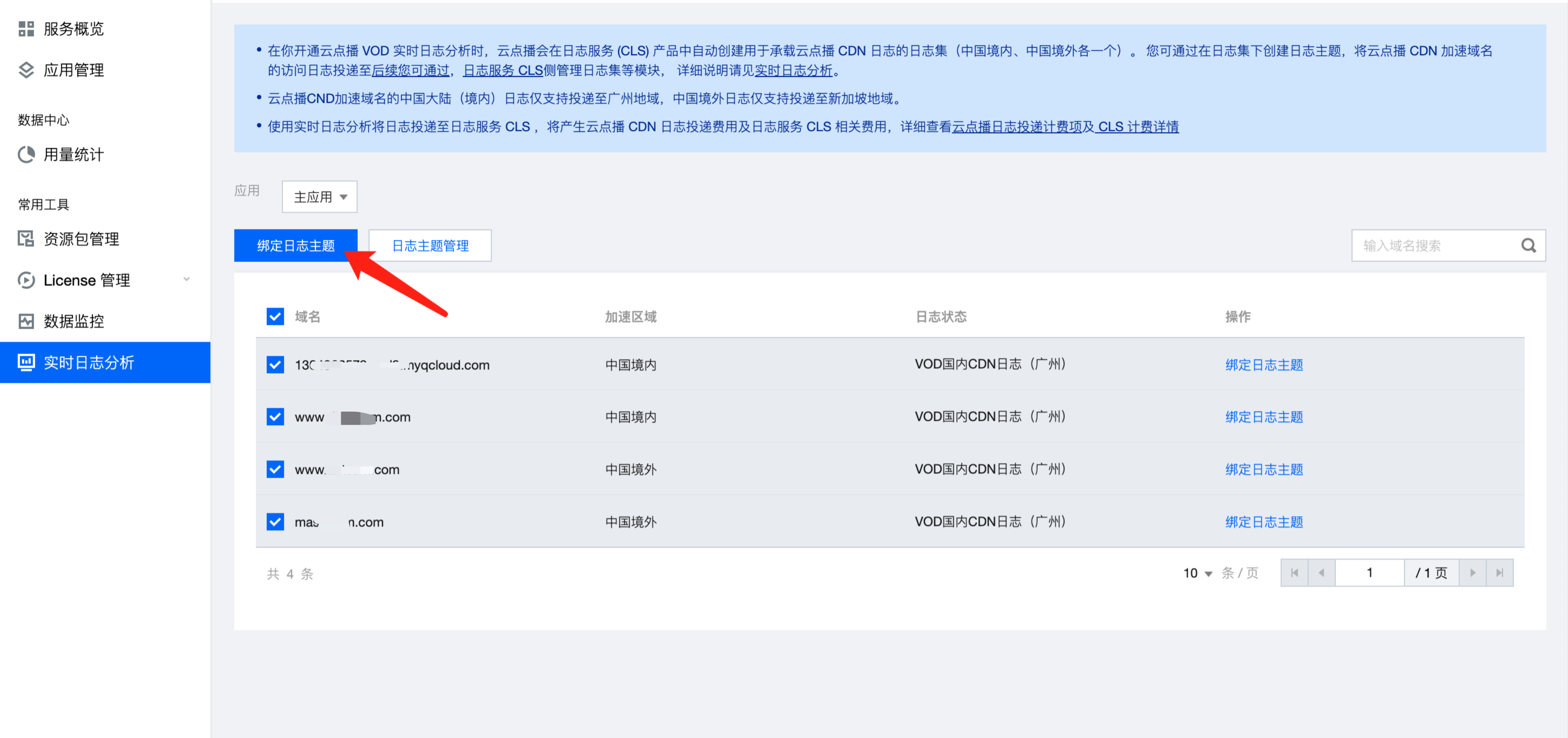
Step 3: Bind the log topic

1. Select the VOD application that needs to be bound.
2. Select a domain name.
3. Click Bind Log Topic to support batch selection of domain names to bind log topics in batches (only one log topic is supported in the same region).
4. After binding the log topic, you can start the Real-Time Log Analysis service.


Other Instructions

Log Set

Log Set(Logset) is the project management unit of Tencent Cloud Log Service(CLS). It is used to distinguish logs from different projects. One log set corresponds to a collection. When you activate the VOD Real-Time Log Analysis function, VOD will create a log set (one each for Guangzhou and Singapore) for you to carry VOD CDN logs in the CLS product.

Log topic

Log topic(Topic) is the basic management unit of Tencent Cloud Log Service(CLS). A log set can contain multiple log topics.
A VOD acceleration domain name can only be bound to one log topic in the same region.
The default log retention time is 30 days. If you need to modify it, you can go to the CLS product to edit the corresponding log topic and modify the log retention time.

Log delivery

After binding a log topic to the VOD acceleration domain name, VOD will deliver the access log of the acceleration domain name to the corresponding log topic.

Disabling the CLS

If you decide to stop using CLS, you can avoid any further billing by permanently deleting all of your CLS resources such as log topics. There is no need to de-register your account, and if you use other Tencent Cloud products, avoid doing so as it will affect your other services. For more details, you can read this article: Cleaning up CLS resources.

Help and Support

Was this page helpful?

Help us improve! Rate your documentation experience in 5 mins.

Feedback