tencent cloud

Tencent Cloud Distributed Cache (Redis OSS-Compatible)

Berita Terkini dan Pengumuman
Catatan Rilis
Pengumuman
Pengenalan Produk
Ikhtisar
Keunggulan
Kasus Penggunaan
Mesin Penyimpanan
Product Series
Performa
Pemisahan Baca/Tulis
Deployment Multi-AZ
Wilayah dan AZ
Panduan Pembelian
Ikhtisar Penagihan
Metode Pembelian
Pembayaran Jatuh Tempo
Memulai
Membuat Instans TencentDB for Redis
Menghubungkan ke Instans TencentDB for Redis (melalui Jaringan Pribadi)
Panduan Pengoperasian
Ikhtisar Operasi
Koneksi SDK
Manajemen dan Pemeliharaan Instans
Peningkatan Instans
Manajemen Deployment Multi-AZ
Pencadangan dan Pemulihan
Manajemen akun
Konfigurasi Parameter
Manajemen Akses
Jaringan dan Keamanan
Pemantauan dan Peringatan Alarm
Replikasi Global
Service Agreement
Service Level Agreement
Terms of Service
Glosarium
DokumentasiTencent Cloud Distributed Cache (Redis OSS-Compatible)

Slow log (Memcached Edition)

Mode fokus
Ukuran font
Terakhir diperbarui: 2026-03-17 17:45:58

Overview

A slow query is defined as a query statement in which the query request exceeds a specified time limit. The corresponding statement is referred to as a slow query statement. The slow query feature allows you to directly view detailed command information for Memcached Edition instances in which query requests exceed 10, 20, 40, or 50 milliseconds.

Notes

Slow logs are retained for 15 days.
The default account can query up to 15,000 times per second, while custom accounts are limited to 20 queries per second.
If the process of querying results is slow, try narrowing the time range down for the query.

Querying Slow Logs

2. At the top of the instance list page on the right, select the region.
3. In the instance list, locate the target instance.
4. Click the target instance ID to enter the Instance Details page.
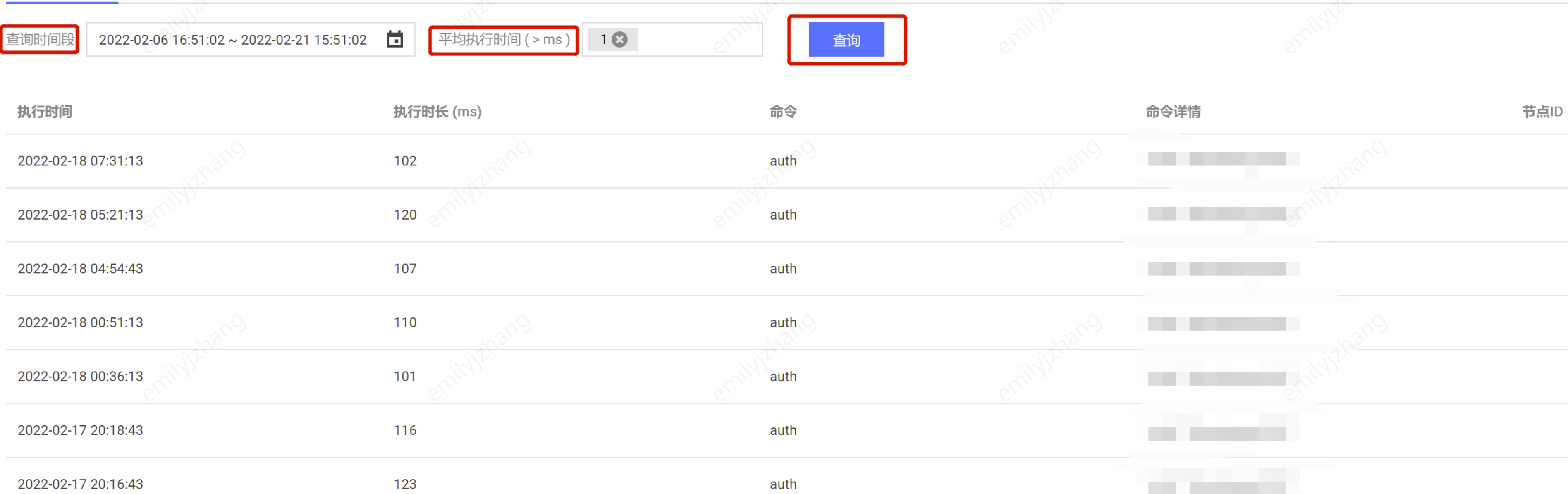
5. Click the Slow Log tab, and then select the time range under Query Time Period. In the dropdown menu under Average Execution Duration, select the threshold for command requests exceeding duration. Click Query to display the records of slow queries executed within that time range.

Exporting Slow Logs

1. On the Slow Log page, click Export at the top right.

2. In the pop-up dialog box, learn the limit on the number of slow logs that can be exported at once, and then click Export.
3. Open the exported slow log file, which is in Excel format.

Bantuan dan Dukungan

Apakah halaman ini membantu?

masukan