What Is TDMQ for MQTT
Baixar
Modo Foco
Tamanho da Fonte
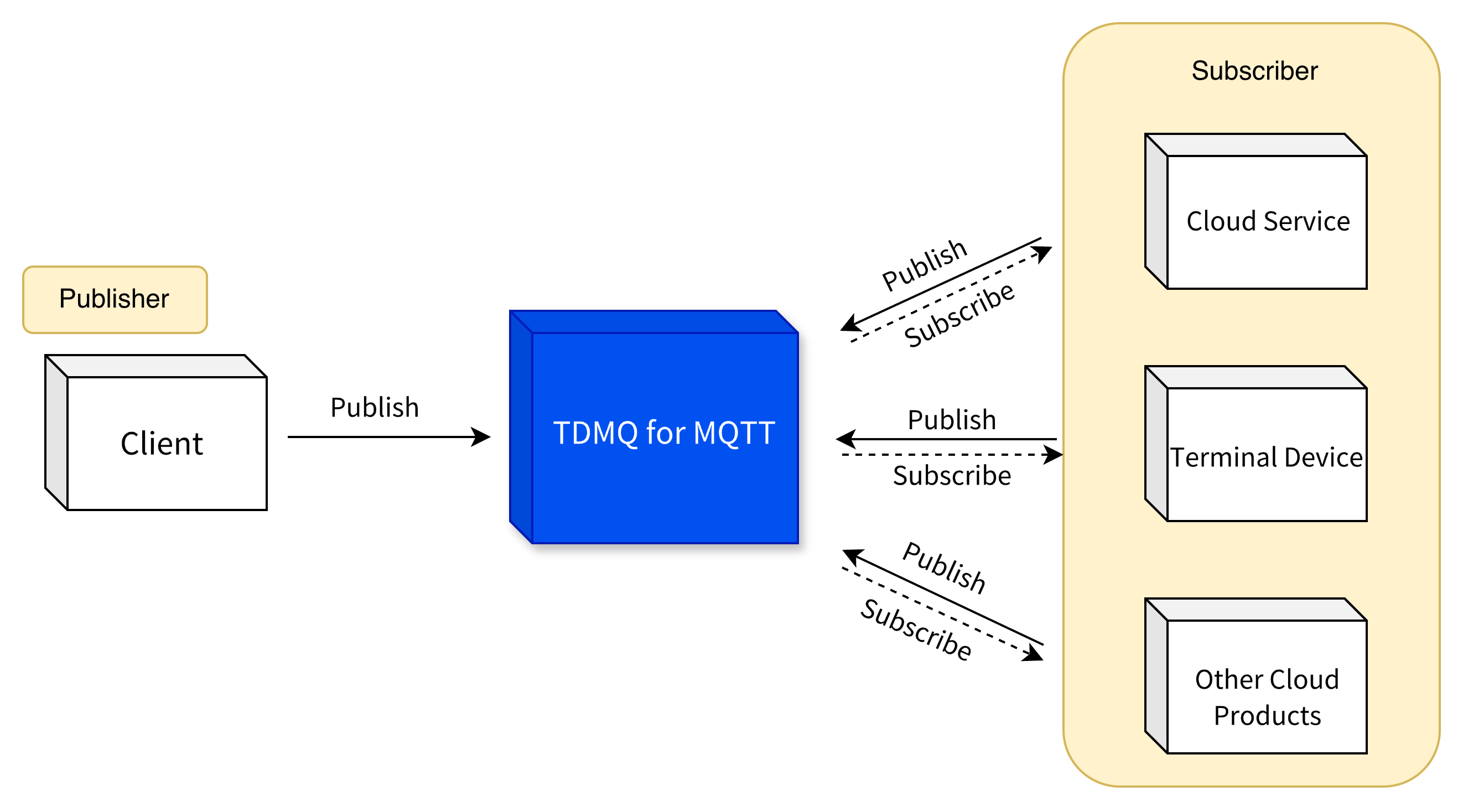
TDMQ for MQTT is a distributed and highly available messaging queue service. It employs a "publish/subscribe" model to establish an extremely lightweight messaging protocol. TDMQ for MQTT is compatible with the standard MQTT protocol, supports seamless integration with open-source communities and mainstream MQTT clients without modifications, and enhances stability, low latency, and high-performance features. It supports millions of concurrent client connections. The messaging model of TDMQ for MQTT is shown below, enabling interactions between devices and devices, devices and the cloud, as well as other cloud products.
Strengths
Compatibility
Compatible with MQTT 3.1, MQTT 3.1.1, and MQTT 5.0 protocols, supporting the common "publish/subscribe" messaging queue model. Supports multi-language client access such as Java, C, C++, Golang, Python, .NET, and Rust from the open-source community.
Reliability
Provides ordered and reliable bidirectional connections, supporting TCP and WebSocket transport layer protocols. Specifically optimized for resource-constrained devices and network environments with low bandwidth, high latency, or unreliability. Supports advanced security features including X.509 certificate mutual authentication, "one-device-one-certificate", and "one-device-one-secret", and also allows integration of custom authentication systems for more secure and controllable connections.
Observability
The console provides rich monitoring metrics and interconnection with Tencent Cloud's monitoring and alarm features. It also provides a complete Cloud API and supports integration with self-service ops systems.
Data Integration
Supports data communication with other cloud products, such as TDMQ for RocketMQ, TDMQ for CKafka, and Serverless Cloud Function, thereby achieving upstream and downstream ecosystems and free circulation of message data.
Ajuda e Suporte
Esta página foi útil?
Você também pode entrar em contato com a Equipe de vendas ou Enviar um tíquete em caso de ajuda.
comentários