Our real-time teleoperation product (also named TRRO) is well designed for the teleoperation scenarios, e.g. autonomous driving remote takeover, remote operation in hazardous environments and online remote services. It provides video/audio transmission and status/control data interaction capabilities, and helps developers quickly build their teleoperation applications.
Architecture
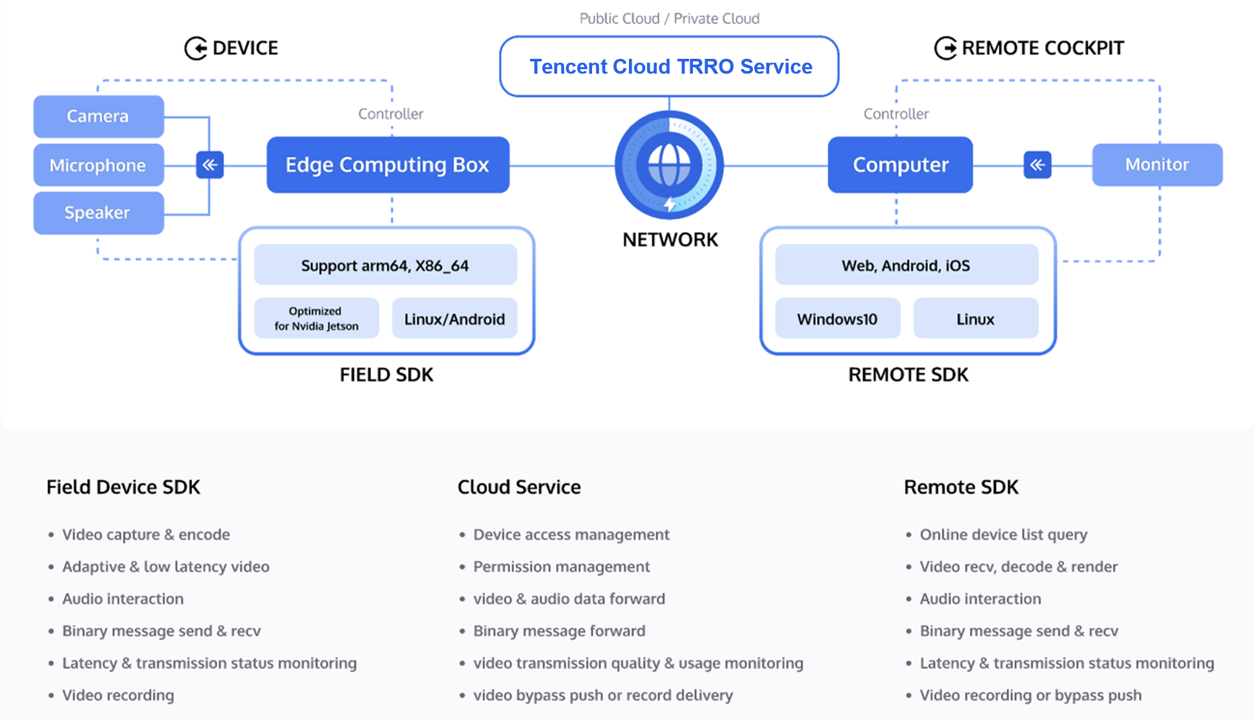
TRRO provides SDKs for field devices and remote devices in teleoperation scenarios, making it easy for developers to quickly integrate SDK and connect to TRRO cloud service. Currently, SDK is available for Linux / Windows C/C++, Web, Android, and iOS platforms, and supports both aarch64 and x86_64 architecture chips. The product architecture is shown in the figure below:
Strengths
Low latency
Provides ultra-low latency audio and video transmission, greatly enhancing the remote operating experience. The video transmission and processing latency can be less than 30ms.
Local Network Scenario:
Vehicle Camera: 30fps GMSL camera glass-to-glass latency can be less than 100ms.
Industrial Camera: 60fps USB3.0 camera glass-to-glass latency can be less than 50ms.
Public Network Scenario(< 50ms rtt):
Vehicle Camera: 30fps GMSL camera glass-to-glass latency can be less than 150ms.
Industrial Camera: 60fps USB3.0 camera glass-to-glass latency can be less than 100ms.
The above data is tested using the stopwatch capture method in a good network environment.
Weak Network Resistance
Able to resist weak network conditions such as network latency jitter and packet loss, reduce the impact of network fluctuations, and enhance the experience and sustainability of remote control under weak network conditions.
The above data is tested by a weak network simulation tool in a 30ms RTT network environment. For higher packet loss rates scenarios (40%-80%), you can proactively set the FEC feature to achieve a lagging rate of 1% or lower. The lagging rate is calculated as the total lagging duration / total session duration * 100%.
Security
Identity Security: Supports two-way authentication between devices and the cloud, device keys are managed by the customer, supports one device one key, no storage in the cloud.
Transmission Security: End-to-end encryption of session content, one session one key with real-time DTLS negotiation.
Permission Security: device level session permission and operation permission management, provides black and allowlist configurations and dynamic permission switching.
Multi-Path Network Transmission
Supports multi-path transmission for audio and video streams and control data streams. It can adaptively select the optimal network path and transmission mode or use multiple paths simultaneously according to various network scenarios, to ensure fluent and continuously teleoperation for the device moving under different network conditions like 4G/5G.
Network Switching Performance
under 50ms RTT, network switching delay < 50ms.
under 50ms RTT, no visible video lagging during network switching.
The above data is tested in a multi-network environment by plugging and unplugging network cables.