tencent cloud

Anti-DDoS

Release Notes and Announcements
Release Notes
Announcements
Product Introduction
Overview
Strengths
Use Cases
Concepts
Blocking Policies
Relevant Products
Comparison of Anti-DDoS Solutions
Purchase Guide
Billing Overview
Purchase Directions
Getting Started
Anti-DDoS Pro
Anti-DDoS Advanced
Operation Guide
Operation Overview
Protection Overview
Usage Limits
Asset Center
Business Connection
Smart Scheduling
Protection Configuration
Security Operations
Service Management
Practical Tutorial
Remote Protection Scheme with Anti-DDoS Pro
Using Anti-DDoS Pro Together with WFA
Suggestions on Stress Tests
Solutions to Real Server IP Exposure
Creating an Anti-DDoS EIP
Configuration Directions and Notes on CC Protection Policies
Syncing Forwarding Rules to New Anti-DDoS Advanced Instances
‌Smart Scheduling of CTCC/CUCC/CMCC Traffic
Troubleshooting
Business IPs Blocked Due to High-traffic Attacks
‌Business IPs Blocked When DDoS Attack Traffic Doesn't Reach the Threshold
How to Fix a 502 Bad Gateway Error
"No ICP filing" Prompted During Domain Name Connection
A public IP suffered DDoS attacks
API Documentation
History
Introduction
API Category
Making API Requests
Anti-DDoS Advanced Instance APIs
Resource List APIs
Protection Configuration APIs
Other APIs
Alarm Notification APIs
Connection Configuration APIs
Intelligent Scheduling APIs
Black hole unblocking APIs
Statistical Report APIs
Data Types
Error Codes
FAQs
Blocking
Attacks
Features
Billing
Service Level Agreement
Product Policy
Privacy Policy
Data Processing And Security Agreement
Glossary
Documentation Anti-DDoSGetting StartedAnti-DDoS AdvancedAnti-DDoS Advanced (Global Enterprise)

Anti-DDoS Advanced (Global Enterprise)

PDF
Focus Mode
Font Size
Last updated: 2024-10-21 17:37:38
Anti-DDoS Advanced (Global Enterprise) is a paid service for Tencent Cloud users with businesses deployed in regions outside the Chinese mainland.
It allows you to purchase and hold public IP address resources separately.
After an Anti-DDoS Advanced (Global Enterprise) instance is bound to cloud resources, the cloud resources can communicate with the public network through it.

This document takes binding an instance to a cloud resource as an example to describe the lifecycle of an Anti-DDoS Advanced (Global Enterprise) instance.

Background

The lifecycle of Anti-DDoS Advanced (Global Enterprise) includes purchasing an instance, configuring protection rules, configuring business rules for the instance, and terminating the instance.

1. Purchasing an instance: Purchase an Anti-DDoS Advanced (Global Enterprise) instance according to your actual needs.
2. Configuring protection rules: Configure protection policies that fit your business.
3. Configuring business rules : Associate the instance with the cloud resources to be protected.
4. Terminating the instance: After disassociating the instance from cloud resources, you can associate it with other cloud resources. The disassociation operation may cause the network of the corresponding cloud resources to be disconnected, and instances that are not bound to cloud resources will incur idle resource fees.

Directions

Purchasing an instance

1. Log in to the Anti-DDoS Advanced (Global Enterprise) console.
2. Purchase an instance as instructed in Purchase Guide.
3. Click Anti-DDoS instances in the console to view the instance just purchased, which is in the Not bound status.
Note:
An Anti-DDoS Advanced (Global Enterprise) instance incurs an idle fee if it's not bound with cloud resource. The idle fee is calculated by second and billed per hour. Bind the instance with cloud resource in time to prevent unnecessary costs. For more information, see Billing Overview.


Configuring protection rules

1. Log in to the new Anti-DDoS console and click Anti-DDoS instances on the left sidebar.
2. Select the target instance and click Configurations.


Associating with cloud resources

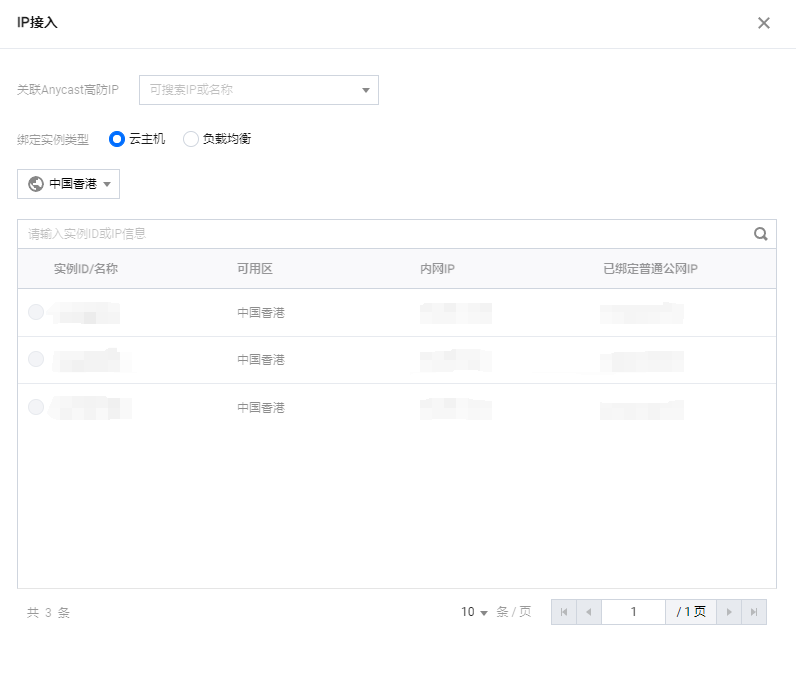
1. Log in to the new Anti-DDoS console and click Business Access > IP access.
2. On the IP access page, click Start Access.
3. On the IP access page, select an Anti-DDoS Advanced (Global Enterprise) instance in the Associate Anycast IP field, select a cloud resource, and then click OK.
Note:
Cloud resources that are associated with a public IP or Anycast IP cannot be associated again.


Disassociating with cloud resources

1. On the IP access page, select an instance and click Delete on the right.

2. In the pop-up window, click OK.
Note:
Note that the disassociation may disconnect your cloud resource from the network. After disassociation, you can associate the instance with other resources later.


Help and Support

Was this page helpful?

Help us improve! Rate your documentation experience in 5 mins.

Feedback