tencent cloud

TDMQ for RocketMQ

Release Notes and Announcements
Release Notes
Announcements
Product Introduction
Introduction and Selection of the TDMQ Product Series
What Is TDMQ for RocketMQ
Strengths
Scenarios
Product Series
Comparison with Open-Source RocketMQ
High Availability
Quotas and Limits
Supported Regions
Basic Concepts
Billing
Billing Overview
Pricing
Billing Examples
Pay-as-you-go Switch to Monthly Subscription (5.x)
Renewal
Viewing Consumption Details
Refund
Overdue Payments
Getting Started
Getting Started Guide
Preparations
Step 1: Creating TDMQ for RocketMQ Resources
Step 2: Using the SDK to Send and Receive Messages (Recommended)
Step 2: Running the TDMQ for RocketMQ Client (Optional)
Step 3: Querying Messages
Step 4: Deleting Resources
User Guide
Usage Process Guide
Configuring Account Permissions
Creating the Cluster
Configuring the Namespace
Configuring the Topic
Configuring the Group
Connecting to the Cluster
Managing Messages
Managing the Cluster
Viewing Monitoring Data and Configuring Alarms
Cross-Cluster Message Replication
Use Cases
Naming Conventions for Common Concepts of TDMQ for RocketMQ
RocketMQ Client Use Cases
RocketMQ Performance Load Testing and Capacity Assessment
Access over HTTP
Client Risk Descriptions and Update Guide
Migration Guide for TencentCloud API Operations Related to RocketMQ 4.x Cluster Roles
Migration Guide
Disruptive Migration
Seamless Migration
Developer Guide
Message Types
Message Filtering
Message Retries
POP Consumption Mode (5.x)
Clustering Consumption and Broadcasting Consumption
Subscription Relationship Consistency
Traffic Throttling
​​API Reference(5.x)
History
API Category
Making API Requests
Topic APIs
Consumer Group APIs
Message APIs
Role Authentication APIs
Hitless Migration APIs
Cloud Migration APIs
Cluster APIs
Data Types
Error Codes
​​API Reference(4.x)
SDK Reference
SDK Overview
5.x SDK
4.x SDK
Security and Compliance
Permission Management
CloudAudit
Deletion Protection
FAQs
4.x Instance FAQs
Agreements
TDMQ for RocketMQ Service Level Agreement
Contact Us
DocumentationTDMQ for RocketMQDeveloper GuideSubscription Relationship Consistency

Subscription Relationship Consistency

PDF
Focus Mode
Font Size
Last updated: 2026-01-23 17:52:23
This document mainly introduces the core concepts of subscription relationship consistency. It covers the definition and constraint mechanisms, delves into the underlying implementation principles and optimization practices, and combines real-world cases to present the solutions of TDMQ for RocketMQ for subscription relationship inconsistency issues. This helps developers quickly identify the root cause of problems and build stable, reliable messaging systems.

Subscription Relationship Definition

A subscription relationship refers to the rules and status configurations that govern how consumers obtain and process messages in the RocketMQ system. This subscription relationship is dynamically registered by a consumer group with the server. During subsequent message transmission, messages are matched, and consumption progress is maintained according to the filtering rules defined by this subscription relationship.
By configuring subscription relationships, you can control the following consumption behaviors:
Message filtering rules: These rules determine which messages within a topic the consumers select for consumption. Setting consumption filtering rules efficiently filters the set of messages needed by the consumers, allowing flexible adjustment of the message receiving scope based on different business scenarios.
Consumption status: The RocketMQ server provides subscription relationship persistence by default. This means that after a consumer group registers its subscription relationship with the server, if a consumer goes offline and later comes back online, it can retrieve the consumption progress from before it went offline and resume consumption.
In the domain model of RocketMQ, the position and workflow of subscription relationships are as follows:

1. Messages are initialized by producers and sent to the RocketMQ server.
2. Messages are stored in specified queues of a topic in the order they arrive at the RocketMQ server.
3. Consumers obtain and consume messages from the RocketMQ server according to the specified subscription relationships.

Subscription Relationship Consistency Constraints

Subscription relationship consistency requires that all consumer instances within the same consumer group must subscribe to the exact same topics with the exact same filtering rules. This involves three specific constraints:
The consumer group must be consistent.
For most distributed applications, multiple consumer instances are typically attached to a single consumer group. The constraints of subscription relationship consistency apply to all consumers within the same consumer group.
The subscribed topics must be consistent.
All consumers within the same consumer group must subscribe to the same topics. For example, if consumer1 subscribes to TopicA and TopicB, consumer2 must also subscribe to TopicA and TopicB. It cannot subscribe only to TopicA, only to TopicB, or to TopicA and TopicC.
The filtering rules must be consistent.
All consumers within the same consumer group must have the same filtering rules, including both the number and the order of tags. For example, if consumer1 subscribes to TopicB with tags Tag1||Tag2, consumer2 subscribing to TopicB must also use Tag1||Tag2. It cannot use only Tag1, only Tag2, or Tag2||Tag1.

Examples of Consistent Subscription Relationships

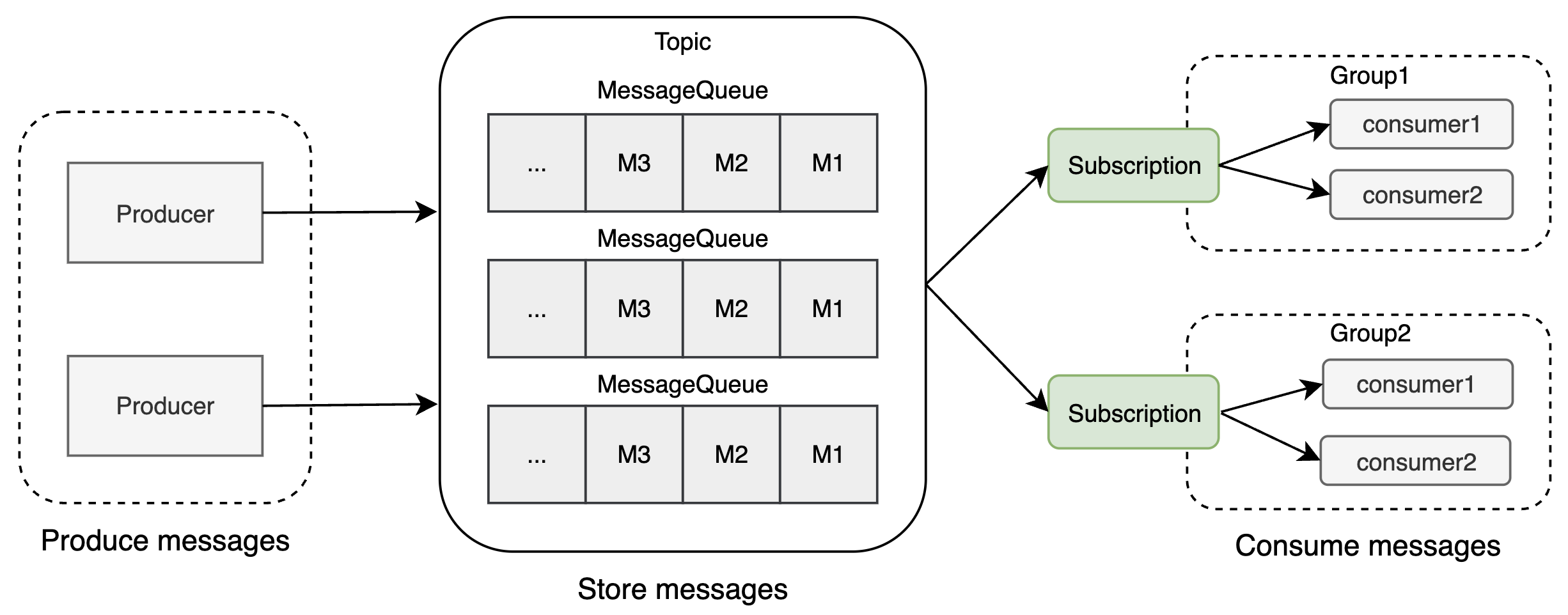
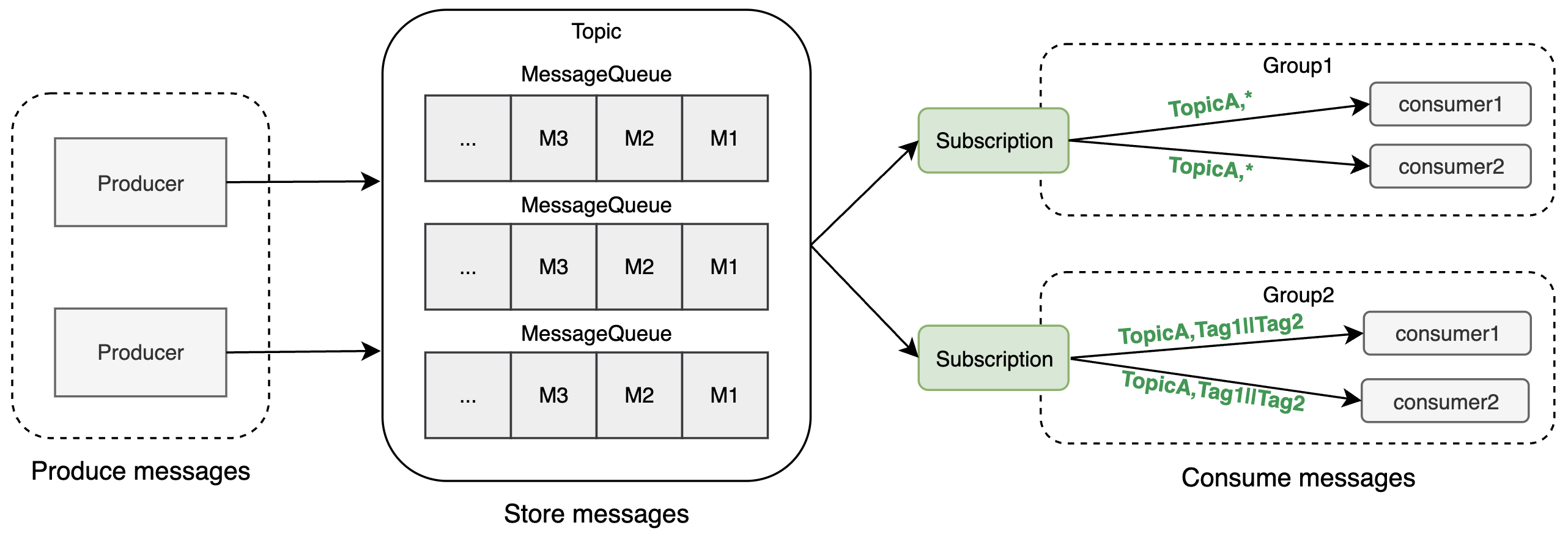
The following diagram illustrates two common correct subscription relationships, corresponding to two scenarios:

Example 1: single-topic single-tag subscription
As shown in the diagram, both consumer1 and consumer2 in Group1 subscribe to all messages in TopicA.
Example 2: single-topic multiple-tag subscription
As shown in the diagram, both consumer1 and consumer2 in Group2 subscribe to messages in TopicA with the tag Tag1 or Tag2, and the order is consistently Tag1||Tag2.

Examples of Inconsistent Subscription Relationships

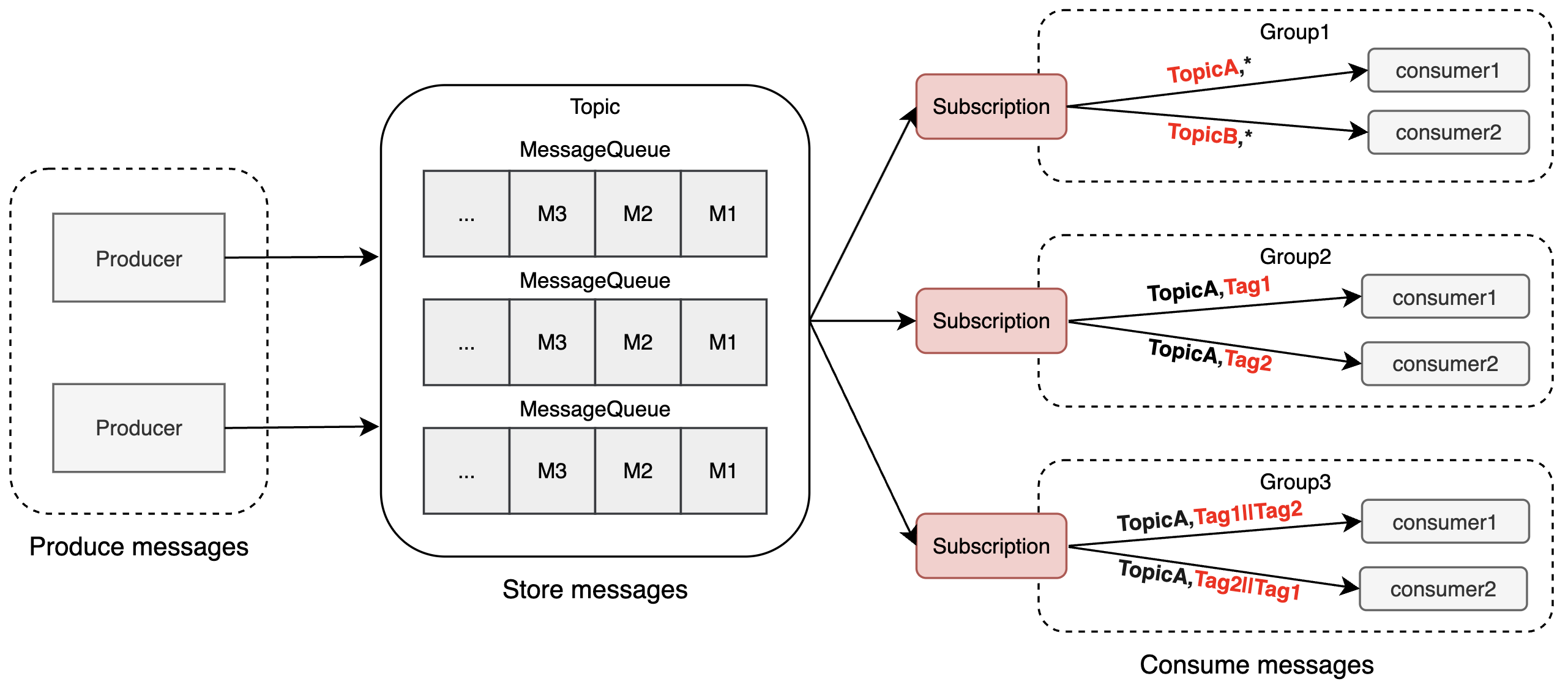
The following diagram illustrates three typical incorrect subscription relationships, corresponding to three scenarios:

Example 1: different subscribed topics
As shown in the diagram, consumer1 and consumer2 in Group1 subscribe to different topics.
Example 2: same topic with different tags
As shown in the diagram, consumer1 in Group2 subscribes to Tag1 of TopicA, while consumer2 subscribes to Tag2 of TopicA.
Example 3: same topic and tags, but different tag order
As shown in the diagram, consumer1 in Group3 subscribes to Tag1||Tag2 of TopicA, while consumer2 subscribes to Tag2||Tag1 of TopicA. Although the subscribed tags are the same, the different order violates the subscription consistency constraint.

Impact of Inconsistent Subscription Relationships

Inconsistent subscription relationships may lead to disordered message consumption logic, resulting in duplicate consumption or message loss.
In the following example, we start two consumers, both of which belong to consumer group Group1 and subscribe to TopicA. However, consumer1 subscribes to messages with Tag1, while consumer2 subscribes to messages with Tag2.
String topic = "TopicA";
String consumerGroup = "Group1";
FilterExpression filterExpressionTag1 = new FilterExpression("Tag1", FilterExpressionType.TAG);
PushConsumer consumer1 = provider.newPushConsumerBuilder()
.setConsumerGroup(consumerGroup)
.setSubscriptionExpressions(Collections.singletonMap(topic, filterExpressionTag1))
.build();
FilterExpression filterExpressionTag2 = new FilterExpression("Tag2", FilterExpressionType.TAG);
PushConsumer consumer2 = provider.newPushConsumerBuilder()
.setConsumerGroup(consumerGroup)
.setSubscriptionExpressions(Collections.singletonMap(topic, filterExpressionTag2))
.build();

What will be the respective behaviors of the two clients in this scenario?
consumer1 will be unable to consume messages with Tag1. This is because when consumer1 pulls messages, the subscription information for its consumer group on the server side has a tag value of Tag2. After server-side filtering, all messages pulled by consumer1 will have Tag2. However, the consumer also performs local filtering upon receiving messages, and these messages will be filtered out as well.
consumer2 will only be able to consume part of the messages with Tag2, because only a portion of the queues is assigned to consumer2.
However, the subscription information of different consumer clients within the same consumer group on the server side will overwrite each other. This results in highly disordered consumption behavior. The consumption patterns of consumer1 and consumer2 in the above example may switch between each other.

Practices for Optimizations by Tencent Cloud

Inconsistent subscription relationships directly lead to abnormal message consumption and require quick identification and fixing. The TDMQ for RocketMQ console provides visual detection capabilities, eliminating the need for manual log or configuration checks. It enables you to discover, locate, and fix issues in 3 steps in the console, reducing Ops complexity.
1. One-click detection
Automatically compares the subscription configurations of all clients within a consumer group and highlights inconsistent subscription relationships.

2. Precise identification
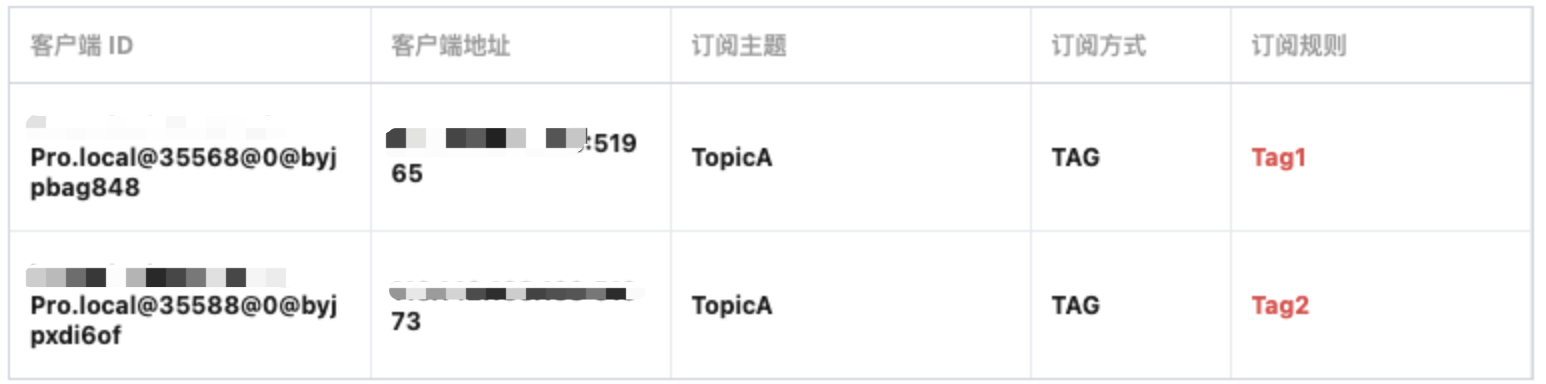
When you click to view the inconsistency details, the associated client instances are displayed, allowing you to quickly identify instances with unexpected subscription relationships.

3. Closed-loop verification
After you make modifications, the status of subscription relationship consistency is synchronized in real time to ensure that the consumer group's subscription relationships meet expectations.

FAQs

What are typical scenarios that cause inconsistent subscription relationships?
The environment isolation is incomplete, and non-production and production environments use the same consumer group to subscribe to different topics.
The subscription relationships are modified in the business code, and old and new versions of consumers coexist during the grayscale release and version deployment process.

Usage Recommendations

Subscription relationship consistency is fundamental to ensuring correct message consumption behavior in RocketMQ messaging systems:
1. Core constraints: All consumers within the same consumer group should strictly adhere to the principles of consistent topics and filtering rules (including tag order). Any deviation in any part may lead to message loss.
2. Tencent Cloud capability: With the one-click detection, precise identification, and closed-loop verification features in the console, developers can quickly identify abnormal instances and resolve issues, reducing the time required for traditional manual troubleshooting from hours to minutes.
3. Best practice: It is recommended to adopt strategies such as consumer group isolation, strict verification of dynamic configurations, and hierarchical governance in multi-topic scenarios to mitigate the risk of inconsistent subscription relationships at the source.


Help and Support

Was this page helpful?

Help us improve! Rate your documentation experience in 5 mins.

Feedback