tencent cloud

TDMQ for RocketMQ

Release Notes and Announcements
Release Notes
Announcements
Product Introduction
Introduction and Selection of the TDMQ Product Series
What Is TDMQ for RocketMQ
Strengths
Scenarios
Product Series
Comparison with Open-Source RocketMQ
High Availability
Quotas and Limits
Supported Regions
Basic Concepts
Billing
Billing Overview
Pricing
Billing Examples
Pay-as-you-go Switch to Monthly Subscription (5.x)
Renewal
Viewing Consumption Details
Refund
Overdue Payments
Getting Started
Getting Started Guide
Preparations
Step 1: Creating TDMQ for RocketMQ Resources
Step 2: Using the SDK to Send and Receive Messages (Recommended)
Step 2: Running the TDMQ for RocketMQ Client (Optional)
Step 3: Querying Messages
Step 4: Deleting Resources
User Guide
Usage Process Guide
Configuring Account Permissions
Creating the Cluster
Configuring the Namespace
Configuring the Topic
Configuring the Group
Connecting to the Cluster
Managing Messages
Managing the Cluster
Viewing Monitoring Data and Configuring Alarms
Cross-Cluster Message Replication
Use Cases
Naming Conventions for Common Concepts of TDMQ for RocketMQ
RocketMQ Client Use Cases
RocketMQ Performance Load Testing and Capacity Assessment
Access over HTTP
Client Risk Descriptions and Update Guide
Migration Guide for TencentCloud API Operations Related to RocketMQ 4.x Cluster Roles
Migration Guide
Disruptive Migration
Seamless Migration
Developer Guide
Message Types
Message Filtering
Message Retries
POP Consumption Mode (5.x)
Clustering Consumption and Broadcasting Consumption
Subscription Relationship Consistency
Traffic Throttling
​​API Reference(5.x)
History
API Category
Making API Requests
Topic APIs
Consumer Group APIs
Message APIs
Role Authentication APIs
Hitless Migration APIs
Cloud Migration APIs
Cluster APIs
Data Types
Error Codes
​​API Reference(4.x)
SDK Reference
SDK Overview
5.x SDK
4.x SDK
Security and Compliance
Permission Management
CloudAudit
Deletion Protection
FAQs
4.x Instance FAQs
Agreements
TDMQ for RocketMQ Service Level Agreement
Contact Us

Overview

PDF
Focus Mode
Font Size
Last updated: 2026-01-23 17:34:05
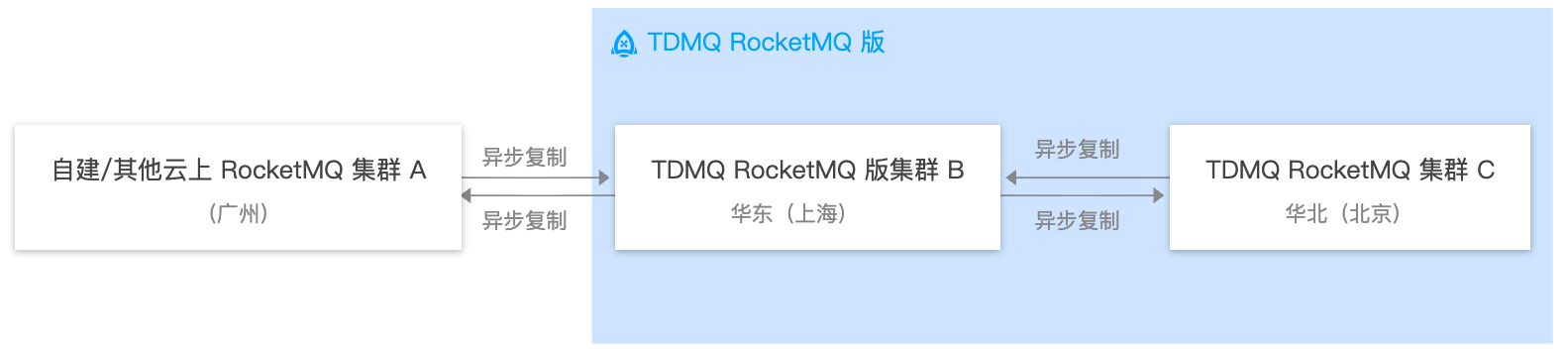
TDMQ for RocketMQ provides the cross-cluster message replication feature, enabling the replication of messages from different clusters within the same region and across regions. These capabilities meet enterprise customers' disaster recovery requirements such as data synchronization, cross-region cold backup, and multi-site active-active.
Note:
The cross-region replication feature is currently in grayscale release in some regions. If the region where your resources are located does not currently support cross-region replication, you can submit a ticket to contact Tencent Cloud.


Feature Overview

TDMQ for RocketMQ provides topic-level message replication and cluster-level message replication two major types of replication tasks. The feature details are shown in the table below:
Replication Task Dimension
Applicable Cluster Type
Task Directional Configuration
Remarks
Topic level.
Tencent Cloud RocketMQ all cluster types can be configured with Topic-level replication tasks.
Replication of messages from RocketMQ 5.x to RocketMQ 4.x clusters is not currently supported (while the reverse is supported).
If you require support for other cloud-based RocketMQ products, please submit a ticket for individual assessment.
One-way replication.
To set up a bidirectional synchronization replication task between Topic A and B, you can create two separate reverse tasks (replicating from A to B and from B to A). The server-side will automatically deduplicate the same message to prevent circular replication.
Filtering supports the use of TAG and SQL expressions.
The specification of a start time point for replication is supported.
Cluster level.
Currently only Tencent Cloud RocketMQ 4.x general clusters are supported. RocketMQ 5.x clusters will be supported soon.
Supports self-built clusters (either self-built on Tencent Cloud or self-built on other clouds).
Supports unidirectional replication and bidirectional replication.
For RocketMQ clusters not on Tencent Cloud, synchronization supports communication via both public networks and VPC networks.
When a VPC network is used, the graphical interface supports establishing connectivity via CCN or dedicated line networks.

Scenarios

Data synchronization

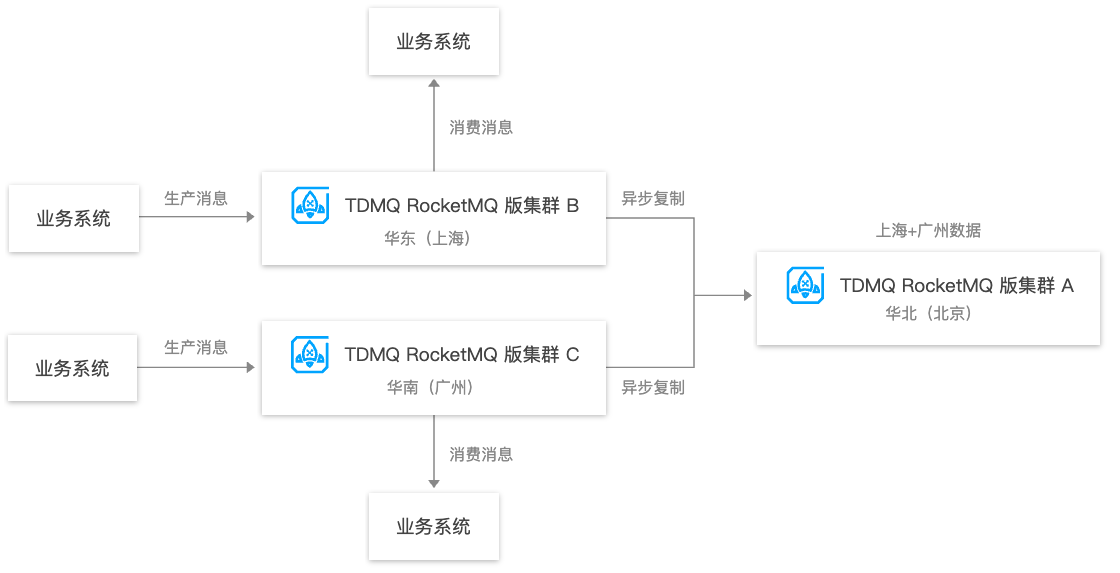
RocketMQ clusters in different regions process mutually exclusive business data. For certain cross-region business scenarios, the message replication capability enables messages from Region A to be replicated to Region B simultaneously for further processing.
A typical business scenario is as follows: A nationwide chain supermarket operates 2000+ stores, with independent business systems deployed in each region (North China, East China, South China, and so on) to handle local store operations. Simultaneously, by replicating messages from key business Topics to the headquarters cluster, the headquarters performs real-time analysis of nationwide sales data for inventory allocation and marketing decisions.
The business pain points addressed include: Independent operation of regional systems with severe data silos; the headquarters can evaluate the effectiveness of promotional activities in real time, conduct corresponding business processing and inventory allocation based on real-time regional performance and stock levels, thereby addressing slow data integration and delayed report generation.


Off-Site Cold Backup

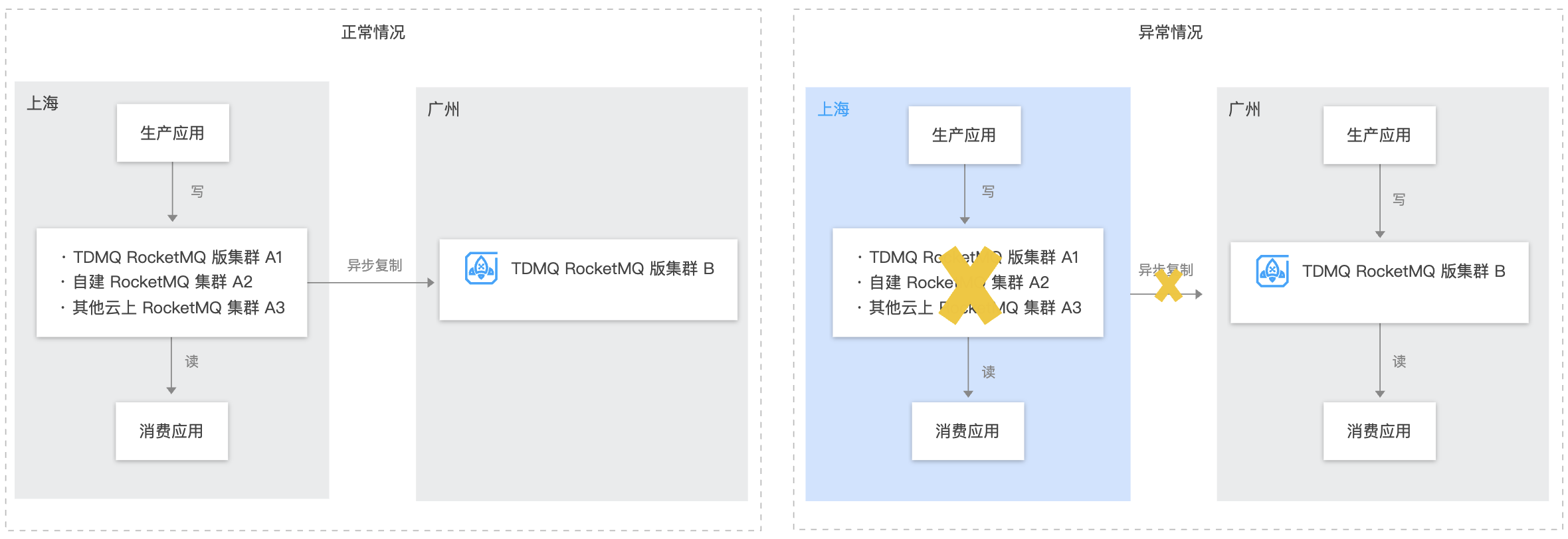
Through unidirectional replication for cross-region synchronization tasks, such as replicating all messages from the production cluster to the disaster recovery cluster via cluster-level replication tasks, real-time cold backup of transactional data is achieved. During disaster recovery switchover scenarios, second-level disaster recovery can be realized by switching access points, significantly enhancing business system robustness. For financial scenarios, this further meets regulatory compliance requirements. Since Tencent Cloud RocketMQ supports message replication with self-built clusters or clusters on other clouds, customers can also use this feature to provide cloud-based backups for production environments in self-built IDCs.
A typical business scenario is: a third-party payment company's core payment system is deployed in the Shanghai Finance cloud region to meet regulatory requirements and business continuity needs, and establishes a disaster recovery center in Shenzhen Finance to achieve cold backup of core transaction data.
The business pain points addressed include: Meeting stringent regulatory requirements through cold backup data; the backup center does not run business systems under normal circumstances, reducing costs; during disaster recovery switchovers, minimizing data loss to the greatest extent and mitigating the impacts of the switchover.


Multi-site active-active

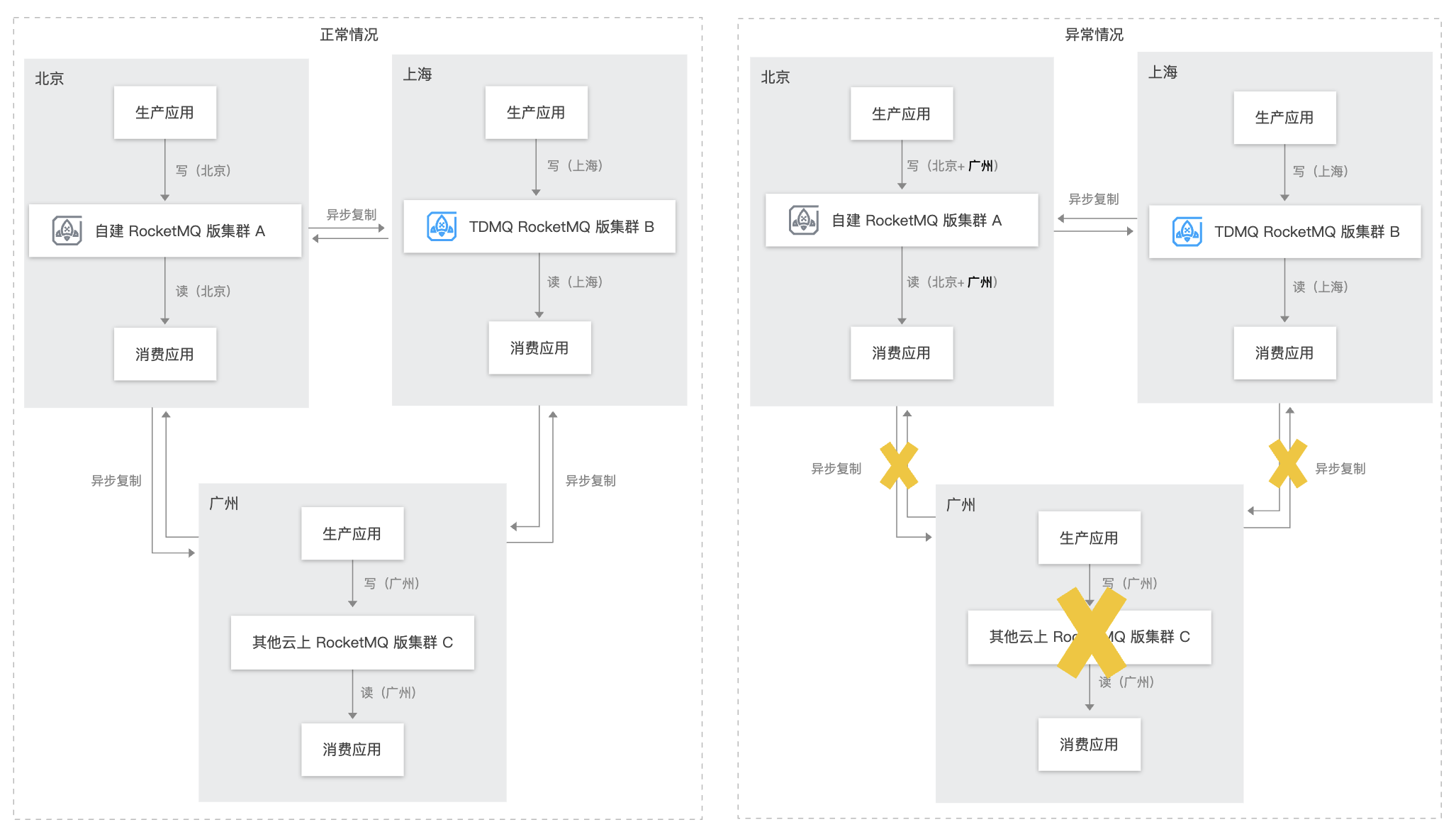
Through bidirectional replication for cross-region synchronization tasks, high availability across regions is achieved via cluster-level or Topic-level bidirectional replication tasks. Additionally, since Tencent Cloud RocketMQ supports bidirectional message replication with self-built clusters or clusters on other clouds, customers can use this feature to synchronize messages from self-built IDCs or other clouds, establishing a hybrid cloud geo-redundant disaster recovery environment.
A typical business scenario is: A large-scale service platform serving hundreds of millions of users establishes a multi-active architecture across Beijing, Shanghai, and Guangzhou to ensure user experience. Users access services from the nearest location, with business data synchronized across regions.
The business pain points addressed include: The multi-active architecture resolves issues of widespread user geographical distribution and sensitivity to network latency; when exceptions occur in a specific region or AZ, services can rapidly switch message traffic to unaffected clusters; business data requires real-time cross-region synchronization at the platform level while avoiding duplicate message processing.


Help and Support

Was this page helpful?

Help us improve! Rate your documentation experience in 5 mins.

Feedback