Overview
ダウンロード
フォーカスモード
フォントサイズ
Requirement Scenarios
Scenario 1: Cross-Region Disaster Recovery
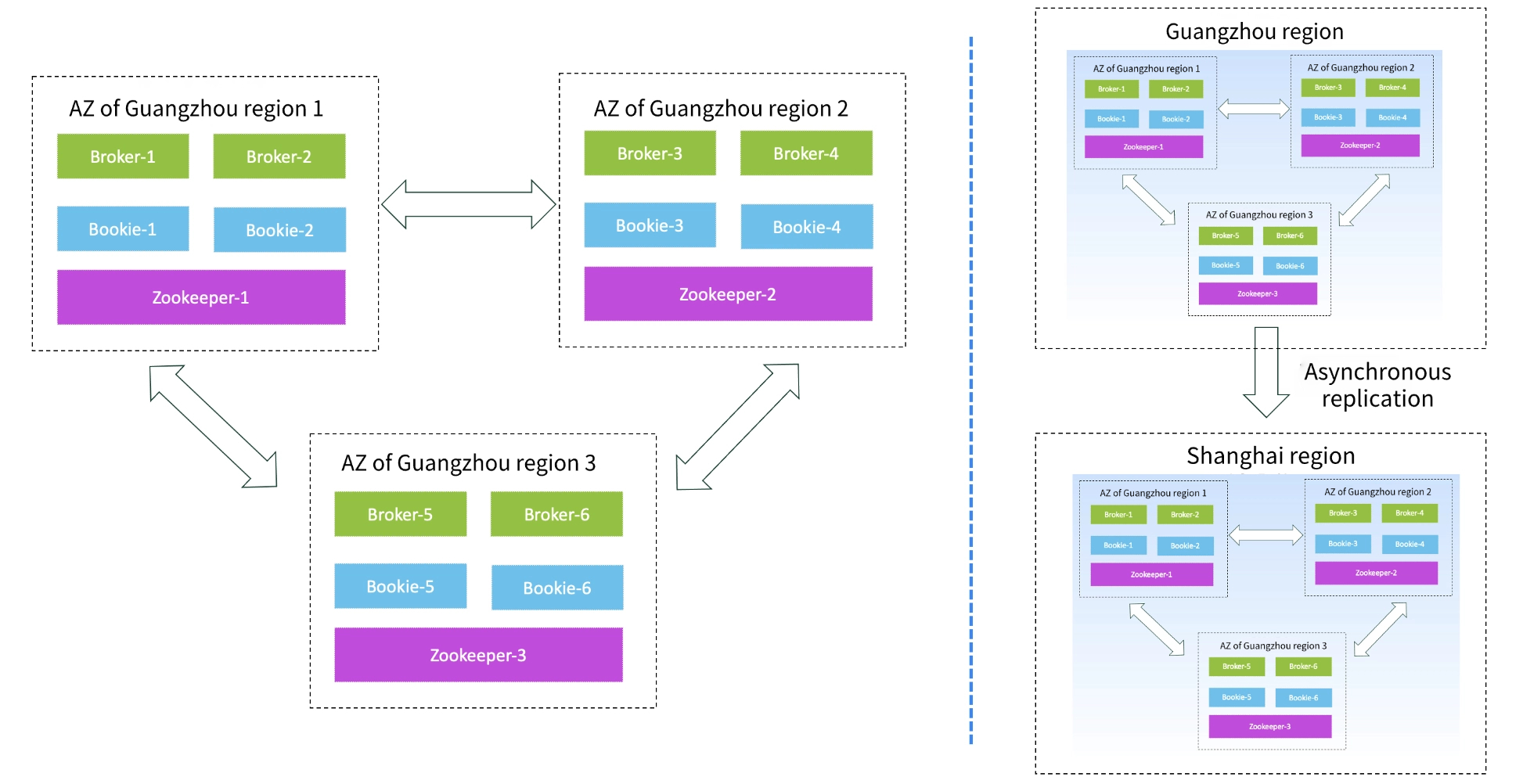
TDMQ for Apache Pulsar Pro Edition supports cross-AZ deployment. When you purchase a TDMQ for Apache Pulsar cluster in a region with 3 or more availability zones (AZs), you can select up to 3 AZs to purchase a cross-AZ instance. The partition replicas of the instance will be forcibly distributed across nodes in different AZs. This deployment mode ensures that your instance continues to normally provide services if a single AZ becomes unavailable. However, intra-city 3-AZ deployment does not meet the disaster recovery requirements of financial customers. They require cross-region disaster recovery to ensure business continuity by quickly switching business to a backup region in the event of a region-level disaster.
Scenario 2: Global Data Archiving
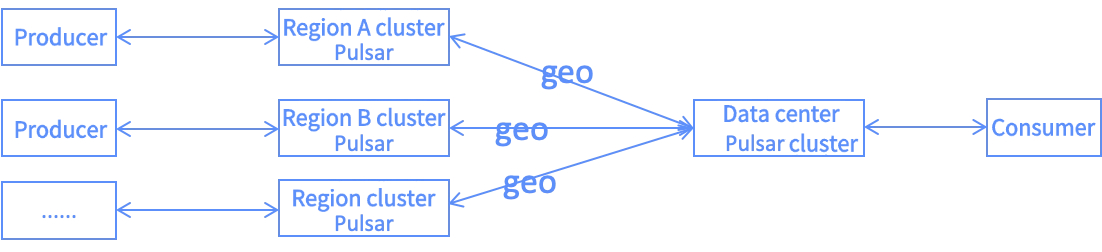
For a global team, business systems may be distributed across multiple regions worldwide, requiring cross-region data transmission and unified data archiving. Data generated from multiple major cities worldwide is replicated across regions and then transmitted back to a data center in a specific region, where data is archived in a unified manner. Topics with the same name may exist in these regions. Therefore, the topics with the same name in the regions need to be merged into a single topic in the target cluster.
Cross-Region Replication
Given the above requirement scenarios, TDMQ for Apache Pulsar Pro Edition implements cross-region cluster replication based on the Geo Replication solution. TDMQ for Apache Pulsar Pro Edition supports scenarios such as cross-region disaster recovery, global data archiving, and cross-region consumption.
Pro clusters support the following two types of replication:
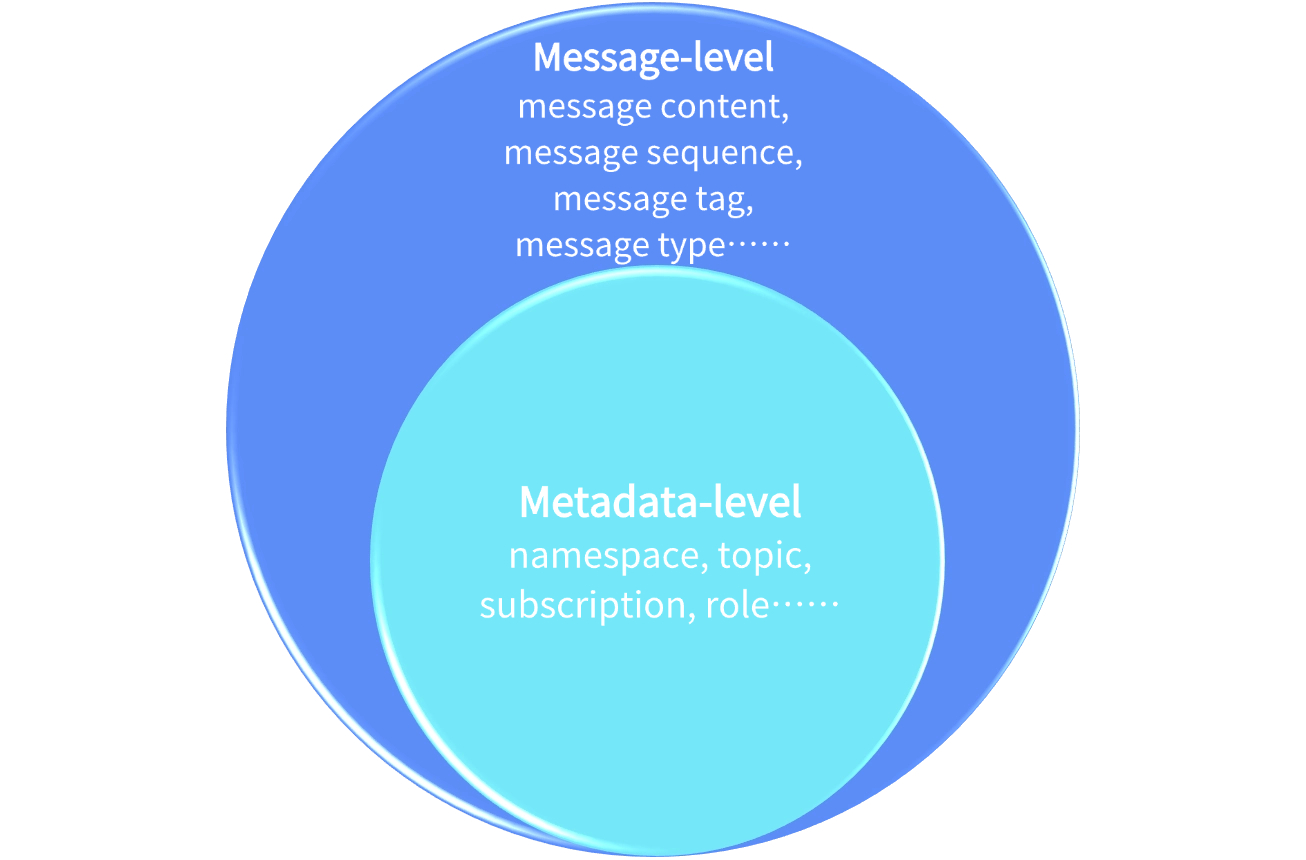
Metadata-level cross-region replication: meets the requirements for the cross-region disaster recovery of core businesses.
Message-level cross-region replication: meets the unified data archiving requirements across regions worldwide.
Billing Overview
Message-level cross-region replication tasks incur fees, while metadata-level cross-region replication tasks do not incur fees. The console provides the corresponding monitoring metrics to facilitate observation.
For detailed billing overview about message-level cross-region replication, see Billing Overview of Pro Clusters.
Use Limits
1. Supported Scope
This feature is supported only by pro clusters with fixed storage.
2. Supported Regions
Shanghai, Nanjing, Guangzhou, and Shenzhen Finance.
3. Link Replication Directions
Currently, both message-level cross-region replication and metadata-level cross-region replication are unidirectional.
4. Replication Objects
Only one synchronization task, including tasks at higher levels, can be created for the same object.
Do not delete topics in a synchronization link. You need to first delete the synchronization link.
5. Overwriting
For existing resources with the same name but different configurations, such as the number of partitions and TTL, the configuration of the target cluster will not be overwritten after a replication task is created.
フィードバック